How to Reclaim IFB Industries Ltd. Shares from IEPF: A Complete Guide
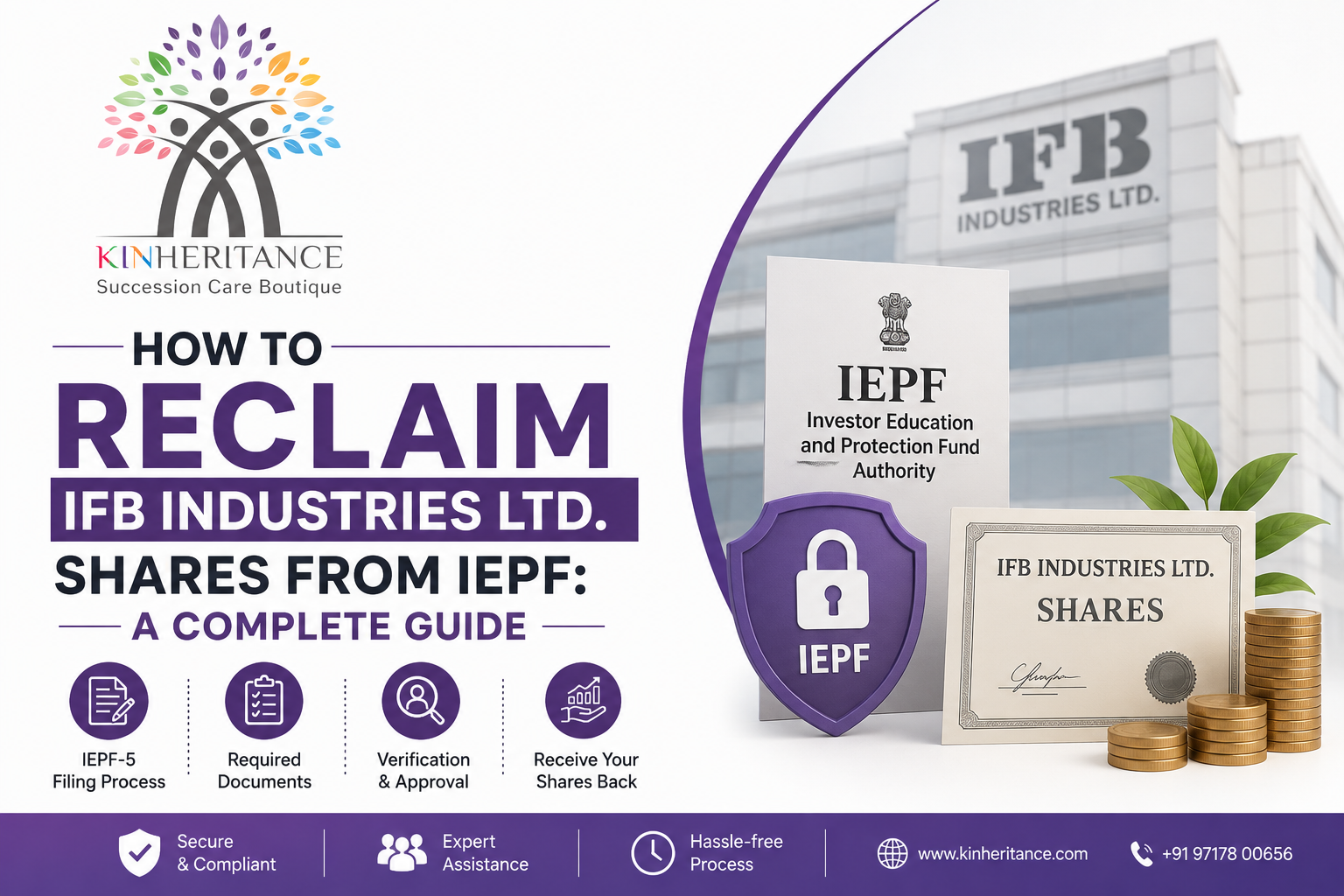
How to Reclaim IFB Industries Ltd. Shares from IEPF: A Complete Guide
If you or someone in your family once invested in IFB Industries Limited the Kolkata-headquartered company behind those familiar washing machines, microwave ovens, and dishwashers sitting in millions of Indian homes there's a fair chance a small part of that investment has quietly slipped away. Not lost in the sense of gone forever, but parked in a government fund because nobody claimed the dividend for seven straight years.
If you need professional assistance with the IEPF claim process, a trusted share recovery company can help you recover your lost or unclaimed shares with proper documentation and guidance.
Choosing an experienced share recovery company can simplify the IEPF-5 filing, verification, and claim process while reducing the chances of delays or errors.
It happens more often than people think. A shareholder moves house and forgets to update the address with the registrar. A father passes away and the children have no idea he ever held shares. A dividend cheque of a few hundred rupees gets ignored one year, then the next, until the law itself steps in and moves the entire shareholding not just the dividend into the Investor Education and Protection Fund, or IEPF.
If that sounds like it could be your family's story, this guide walks you through exactly how IFB Industries shares end up with the IEPF, how to check if yours are among them, and how to get them back legally, cleanly, and without losing months chasing paperwork.
First, What Exactly Is the IEPF?
The Investor Education and Protection Fund was set up by the Ministry of Corporate Affairs under the Companies Act, 2013. Its job is simple in theory: hold on to unclaimed dividends, matured deposits, and this is the part most people miss the underlying shares themselves, until the rightful owner (or their legal heir) comes forward to claim them.
Here's the rule that catches most investors off guard: it isn't just the dividend that gets transferred. Under Section 124 of the Companies Act, if a shareholder fails to encash dividends for seven consecutive years, the company is legally required to transfer the entire shareholding linked to that folio or demat account to the IEPF not just the unpaid dividend amount. So a person could have held IFB Industries shares worth a substantial sum, quietly appreciating in value for over a decade, and it would now sit with the government, waiting.
The good news is that this transfer doesn't mean forfeiture. The law is designed to protect the investor, not punish them. Shares moved to the IEPF can be claimed back at any time there's no expiry provided you follow the prescribed process and can establish your ownership.
Why IFB Industries Shares Specifically End Up Here
IFB Industries has been listed since 1994 and has built a large, long-tenured shareholder base over the decades including plenty of individual investors who bought shares in the 1990s and early 2000s and simply held on, the way long-term investors do. That long history is exactly why unclaimed shareholdings accumulate:
- Address and bank detail changes that were never communicated to the registrar or depository, meaning dividend warrants and notices bounced back for years.
- Physical share certificates from the pre-demat era that were never dematerialised, so the holder lost track of them entirely.
- Death of the original shareholder without the family knowing the holding existed, let alone how to transfer or claim it.
- Dormant demat accounts where dividends were credited to a bank account that was later closed, effectively making them "unclaimed" even though the investor was alive and well.
- Corporate actions like bonus issues or stock splits that increased the shareholding over the years meaning families sometimes recover far more value than they expected, because they didn't account for how the original number of shares had multiplied.
If your family holds or once held IFB Industries shares and hasn't received a dividend credit or annual report in years, it's worth checking whether they've already been moved to the IEPF.
How to Check If Your IFB Industries Shares Are with the IEPF
Before filing anything, you need to confirm whether your shares have actually been transferred. This is a straightforward search:
- Visit the official IEPF portal at iepf.gov.in and use the "Search Unclaimed/Unpaid Amount" facility, searching by investor name, folio number, or company name (IFB Industries Limited).
- Check the company's website under regulatory disclosure norms, IFB Industries is required to publish the list of shareholders whose dividends are due for transfer, well before the actual transfer happens, giving investors a last chance to claim before the shares move.
- Look up your folio or DP ID against the company's Registrar and Share Transfer Agent records, since they maintain the authoritative unclaimed-shareholder data that is eventually reported to the IEPF Authority.
If your name or your late relative's name shows up in these records, the shares are recoverable. What follows next is where most people either get stuck for months, or hand it over to someone who knows the process end to end.
The Legal Process to Reclaim Shares from IEPF
Recovering shares isn't a single form-fill-and-forget exercise. It's a multi-step process involving both the company (through its Nodal Officer) and the IEPF Authority, and each step has its own documentation requirements.
Step 1: File Form IEPF-5 online. This is the formal claim application, filed on the MCA/IEPF web portal. It requires your personal details, the company's CIN, folio or DP details, and the specifics of the shares being claimed. On submission, you receive an acknowledgement with a unique SRN (Service Request Number) that you'll use to track your claim.
Step 2: Compile and submit the physical claim package. Within the stipulated window after filing IEPF-5, you need to send a signed physical copy of the form along with supporting documents to the Nodal Officer of IFB Industries at its registered office. This typically includes:
- Self-attested copies of PAN and Aadhaar
- A cancelled cheque leaf of your linked bank account
- Client Master List (CML) of your demat account, countersigned by your Depository Participant
- A notarised indemnity bond (as prescribed in the IEPF-5 instructions)
- An advance stamped receipt, duly signed and witnessed
- Proof of entitlement original share certificates, dividend warrants, or transmission documents if the claim is being made by a legal heir
Step 3: Company verification. The company must prepare a verification report within 15 days of receiving your claim and forward it to the IEPF Authority, confirming your entitlement.
Step 4: IEPF Authority sanction. Once the verification report is received, the Authority is expected to process and sanction the refund within roughly 60 days, after which the shares are credited directly to your demat account.
In practice, the process is far more sensitive to small errors than it looks on paper. A mismatched signature, an outdated Client Master List, a missing witness signature on the indemnity bond, or an inconsistency between the claimant's name and the folio records can send the entire application back to square one sometimes months later. This is precisely the stage where families lose the most time, and where professional guidance genuinely pays for itself.
When Legal Heirs Are Involved
A large share of IEPF claims for a company as old as IFB Industries come not from the original investor, but from their children or legal heirs. If the shareholder has passed away, the process adds a transmission layer before the IEPF claim can even be filed establishing legal heirship through a succession certificate, legal heir certificate, or probated will, and then transmitting the shares into the heir's name (or names, if there are multiple legal heirs) before the IEPF-5 claim is filed.
This is often the most emotionally and procedurally complex part of the journey, because it isn't just about paperwork it's about untangling a financial thread a parent or grandparent left behind, sometimes without ever mentioning it. It's exactly the kind of situation where structured, empathetic guidance matters as much as regulatory know-how.
Why Families Choose to Get Help with Share Recovery
Technically, nothing stops an individual from filing the IEPF-5 claim themselves. But the reality most people discover halfway through is that this isn't really a "one form" process it's a coordination exercise between the depository, the company's registrar, the Nodal Officer, and the IEPF Authority, each with their own document standards and timelines. A single rejected indemnity bond or an unclear legal heir certificate can add three to six months to what should have been a routine recovery.
This is where Kinheritance's Share Recovery service comes in. Rather than leaving families to interpret dense compliance language on their own, Kinheritance identifies the unclaimed IFB Industries (or any other listed company's) shareholding, prepares every document to the exact specification the registrar and IEPF Authority expect, files the claim, and follows up with the company and the Authority until the shares actually land in your demat account not just until the form is submitted. For cases involving deceased shareholders, the team also handles the transmission-to-legal-heirs process alongside the recovery claim, so families aren't juggling two separate, equally confusing procedures at once.
Two Families, Two Recoveries: Real Stories from Our Desk
The Forgotten Folio in Kolkata
Mrs. Bandopadhyay's father had worked in Kolkata through the 1990s and had picked up a small parcel of IFB Industries shares back when the company first got listed a modest, sentimental investment more than a financial strategy. He passed away in 2015, and in the flurry of settling his affairs, an old, half-forgotten share certificate got boxed away with his other papers. It surfaced again years later during a house move. Nobody in the family knew whether it still had any value, whether it had been dematerialised, or where to even begin. When they reached out to Kinheritance, our team traced the folio, confirmed the shares had indeed been transferred to the IEPF due to the seven-year unclaimed dividend rule, and guided the family through establishing legal heirship before filing the transmission and recovery claim together. What started as a stack of old paper ended with shares worth significantly more than the family expected, thanks to a bonus issue over the years credited straight into a newly opened demat account in Mrs. Bandopadhyay's name.
The NRI Who Lost Track While Abroad
Mr. Suresh Iyer had bought a small quantity of IFB Industries shares in the early 2000s before relocating to the Middle East for work. Over the years, his registered bank account back in India was closed, dividend payments started bouncing, and eventually stopped altogether without him noticing he simply assumed the company had stopped issuing dividends that year, the way some do. It was only when a cousin mentioned a similar recovery story that he decided to check the IEPF portal himself and found his name listed. Coordinating documentation from abroad notarisation, KYC updates, a fresh Client Master List felt daunting given the time-zone gap and the physical document requirements. Kinheritance managed the entire filing on his behalf, coordinated the notarisation process through recognised channels usable by NRIs, and kept him updated at every stage over WhatsApp and email. His IFB Industries shares were credited back to his demat account well within the expected timeline, without a single trip back to India being necessary.
These stories aren't unusual they're the norm. Most unclaimed shareholdings exist not because families were careless, but because life simply moved on, addresses changed, and paperwork got buried under everything else.
A Final Word
If you suspect your family holds unclaimed IFB Industries shares or shares in any listed company, for that matter the worst thing to do is nothing. There's no deadline for claiming shares back from the IEPF, but every year that passes makes tracing old records, matching signatures, and locating original certificates that much harder. The earlier you start, the smoother the process tends to be.
Whether it's a folio you've just discovered, a certificate inherited from a parent, or a demat account you haven't logged into in a decade, Kinheritance's Share Recovery team can help you identify what's owed to you and bring it home properly documented, fully compliant, and without the runaround.
Frequently Asked Questions
1. How do I know if my IFB Industries shares have been transferred to the IEPF? Search the IEPF portal (iepf.gov.in) under "Search Unclaimed/Unpaid Amount" using your name, folio number, or the company name. You can also check IFB Industries' investor relations page, which is required to publish the list of shareholders due for transfer before it happens.
2. Is there a time limit to claim shares back from the IEPF? No. Unlike the seven-year window that triggers the transfer, there is no expiry on your right to claim the shares back once they're with the IEPF. You can file a claim years, even decades, later.
3. What if the original shareholder has passed away? Legal heirs can claim the shares, but they first need to complete a transmission process establishing heirship through a legal heir certificate, succession certificate, or probated will before or alongside filing the IEPF-5 claim.
4. Do I need a demat account to claim shares from the IEPF? Yes. Shares recovered from the IEPF are credited electronically to a demat account, so you'll need an active one in your name (or the legal heir's name) before the claim is processed.
5. What documents are typically required for an IEPF share claim? Commonly required documents include self-attested PAN and Aadhaar, a cancelled cheque, a Client Master List verified by your DP, a notarised indemnity bond, an advance stamped receipt, and proof of original entitlement such as share certificates or dividend records.
6. How long does the IEPF claim process usually take? From filing Form IEPF-5 to receiving the shares in your demat account, the process typically takes anywhere between 60 and 120 days, depending on how quickly the company verifies your claim and how complete your documentation is on the first attempt.
7. Are there any fees charged by the IEPF Authority to process a claim? No, the IEPF Authority itself does not charge a fee for processing genuine claims. Costs typically arise from notarisation, stamp duty, and professional assistance if you choose to use a recovery service.
8. Can NRIs claim IFB Industries shares from the IEPF? Yes. NRIs can file claims, though the documentation particularly notarisation and KYC verification needs to be handled carefully given the cross-border requirements. Many NRIs choose to have this managed on their behalf to avoid delays.
9. What happens if my claim gets rejected? Claims are usually rejected or sent back due to document mismatches, incomplete indemnity bonds, or unclear entitlement proof. You can refile after correcting the issue, though this can add significant time which is why getting the documentation right the first time matters.
10. Why should I use a share recovery service instead of filing on my own? While it's legally possible to file independently, the process involves coordinating between the depository, the company's Nodal Officer, and the IEPF Authority, each with exacting documentation standards. A share recovery service like Kinheritance handles the identification, documentation, filing, and follow-up end to end, significantly reducing the chances of rejection or delay especially in cases involving inheritance or NRI claimants.


