How to Reclaim Ol Axis Bank Shares from IEPF with Kinheritance
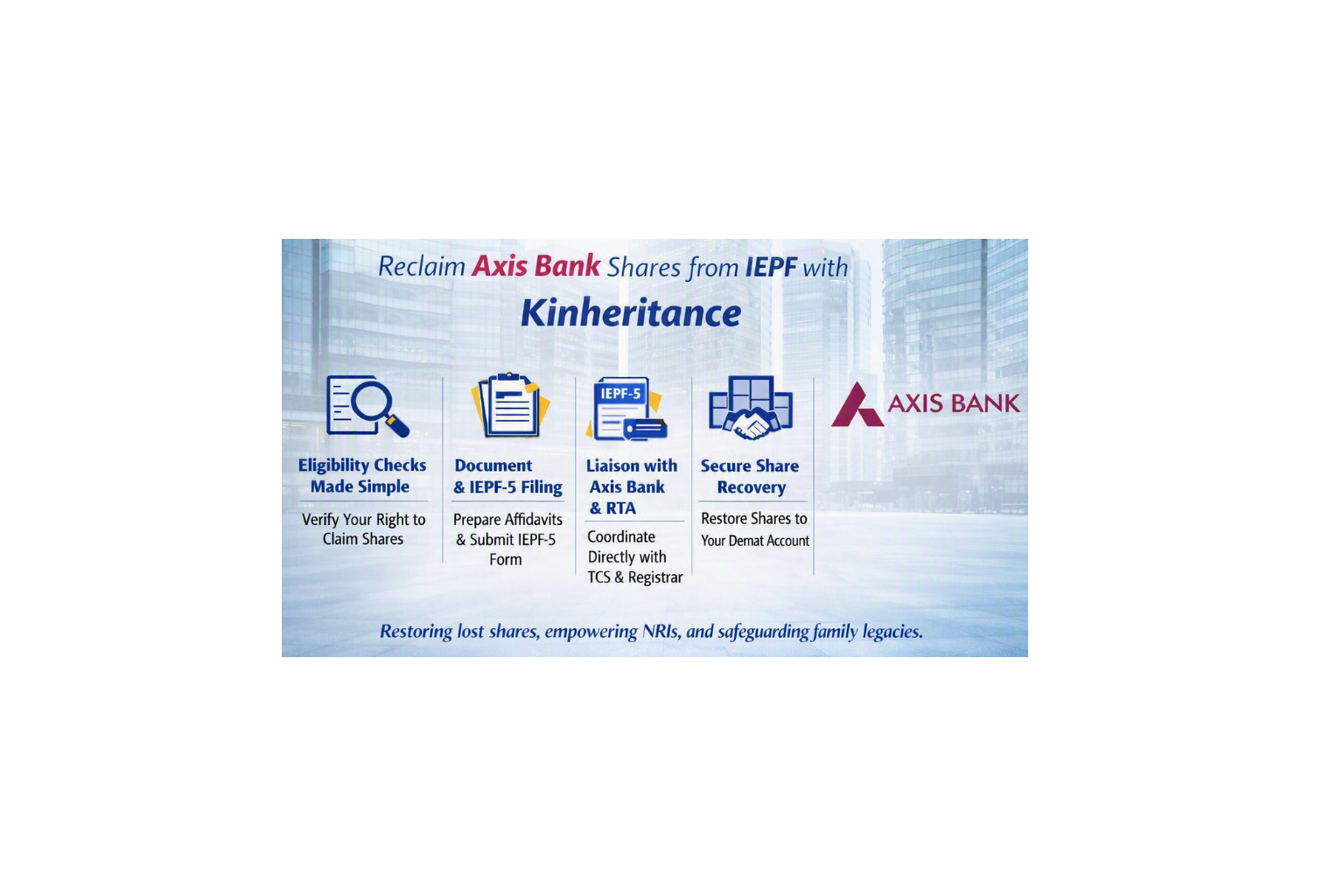
How to Reclaim Ol Axis Bank Shares from IEPF with Kinheritance
Have you discovered old share certificates in a family locker? Or perhaps you recently realized that investments made years ago in Axis Bank Limited seem to have disappeared from active records? If dividends or shares have remained unclaimed for seven consecutive years, they don't simply vanish, by regulatory mandate, they are transferred to the Investor Education and Protection Fund (IEPF) under the Ministry of Corporate Affairs (MCA).
Retrieving these assets can feel daunting due to strict regulatory compliance, legal paperwork, and coordination between multiple entities. Working alongside a specialized asset recovery firm like Kinheritance simplifies the end-to-end recovery process.
Here is a comprehensive breakdown of how the recovery process works and how professional support makes all the difference.
What Happens to Unclaimed Axis Bank Shares?
Under Section 124(6) of the Companies Act, 2013, if an investor does not claim dividends for seven consecutive years, the underlying shares are transferred directly to the IEPF Authority. Common reasons shares end up with the IEPF include:
-
Outdated Addresses: Moving homes without updating details with the company's Registrar & Share Transfer Agent (RTA).
-
Physical Certificates: Holding physical paper shares that were never dematerialized.
-
Name & Signature Mismatches: Differences in name spelling or signatures across old records, PAN, and Aadhaar cards.
-
Loss of Shareholder: Cases where the original shareholder has passed away without clear nominee details or an executed Will.
While the funds and shares are safely held with the government, getting them back requires establishing rightful ownership through a structured legal procedure.
Step-by-Step Guide to Reclaiming Your Shares
Step 1: Document Verification and Pre-Claim Preparation
Before filing any government forms, your current records must align with those in the records of Axis Bank's RTA, KFin Technologies Limited.
-
Demat Account & Bank KYC: Ensure you have an active Demat account and updated bank details.
-
Transmission (In Case of Deceased Shareholder): If the original shareholder has passed away, legal heirs must first complete share transmission formalities with KFintech to obtain an Entitlement Letter before submitting an IEPF claim.
-
Name Corrective Action: Fix any discrepancies between your current legal identity documents and the name on the original share certificates.
Step 2: Online Filing of e-Form IEPF-5
The official claim process starts on the IEPF portal
-
Fill out e-Form IEPF-5 with details regarding Axis Bank Limited (including Folio Number or DP ID-Client ID, number of shares, and unclaimed dividend details).
-
Submit the form on the MCA portal to generate a unique Service Request Number (SRN) and download the generated Acknowledgement Slip.
Step 3: Submitting Physical Claim Dossier
Filing online is only half the battle. A physical document packet marked "Claim for refund from IEPF Authority" must be submitted to Axis Bank’s Nodal Officer or KFintech.
Key documents required in the physical dossier include:
-
Printout of the completed e-Form IEPF-5 and SRN Acknowledgement Slip.
-
Original Indemnity Bond executed on non-judicial stamp paper.
-
Original Advance Stamped Receipt signed by the claimant.
-
Original Share Certificates (if physical shares were held).
-
Self-attested copies of PAN and Aadhaar Card.
-
Client Master List (CML) of your Demat account showing active status.
-
Original Cancelled Cheque displaying your name and account details.
-
Legal heir documents, Death Certificate, or Succession Certificate (if applicable).
Step 4: Verification and Asset Credit
Once the physical dossier is received:
-
Verification by Axis Bank & KFintech: The bank’s verification officer checks all physical documents against the online form and company databases. Upon satisfaction, they submit an online Verification Report to the IEPF Authority.
-
IEPF Approval & Refund: The IEPF Authority reviews the report and approves the claim. The recovered Axis Bank shares are credited directly to your Demat account, while associated unclaimed dividend amounts are wired to your bank account.
Why Partner with Kinheritance?
Navigating government portals, drafting legal indemnity bonds, resolving name variations, and following up across multiple departments can take months of complex coordination.
Kinheritance specializes in unclaimed asset recovery, succession planning, and legal documentation. Choosing an expert partner provides distinct benefits:
-
Database Identification: Assistance in locating dormant holdings and precise unclaimed amounts across old folios.
-
Hassle-Free Documentation: Full handling of complex paperwork, including indemnity bonds, affidavits, transmission applications, and signature verification formats.
-
Regulatory Expertise: Direct alignment with financial institutions, RTAs (like KFintech), and regulatory bodies to minimize rejections or resubmissions.
-
End-to-End Tracking: Constant tracking of your Service Request Number (SRN) from initial filing right up to the final credit in your Demat account.
Whether you are recovering forgotten investments or settling an estate legacy for your family, expert guidance ensures a smooth and compliant path toward reclaiming what is rightfully yours.
Frequently Asked Questions (FAQs)
1. What is IEPF and why were my Axis Bank shares transferred? The Investor Education and Protection Fund (IEPF) safeguards unclaimed dividends and dormant shares. If dividends remain unclaimed for seven consecutive years, Axis Bank shares are transferred to IEPF’s demat account.
2. Can I reclaim Axis Bank shares from IEPF? Yes. Investors and heirs can reclaim their shares by filing Form IEPF‑5, submitting required documents, and coordinating with Axis Bank’s Nodal Officer.
3. What documents are required for recovery?
-
Identity proof (Aadhaar, Passport for NRIs)
-
Client Master Report from your DP
-
Original share certificates (if physical)
-
Proof of entitlement (succession certificate, probate, or transmission documents for heirs)
4. How long does the recovery process take? Typically 3–6 months, depending on documentation accuracy and company verification.
5. Can NRIs reclaim Axis Bank shares from IEPF? Yes. NRIs can reclaim shares by providing valid identity proof, overseas address, and demat/bank details linked to India. Kinheritance offers specialized NRI support.
6. Why should I use Kinheritance for recovery? Kinheritance simplifies the process with guided workflows, document templates, and emotional storytelling that honors family legacy.
7. What risks should I be aware of?
-
Fraudulent agents promising “quick recovery.”
-
Incorrect demat or bank details leading to rejection.
-
Missing succession documents causing delays.
8. Is recovery possible without professional help? Yes, but professional guidance ensures faster, smoother recovery and minimizes rejection risks.
TESTIMONIAL
A. Sharma, Indore
“Our family had Axis Bank shares that were transferred to IEPF years ago. We didn’t know where to start until we found Kinheritance. Their team handled everything , from eligibility checks to document filing and coordination with Axis Bank’s registrar. The process was transparent and stress‑free.
Within a few months, the shares were restored to our demat account. Kinheritance helped us reclaim not just our investments, but our peace of mind.”


