Living Trust, Testamentary Trust, and Will comparison by Kinheritance
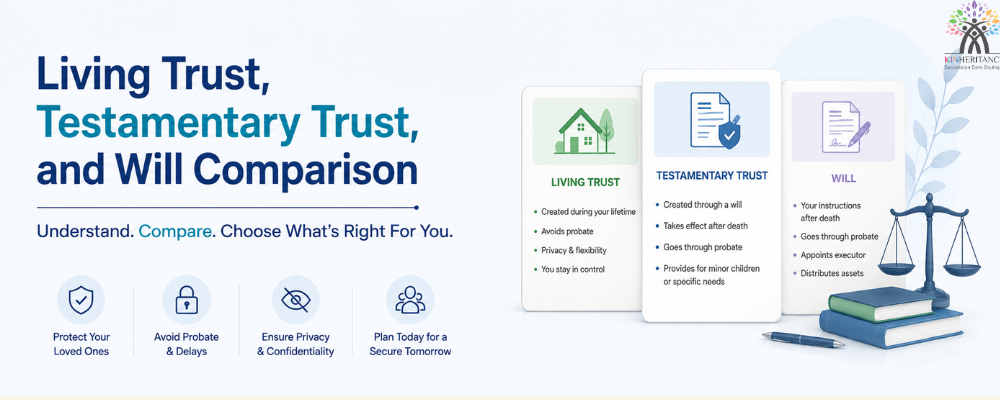
Living Trust, Testamentary Trust, and Will comparison by Kinheritance
Every individual spends years building financial security through hard work, disciplined savings, strategic investments, and careful wealth creation. Whether it is a family home, business assets, shares, mutual funds, gold, or other valuable possessions, these assets often represent a lifetime of dedication and sacrifice. However, building wealth is only one part of financial planning. Equally important is ensuring that your wealth is passed on smoothly, efficiently, and according to your wishes.
Unfortunately, many families focus extensively on wealth creation but pay little attention to succession planning. As a result, legal heirs are often left dealing with complex documentation, ownership disputes, probate proceedings, delayed asset transfers, and uncertainty regarding inheritance rights. In some cases, valuable investments remain unclaimed for years because family members are unaware of their existence or lack the necessary legal framework to establish ownership.
Succession planning is the process of organising how your assets will be managed during your lifetime and transferred after your death. It provides clarity, protects family interests, minimises disputes, and ensures that loved ones receive their rightful inheritance with minimal legal complications. Effective succession planning often works alongside important estate-planning mechanisms such as Will drafting and registration, share recovery services, and the transfer of investments through legal heirship procedures.
Among the various succession planning tools available in India, three options are commonly used: a will, a living trust (private revocable trust), and a testamentary trust. While all three help transfer wealth to future generations, they differ significantly in terms of control, confidentiality, costs, taxation, compliance requirements, and ease of administration. Understanding these differences is essential before selecting the most suitable structure for your family and financial situation.
Why Succession Planning Matters
Succession planning is not merely a legal exercise. It is a critical step toward protecting your family's future and preserving the wealth you have worked hard to create. A properly structured succession plan helps ensure that assets are distributed according to your wishes rather than being subject to default inheritance laws. It reduces the possibility of family disputes, protects vulnerable beneficiaries, simplifies asset administration, and provides peace of mind. This becomes particularly important for individuals who own multiple properties, operate businesses, hold substantial investment portfolios, have children from different generations, or wish to provide financial protection for minors, elderly dependents, or individuals with special needs.
The three most commonly used succession planning tools in India are:
- Will
- Living Trust (Private Revocable Trust)
- Testamentary Trust
Each serves a different purpose and offers unique advantages depending on your goals.
Understanding a Living Trust (Private Revocable Trust)
A living trust, also known as a private revocable trust, is established during the lifetime of the person creating it, known as the settlor. Assets are transferred into the trust and managed by appointed trustees for the benefit of chosen beneficiaries.
- Unlike a will, a living trust becomes operational immediately after its creation. This means assets are managed according to the trust deed during the settlor's lifetime and continue seamlessly after death.
- A living trust is particularly useful for high-net-worth individuals, business owners, families with minor children, and individuals seeking privacy and continuity in wealth management.
- The trust deed serves as the governing document, specifying how assets should be managed, distributed, and protected. Depending on the nature of the assets involved, registration requirements and compliance obligations may also apply.
- One of the greatest advantages of a living trust is continuity. Since assets are already held within the trust structure, there is no disruption in management if the settlor becomes incapacitated or passes away.
Benefits of a Living Trust
Living trusts offer several advantages that make them attractive for long-term wealth preservation and family governance.
- They provide confidentiality because trust deeds remain private documents, unlike probate proceedings that become public records. They also ensure continuity of asset management in cases of illness, disability, or death.
- For families with young children, trusts allow wealth to be distributed in phases rather than transferred outright at a young age. This provides financial protection while ensuring assets are managed responsibly.
- Living trusts can also be customised to include specific instructions regarding education, healthcare, property ownership, and long-term financial support for beneficiaries.
Limitations of a Living Trust
Despite their advantages, living trusts require greater administrative effort and ongoing compliance. Trusts may need separate PAN registration, bank accounts, investment accounts, and annual tax filings. If immovable property is transferred into the trust, stamp duty and registration costs may apply. Professional assistance is often required for drafting and administering the trust, increasing initial setup costs compared to a simple will.
Understanding a Testamentary Trust
A testamentary trust is a trust created through a will and comes into existence only after the death of the testator. Unlike a living trust, no assets are transferred during the individual's lifetime. Instead, the will contains provisions establishing the trust, identifying trustees, naming beneficiaries, and specifying instructions for future administration. The trust becomes operational after death, once the will is executed and necessary legal procedures are completed. Testamentary trusts are often used when individuals want structured control over asset distribution but prefer to retain full ownership and flexibility throughout their lifetime.
Benefits of a Testamentary Trust
A significant advantage of a testamentary trust is simplicity during the individual's lifetime. Since the trust does not become active until after death, there are generally fewer compliance requirements and administrative obligations while the testator is alive. It is also more cost-effective than a living trust because there is no immediate transfer of assets and no need for ongoing trust administration during the creator's lifetime. The will can be revised, amended, or revoked whenever circumstances change, providing flexibility until death. This structure is particularly useful for parents seeking long-term protection for minor children, beneficiaries with special needs, or heirs who may not be financially experienced.
Limitations of a Testamentary Trust
Because the trust becomes effective only after death, it does not provide lifetime asset protection or continuity of management. In many cases, the will must undergo probate proceedings before the trust can begin operating. Probate can sometimes result in delays, court involvement, and additional legal expenses. Unlike living trusts, testamentary trusts do not assist with asset management if the individual becomes incapacitated during their lifetime.
Understanding a Will
A will remains the most common and widely used succession-planning document in India. A will is a legal declaration through which a person specifies how assets should be distributed after death. It allows the testator to identify beneficiaries, appoint an executor, provide instructions regarding specific assets, and outline their final wishes. One of the reasons Wills remains popular is their simplicity. They can be drafted relatively easily and updated as life circumstances change. A properly drafted Will can cover a wide range of assets including property, bank accounts, investments, jewellery, business interests, and personal belongings.
Benefits of a Will
A will is the most affordable succession planning tool available. It does not require ongoing compliance, annual filings, or separate administration during the testator's lifetime. It can be modified whenever required and remains fully within the individual's control. For individuals with straightforward family structures and uncomplicated assets, a will often provides an effective solution.
Limitations of a Will
Although simple and cost-effective, a will may not always guarantee smooth asset transfer. Probate proceedings may be required in certain situations, particularly when significant properties or disputes are involved. Probate can increase timelines and administrative complexity. Wills also become part of the public record during probate proceedings, reducing confidentiality compared to trust-based structures. Additionally, unclear drafting or ambiguous language may create opportunities for disputes among legal heirs.
Which Succession Planning Tool Should You Choose?
There is no universal solution that works for every family. A living trust is generally suitable for individuals seeking confidentiality, continuity, asset protection, and long-term management of wealth. It is particularly useful for business owners and families with complex financial structures. A testamentary trust works well for individuals who want structured inheritance planning but prefer to avoid transferring assets during their lifetime. A will is often sufficient for individuals with relatively straightforward assets and family circumstances who want a simple and affordable succession planning solution. The ideal choice depends on your financial goals, family dynamics, asset complexity, and long-term objectives.
Conclusion
Succession planning is not simply about distributing wealth. It is about protecting loved ones, preserving family harmony, and ensuring that your life's work benefits future generations exactly as you intend. Whether you choose a will, a living trust, or a testamentary trust, the most important step is taking action before a crisis occurs. A well-structured succession plan can reduce uncertainty, minimise legal complications, prevent disputes among heirs, and streamline the transfer of assets. It also works hand in hand with essential estate-planning services such as share recovery, transmission of inherited investments, and estate administration. By evaluating your family's unique circumstances and selecting the right succession planning tool, you can create a lasting legacy that protects both your wealth and your family's future. In the end, succession planning is not merely a financial decision. It is a commitment to ensuring that the people and values most important to you continue to be cared for long after you are gone.
Kin Will — Online Will Drafting & Registration
Protect your family’s legacy with personalized, legally compliant Will creation and registration services.