Loan Against Mutual Funds vs Personal Loans: Which Is Smarter for Urgent Cash Needs ?
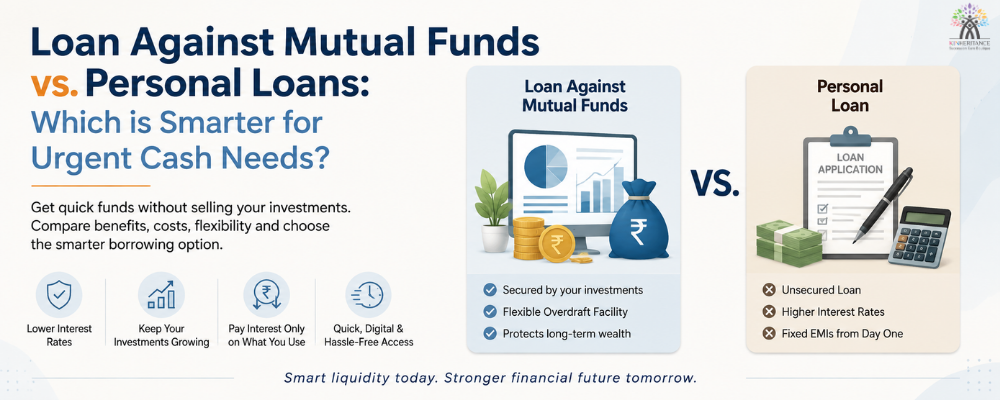
Loan Against Mutual Funds vs Personal Loans: Which Is Smarter for Urgent Cash Needs ?
Financial emergencies rarely come with an advance warning. Whether you are facing an unexpected medical bill, an urgent home repair, a sudden business cash flow shortage, or a high-value personal requirement, having swift access to capital is essential. When faced with an immediate need for liquidity, most borrowers turn to one of two popular credit products: a Loan Against Mutual Funds or a standard Personal Loan.While both instruments serve the primary purpose of providing fast liquidity, their underlying mechanisms, cost structures, and long-term financial impacts are fundamentally different. Choosing the wrong financing option can lead to unnecessarily high interest burdens, tax complications, or the premature liquidation of long-term wealth-building assets.
This comprehensive guide breaks down the core mechanics, interest models, speed of disbursal, and strategic advantages of both options so you can make an informed, cost-effective decision for your urgent cash needs.
Understanding the Fundamentals
Before comparing specific parameters, it is critical to understand how each financing option operates under the hood.
What Is a Loan Against Mutual Funds?
A loan against mutual funds is a secured borrowing facility where an investor pledges their existing equity or debt mutual fund units as collateral to a bank or non-banking financial company (NBFC).
-
The Pledge Mechanism: When you apply for an LAMF, a legal lien is marked against your chosen mutual fund units via digital platforms integrated with registrars like CAMS or KFintech.
-
Asset Ownership: You retain full ownership of the underlying assets. The mutual fund units remain invested in the market, continuing to generate potential capital appreciation and dividend payouts.
- Overdraft Structure: Most modern LAMF products operate like an overdraft credit line. You are approved for a maximum borrowing limit based on the value of your portfolio, but you only pay interest on the amount you physically draw down and use.
What Is a Personal Loan?
A personal loan is an unsecured credit facility granted by a financial institution based primarily on your income, employment stability, and credit score (such as CIBIL).
-
No Collateral: Lenders do not require you to pledge any physical or financial asset as security.
-
Risk Premium: Because the lender bears 100% of the default risk without an underlying asset to liquidate, personal loans carry higher, risk-adjusted interest rates.
-
Lump-Sum Structure: Personal loans are disbursed as a single lump sum directly into your bank account. Equated Monthly Installments (EMIs) begin immediately on the full principal amount, regardless of how quickly or gradually you spend the funds.
Detailed Comparison: Head-to-Head Analysis
To evaluate which product aligns best with your immediate needs, let us analyse the core parameters side by side.
| Comparison Parameter | Loan Against Mutual Funds (LAMF) | Personal Loan |
| Security / Collateral | Secured (Equity or Debt Mutual Funds) | Unsecured (no collateral required) |
| Typical Interest Rates | 9.0% to 12.0% per annum | 10.5% to 24.0% per annum |
| Loan-to-Value (LTV) | Up to 50% for equity; up to 80% for debt | Dependent on salary, net income, and risk profile |
| Borrowing Limit | Based on the current mutual fund portfolio value | Based on monthly income and debt-to-income ratio |
| Interest Calculation | Charged only on the utilised amount (daily/monthly) | Charged on the total sanctioned loan amount from day one |
| Disbursal Speed | 2 hours to 24 hours (100% digital process) | 1 to 7 working days (unless pre-approved) |
| Repayment Term | Highly flexible (bullet payment or interest-only EMIs) | Structured monthly EMIs (12 to 60 months) |
| Preclosure Charges | Typically zero or nominal | 2% to 5% of outstanding principal |
| Impact on Investments | Units remain invested and continue growing. | Requires selling units or paying out of monthly income |
| Credit Score Requirement | Low sensitivity (secured by market assets) | High sensitivity (CIBIL score of 750+ required for best rates) |
Deep-Dive Evaluation of Key Financial Factors
1. Cost of Borrowing and Interest Rates
The most immediate factor in any credit decision is the total cost of capital.
Because an LAMF is backed by tangible financial assets, lenders view it as a low-risk exposure. If a borrower defaults, the lender has the legal right to enforce the lien and redeem the mutual fund units to recover the outstanding debt. Consequently, interest rates for LAMF generally range between 9.0% and 12.0% per annum.
In contrast, personal loans carry zero collateral protection for the lender. To hedge against default risk, banks price personal loans significantly higher—ranging from 10.5% for high-income corporate employees with stellar credit to upwards of 24.0% per annum for self-employed individuals or mid-tier credit profiles.
Example Savings Scenario:
Imagine you need ₹5,000,000 ($60,000 equivalent) for a 6-month period to handle a business supply-chain delay.
Personal Loan at 14% p.a.: You pay interest on the full ₹5,000,000 from day one. Over 6 months, interest costs equal approximately ₹3,50,000.
LAMF Overdraft at 10% p.a.: You draw ₹2,000,000 in Month 1 and the remaining ₹3,000,000 in Month 3. You only pay 10% interest calculated daily on the precise balance drawn, saving upwards of ₹1,20,000 to ₹1,80,000 in total interest outlay.
2. Market Compounding vs. Disruption of Financial Goals
When faced with an urgent cash need, many investors instinctively consider selling their mutual fund holdings. However, prematurely liquidating equity investments disrupts long-term wealth creation and triggers immediate tax consequences.
-
Tax Liability: Redeeming mutual funds can trigger Short-Term Capital Gains (STCG) or Long-Term Capital Gains (LTCG) tax, reducing the net cash you actually receive.
-
Opportunity Cost: Exiting the market during a growth phase means missing out on market rallies and compound interest.
The LAMF Advantage:
Taking a loan against your mutual funds avoids redemption entirely. Your underlying investments stay intact within your portfolio. If your equity mutual funds generate an average annualised return of 12% to 15% over time, while your LAMF interest rate is 10%, your net portfolio returns actually offset the borrowing cost. You retain full exposure to compounding while solving your short-term liquidity constraint.
3. Application Process, Documentation, and Speed
During a financial crisis, time-to-disbursal is often as important as the interest rate.
-
Digital LAMF Workflow: Modern financial ecosystems permit seamless digital pledging. By linking your PAN card and phone number registered with Central Depository Services Limited (CDSL), CAMS, or KFintech, you can select specific mutual fund schemes to pledge. The digital lien is verified via OTP within minutes. Once approved, the overdraft limit is activated in your bank account in as little as 2 to 6 hours.
-
Personal Loan Workflow: Unless you hold a pre-approved personal loan offer with your primary banking institution, personal loans require manual verification. You must submit salary slips for the last 3 to 6 months, 6 months of bank account statements, Income Tax Returns (ITR), Form 16, and employment proof. The verification, field checks, and underwriting approval processes routinely take between 2 and 7 business days.
4. Credit Score Sensitivity and Eligibility
Your credit history plays a vastly different role in these two loan products.
-
Personal Loans: Heavily dependent on your credit score. Lenders strictly evaluate your CIBIL rating, existing debt-to-income (DTI) ratio, employer classification, and salary level. A credit score below 750 frequently results in immediate application rejection or exorbitant interest rates.
-
Loan Against Mutual Funds: Because the loan is secured against market securities, lenders exercise far less scrutiny over your credit history or monthly income level. Even self-employed individuals, freelancers, or retired investors with fluctuating monthly income can easily secure high-value approval provided they hold eligible mutual fund units.
Potential Risks and Limitations to Consider
While a loan against mutual funds offers superior flexibility and lower interest, borrowers must be aware of its unique structural risks.
1. Loan-to-Value (LTV) Ratios and Margin Calls
Regulatory guidelines dictate maximum LTV limits on financial assets:
-
Equity Mutual Funds: Lenders typically lend up to 50% of the current Net Asset Value (NAV).
-
Debt Mutual Funds: Lenders offer up to 75% to 80% of the NAV due to lower price volatility.
The Margin Call Risk:
Because mutual funds are market-linked assets, their NAV fluctuates daily. If a sharp market correction occurs and your portfolio value drops significantly, your LTV ratio may exceed the bank's maximum safety threshold. In such events, the lender will issue a margin call, requiring you to either:
-
Pay down a portion of the principal balance to bring the LTV back into compliance.
-
Pledge additional mutual fund units as extra collateral.
If you fail to meet the margin call within the stipulated timeframe (usually 24 to 48 hours), the lender holds the legal authority to liquidate a portion of your pledged units to recover their funds.
2. Inability to Sell Pledged Holdings
While your mutual fund units remain pledged, you cannot redeem, transfer, or switch those specific units. If you decide you want to exit a poorly performing fund manager or rebalance your portfolio, you must first clear the outstanding loan balance to remove the lien.
Strategic Decision Matrix: Which Should You Choose?
The Strategic Decision Matrix evaluates four critical financial dimensions—Asset Availability, Cost & Flexibility, Financial Continuity, and Risk Profile—to determine whether a Loan Against Mutual Funds (LAMF) or a Personal Loan is the better choice.
1. Asset Availability and Borrowing Limits
The decision process begins with your current assets. A loan against mutual funds requires existing collateral, with lenders setting strict borrowing limits based on asset volatility. Generally, equity mutual funds allow you to borrow up to 50% of their net asset value, while lower-risk debt mutual funds allow up to 75% to 80%. If you do not hold mutual funds, or if your portfolio value is too small to cover the needed funds, a personal loan becomes your primary option. Personal loans rely on your monthly income, employment stability, and credit score rather than pledged assets.
2. Interest Rate Structures and Cost Efficiency
The interest calculation method creates a significant difference in borrowing costs between the two options. Because a Loan Against Mutual Funds is backed by security, lenders offer lower interest rates (typically 9% to 12% per annum) and usually structure it as an overdraft credit line. You only pay interest on the money you actually withdraw and for the exact duration you use it. Personal loans carry higher interest rates (typically 10.5% to 24% per annum) because they are unsecured. Interest starts accruing on the full lump-sum amount immediately upon disbursal, regardless of how quickly you spend the funds.
3. Financial Continuity and Opportunity Cost
Evaluating the choice requires considering how each loan impacts long-term wealth growth. Selling investments during a liquidity shortage triggers capital gains taxes and interrupts compound growth. A Loan Against Mutual Funds places a legal lien on your units without liquidating them, allowing your portfolio to stay invested and potentially earn market returns that can offset borrowing costs. Conversely, a personal loan preserves your investments without placing a lien on them, but it commits a fixed portion of your future monthly cash flow to debt repayment over a multi-year period.
4. Market Risk Exposure and Margin Calls
Risk management differs significantly between the two products. Personal loans carry zero exposure to market movements, meaning your monthly installment remains fixed regardless of economic volatility. In contrast, a Loan Against Mutual Funds introduces market risk. If a severe market decline significantly reduces the value of your pledged portfolio, your loan-to-value ratio will increase. The lender may then issue a margin call, requiring you to deposit additional cash or pledge extra mutual fund units within a short window. If you fail to meet the margin call, the lender has the authority to sell a portion of your mutual fund units during a market dip to recover the loan balance.
Choose a Loan Against Mutual Funds (LAMF) if:
-
You already hold a mutual fund portfolio: You have accumulated equity or debt investments with sufficient value to back your required loan sum.
-
You want to minimize total interest paid: You plan to repay the money quickly (within 1 to 12 months) and want to pay interest strictly on what you draw down.
-
You want to avoid tax triggers: You do not want to sell investments and incur capital gains tax or disrupt long-term compounding goals.
-
You have a lower credit score or variable income: You are self-employed, between jobs, or have a modest credit score that prevents access to cheap unsecured loans.
-
You need rapid funding: You require money disbursed within hours without compiling physical physical paperwork or salary slips.
Choose a Personal Loan if:
-
You do not own investment assets: You do not have mutual fund investments, or your portfolio value is too small to cover the needed borrowing amount.
-
You need long-term, fixed-installment repayment: You want a structured repayment schedule spread evenly over 3 to 5 years via fixed monthly EMIs.
-
You want immunity from market volatility: You do not want your borrowing capacity tied to daily stock market swings or risk margin calls during market crashes.
-
You hold high-performing credit: You possess an exceptional credit score (CIBIL 780+) and can qualify for pre-approved, competitive personal loan rates from your bank.
Actionable Steps to Apply for a Loan Against Mutual Funds
If you determine that an LAMF is the smarter option for your current needs, follow these steps to secure the lowest rates and fastest disbursal:
-
Audit Your Mutual Fund Portfolio: Consolidate your mutual fund CAS (Combined Account Statement) from CAMS or KFintech to check your total eligible balance across equity and debt schemes.
-
Calculate Your Required LTV: Estimate your borrowing limit by taking 50% of your equity fund holdings and up to 80% of your debt fund holdings.
-
Compare Digital Lenders: Evaluate interest rates, annual maintenance fees, processing charges, and overdraft terms across major banks and digital NBFC platforms.
-
Initiate Digital Lien Marking: Complete the online application on your chosen lender's platform, select the mutual fund schemes you wish to lock, and authenticate the lien creation via the OTP sent to your registered mobile number.
-
Access Your Credit Line: Once the lien confirmation is received from the registrar, link your bank account to access your new overdraft limit immediately.
Final Verdict
When faced with an urgent financial requirement, a Loan Against Mutual Funds is generally the superior, lower-cost, and more flexible tool for existing investors. It preserves your long-term wealth engine, avoids capital gains taxes, offers significantly lower interest rates, and provides instant digital liquidity without administrative delays. However, if you require a long repayment horizon without exposing your debt to market volatility, or if you lack sufficient portfolio value, a Personal Loan remains a reliable alternative. Regardless of the route you choose, platforms like Kinheritance help you bridge these decisions smoothly—allowing you to easily evaluate your portfolio, execute a seamless loan against securities, and ensure your investments continue to serve both your immediate cash flow needs and your family's long-term estate-planning goals.
Loan Against Shares & Securities
Unlock instant liquidity against your approved shares and mutual funds without selling your investments.