Reclaiming Aditya Birla Capital Ltd. Shares from IEPF with Kinheritance
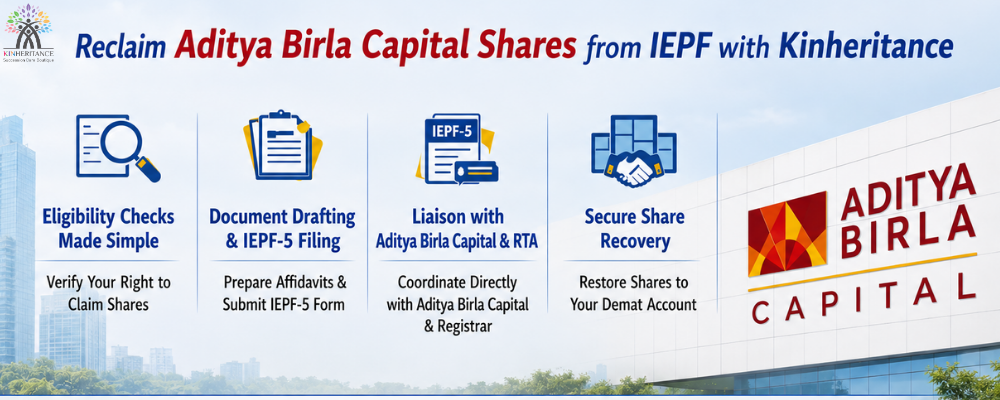
Reclaiming Aditya Birla Capital Ltd. Shares from IEPF with Kinheritance
Many investors across India lose track of their investments over time due to address changes, misplaced share certificates, inactive Demat accounts, or the passing away of the original shareholder. As a result, thousands of investors and legal heirs later discover that valuable investments in Aditya Birla Capital Ltd. have become dormant or are no longer reflected in their active portfolios. For individuals researching IEPF share recovery and tracing forgotten investments, understanding the legal recovery process is the first step toward reclaiming ownership of these assets through established regulatory channels such as Kinheritance. Under the Companies Act, companies are required to transfer shares to the Investor Education and Protection Fund (IEPF) when dividends remain unclaimed for seven consecutive years. Before the shares themselves are transferred, the corresponding unpaid dividends are moved to special unpaid dividend accounts maintained by the company. If no communication, claim, or dividend encashment occurs during the prescribed period, the shares and accumulated dividends are eventually transferred to the IEPF Authority under the Ministry of Corporate Affairs. The transfer to IEPF does not result in permanent loss of ownership. The original shareholder or their rightful legal heirs retain the legal right to recover the shares and associated dividends by following the prescribed claim procedure. While the process involves documentation, verification, and regulatory review, successful recovery remains possible even when the investments are several decades old.
Why Aditya Birla Capital Ltd. Shares Become Unclaimed
Investments often become unclaimed for reasons that have little to do with investor negligence. Many shareholders originally acquired their holdings in physical form and later changed residences without updating contact information. Dividend warrants sent by post remained undelivered, resulting in years of unclaimed dividend payments. In many families, investments made by parents or grandparents are forgotten after their passing. Successive generations may remain unaware that shares exist in the family's name. In other situations, investors hold securities jointly, and procedural challenges arise after the death of one of the holders. Name mismatches caused by marriage, spelling inconsistencies, or outdated KYC records can further complicate communication between companies and shareholders. Over a long period, even a modest investment in Aditya Birla Capital Ltd. may have appreciated significantly. This makes it worthwhile for investors and legal heirs to verify whether forgotten holdings have been transferred to the IEPF.
Step 1: Verifying Whether Shares Have Been Transferred to IEPF
The recovery process begins with identifying the current status of the shares. Investors should first determine whether their Aditya Birla Capital Ltd. shares have been transferred to the Investor Education and Protection Fund Authority. This verification can be performed through the company's investor relations resources and the IEPF database using available shareholder information. The search generally requires details such as the shareholder's folio number, DP ID, client ID, PAN details, or other historical investment records. Older shareholders who possessed physical certificates may locate information from original share certificates, dividend warrants, allotment letters, or correspondence received from the company. Once the shares are identified as having been transferred to IEPF, the claimant must establish ownership and initiate communication with the company's Registrar and Share Transfer Agent. The registrar assists in validating shareholder records and guiding applicants regarding the next stage of the recovery procedure. At this stage, investors should compile every available document related to the investment. Even documents that appear insignificant, such as old dividend receipts or photocopies of certificates, can prove useful during verification.
Step 2: Documentation and Share Transmission Process
The documentation process represents one of the most important stages of recovering unclaimed shares. For living shareholders, the primary objective is to establish identity and ownership. The company generally requires PAN details, Aadhaar details, address proof, bank account information, and proof of shareholding. Investors holding shares in the Demat form may also need to provide a Client Master List issued by their Depository Participant. The process becomes more detailed when the original shareholder is deceased. In such situations, legal heirs must first complete what is known as share transmission. Share transmission is the legal process through which ownership rights are transferred from the deceased shareholder to the rightful successors before the IEPF recovery claim can proceed. The documents required for transmission generally depend on the specific circumstances of the family and the value of the estate. The process may involve submission of a death certificate, succession certificate, legal heir certificate, probate documents, registered will, family settlement records, or other supporting legal documentation. Where multiple legal heirs exist, companies may also seek declarations, affidavits, or no-objection certificates to establish consensus among family members regarding ownership rights. Because every estate differs, legal heir claims often require greater scrutiny than claims filed directly by living shareholders. Once the registrar verifies the claimant's ownership rights and confirms entitlement, the company issues an entitlement letter indicating the shares and dividends transferred to IEPF. This entitlement document serves as an important component of the subsequent claim process.
Step 3: Filing Form IEPF-5 Through the MCA Portal
After obtaining the entitlement confirmation, investors must submit Form IEPF-5 through the Ministry of Corporate Affairs portal. Form IEPF-5 is the official claim application used for recovering shares and dividends transferred to the Investor Education and Protection Fund Authority. The form requires detailed information relating to the claimant and the investment. Applicants must carefully enter their personal information, Demat account details, banking information, shareholding particulars, and details of the transferred dividends. Since the recovered shares are ultimately credited electronically, accuracy in Demat information becomes essential. One of the most common causes of delay is inconsistency among documents. Differences in spellings, initials, addresses, signatures, PAN details, bank information, or Demat records often trigger clarification requests during verification. Ensuring consistency across all submitted documents can significantly reduce processing timelines. Upon successful filing, the system generates a Service Request Number (SRN) along with an acknowledgement receipt. These references should be preserved carefully, as they are required throughout the claim process. The online filing completes only one part of the IEPF recovery procedure. The next stage involves submission of physical documentation for company-level verification.
Step 4: Preparing and Dispatching the Physical Claim Dossier
Following submission of Form IEPF-5, the claimant must prepare a comprehensive physical application package. The physical dossier serves as documentary evidence supporting the online application and enables the company to complete formal verification of the claim. The package usually contains the signed copy of Form IEPF-5, an acknowledgement receipt generated by the MCA system, an entitlement letter issued by the company, self-attested identity documents, address proof, bank details, and supporting ownership records. Claimants are also generally required to execute an indemnity bond and provide an advance receipt signed in the prescribed format. Where original physical share certificates remain available, these documents may need to be enclosed as supporting evidence. For shares held electronically, a certified Client Master List may be requested instead. The complete set of documents must be sent to the designated Nodal Officer responsible for IEPF matters at Aditya Birla Capital Ltd. Maintaining copies of every submitted document is highly advisable. Many applicants also use registered post, speed post, or trackable courier services to maintain proof of delivery and assist with future follow-up queries.
Step 5: Verification by the Company and IEPF Authority
After receiving the physical dossier, the company begins an extensive verification process. The company's verification team compares submitted records against historical shareholder data, dividend records, transfer registers, Demat records, and previous correspondence maintained by the company. The objective is to ensure that the claimant is genuinely entitled to the shares being claimed. Where documents are incomplete or discrepancies arise, the applicant may receive a request for clarification. Prompt responses to such requests are important, as delays in communication may extend the processing timeline. Upon satisfactory verification, the company prepares an electronic verification report and submits it directly to the IEPF Authority through the designated online platform. This verification report plays a critical role in obtaining final approval from the government authority.
Final Approval and Transfer of Shares
Following receipt of the company's verification report, the Investor Education and Protection Fund Authority conducts its independent review of the claim. The authority evaluates both the claimant's application and the verification report submitted by the company. If the authority is satisfied that ownership has been established and procedural requirements have been fulfilled, a sanction order is issued. Once approved, the shares are credited directly to the claimant's active Demat account through electronic transfer mechanisms. Any eligible dividends associated with the recovered shares are transferred to the claimant's validated bank account. Upon completion of this process, ownership is effectively restored to the claimant, allowing them to manage, hold, or dispose of the recovered investments according to their own financial objectives.
Real Shareholder Experiences
Many successful recoveries originate from investments that families believed were permanently lost. One common scenario involves adult children sorting through old family documents after the death of a parent. During the process, they discover physical share certificates purchased decades earlier. Initially assuming the certificates held little value, further investigation reveals that the underlying investments had been transferred to the IEPF after years of unclaimed dividends. Following document verification and transmission procedures, the family successfully recovered the shares and associated dividends. Another common case involves investors who relocated frequently during their careers. Since dividend warrants and company communications were sent to outdated addresses, multiple dividend payments remained unclaimed. Eventually, the shares were transferred to IEPF despite the investor remaining completely unaware of the development. Years later, after conducting an IEPF search, the shareholder was able to initiate recovery and restore ownership of their investment. There are also cases involving inherited family wealth where grandchildren discover investments made by their grandparents several decades earlier. Through a combination of succession documentation, legal heir verification, and regulatory approvals, these long-forgotten assets are often successfully returned to the family. These examples demonstrate the importance of examining historical financial records before assuming that an old investment no longer exists.
Frequently Asked Questions
Can shares still be recovered if the original certificates are missing?
Yes, recovery is often possible even when original certificates are unavailable. Companies and registrars maintain shareholder records that can assist in establishing ownership. Additional documentation and declarations may be required depending on the circumstances.
Can legal heirs recover shares transferred to IEPF?
Yes. Legal heirs can initiate recovery after completing the necessary transmission formalities and providing documentary proof of succession, inheritance, or entitlement.
How long does the IEPF claim process usually take?
Processing timelines vary depending on the complexity of the claim, accuracy of documentation, responsiveness of applicants, and regulatory workload. Claims involving deceased shareholders often require additional verification.
Are dividends recovered along with shares?
In most eligible cases, unpaid dividends transferred to IEPF are reviewed as part of the same claim and can be credited to the claimant upon approval.
Can jointly held shares be recovered?
Yes. However, additional documentation may be required, particularly if one of the joint holders is deceased or if ownership records require clarification.
Conclusion
Recovering unclaimed Aditya Birla Capital Ltd. shares can appear challenging at first, but the process becomes manageable when approached systematically. By verifying the status of the shares, completing ownership validation, gathering the required documentation, filing the correct applications, and responding promptly to verification requests, investors and legal heirs can successfully reclaim valuable investments that may have remained dormant for years.
Whether the investment belongs to an original shareholder, a nominee, or a legal heir, taking timely action can prevent valuable assets from remaining forgotten indefinitely. For individuals seeking guidance on the IEPF claim process, unclaimed shares recovery, or recovery of historical investment holdings, understanding the regulatory framework and maintaining complete documentation remains the most effective path toward restoring ownership and preserving long-term family wealth through informed assistance available from Kinheritance.
India’s Leading Shares Recovery & IEPF Claim
Expert assistance for recovering lost, unclaimed, or IEPF-transferred shares and unpaid dividends.