Reclaiming CEAT Ltd. Shares from IEPF with Kinheritance
Reclaiming CEAT Ltd. Shares from IEPF with Kinheritance
Many investors purchase shares with the vision of creating wealth for future generations. Over time, however, investments may be forgotten due to relocation, change of address, loss of physical share certificates, inactive demat accounts, or the unfortunate passing away of the original shareholder. In such situations, dividends often remain unclaimed, and the corresponding shares may eventually be transferred to the Investor Education and Protection Fund (IEPF) under the Companies Act. Investors can verify the applicable rules through the official IEPF Rules and Notifications available here: https://www.iepf.gov.in/content/iepf/global/master/Home/Notifications/rules.html.For thousands of families, dormant investments in CEAT Ltd. represent not just financial assets but an important part of their family's legacy. The good news is that shares transferred to the IEPF are not lost permanently. The rightful shareholder, nominee, or legal heir can recover eligible shares and unclaimed dividends by following the prescribed recovery procedure.This comprehensive guide explains everything you need to know about recovering CEAT Ltd. shares from IEPF, understanding the company's investment value, identifying transferred shares, completing the recovery process, handling inheritance claims, and avoiding common mistakes that can delay recovery.
About CEAT Ltd. India Leading Tyre Mnaufacturing
CEAT Ltd. is one of India's most recognized tyre manufacturers and a flagship company of the RPG Group. The company's roots trace back to 1924 in Turin, Italy, while its Indian operations began in 1958. Over the decades, CEAT has evolved into a globally respected brand with a presence in more than 110 countries.The company manufactures tyres for passenger vehicles, two-wheelers, commercial vehicles, tractors, buses, trucks, and off-highway equipment. With multiple manufacturing facilities across India and international operations through subsidiaries and partnerships, CEAT has established itself as an important player in the automotive industry.CEAT is also known for its focus on quality, innovation, sustainability, and advanced manufacturing practices. Its strong dealer network, wide product portfolio, and long-standing market reputation have made it a preferred choice among investors seeking exposure to India's automotive and infrastructure growth.Many investors acquired CEAT shares decades ago when investing in quality Indian companies was viewed as a long-term strategy for wealth creation. Today, those forgotten investments may hold substantial value because of the company's growth, dividend history, and corporate developments over the years.
Understanding IEPF and Share Transfer
The Investor Education and Protection Fund Authority was established to protect investor interests and manage unclaimed financial assets.When a shareholder fails to claim dividends for seven consecutive years, the company is legally required to transfer the related shares and unpaid dividends to the IEPF Authority.This is one of the most common reasons investors lose track of their investments.In many cases, shareholders shift residences without updating company records. Dividend warrants continue to be sent to outdated addresses and remain unclaimed. After seven years, the shares associated with those dividend payments become eligible for transfer to the IEPF.A similar situation occurs when investors hold physical share certificates but forget about the investment altogether. Since dividends are not claimed and communication from the company does not reach the investor, the shares eventually move to the IEPF.The transfer does not affect ownership rights. It simply means that the shares are held by the IEPF Authority until the rightful claimant comes forward and successfully completes the recovery process.
Why CEAT Ltd. Shares Get Transferred to IEPF
Several circumstances can result in the transfer of CEAT Ltd. shares to the Investor Education and Protection Fund.One of the most common reasons is prolonged inactivity. Investors often change cities, phone numbers, email addresses, or bank accounts without informing the company or registrar.Another major reason is the loss of physical share certificates. Many old investments were made before dematerialization became mandatory. Over time, documents may get misplaced, damaged, or forgotten.The death of the shareholder also contributes significantly to IEPF transfers. Family members frequently discover investments years after a parent or grandparent has passed away. By then, the shares may already have been transferred to the IEPF because no one claimed the dividends.Other contributing factors include PAN mismatches, incomplete KYC records, dormant demat accounts, outdated signatures, missing nominations, and non-response to company communications.
Are CEAT Shares Lost Forever After Transfer to IEPF?
Absolutely not.
One of the biggest misconceptions among investors is that shares transferred to the Investor Education and Protection Fund are permanently lost.In reality, the law continues to protect the rights of the original shareholder and their successors.
The following individuals may be eligible to recover CEAT shares from IEPF:
- Original shareholder
- Registered nominee
- Legal heir
- Beneficiary under a Will
- Holder of a succession certificate
- Person legally entitled under applicable inheritance laws
As long as entitlement can be established and documentation is submitted correctly, recovery remains possible.
How to Check Whether Your CEAT Ltd. Shares Are in IEPF
The first step in any recovery process is determining whether the shares have actually been transferred.Many investors begin by reviewing old records such as physical share certificates, dividend warrants, demat statements, tax files, annual reports, and bank statements.Important information that can assist in tracing shareholdings includes the shareholder's name, folio number, certificate number, PAN details, dividend records, and demat account details.Even where complete records are unavailable, partial information may still be enough to identify historic holdings.Legal heirs should carefully examine old financial files, lockers, investment folders, insurance documents, and income tax records belonging to the deceased investor. Forgotten investments often emerge during family estate planning or inheritance discussions.
Importance of Transmission in Inherited Share Recovery
When the original shareholder has passed away, transmission becomes an essential part of the recovery process.Transmission refers to the transfer of ownership rights from a deceased shareholder to a nominee or legal heir.Investors often confuse transmission with transfer. However, transmission arises because of death, while transfer usually occurs through sale or voluntary ownership transfer.
Step-by-Step Process to Recover CEAT Ltd. Shares from IEPF
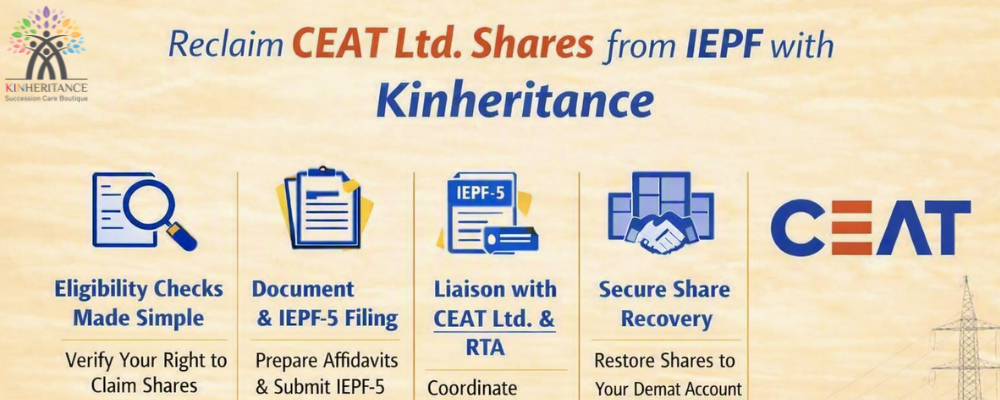
Recovering shares from IEPF involves several stages of verification and documentation.The process begins with confirming that the shares have been transferred to the Investor Education and Protection Fund. Once confirmed, the claimant should gather all available records related to the investment.The next step involves ensuring that KYC details are fully updated. Mismatches in PAN, Aadhaar, bank records, signatures, or addresses often create avoidable delays.The claimant must also maintain an active demat account because recovered shares are generally credited electronically.After gathering all supporting documents, the claimant files the prescribed recovery application and submits the necessary records for verification.The company and its Registrar and Transfer Agent then verify the shareholding records and supporting documents. Additional clarifications may be requested if discrepancies are identified.Following company verification, the claim proceeds to the IEPF Authority for examination and approval.Upon successful completion of the review process, eligible shares are credited back to the claimant's demat account, and any recoverable dividends are released to the registered bank account.
Documents Commonly Required for Recovery
The exact documentation depends on the nature of the claim, but investors should generally be prepared with identity proofs, address proofs, bank account details, PAN records, Aadhaar information, and demat account details.Where physical shares are involved, original share certificates or available supporting records may also be required.Legal heir claims often require additional evidence. Depending on the circumstances, authorities may request a death certificate, succession certificate, legal heir certificate, probate of Will, letters of administration, family settlement documents, relationship proof, or no-objection declarations from other legal heirs.The completeness and accuracy of these documents often determine how smoothly the recovery process proceeds.
Common Challenges Faced During CEAT Share Recovery
Although recovery is legally permitted, many claimants encounter difficulties because of documentation errors.One major challenge is the absence of succession documents in legal heir cases. Families may discover investments but have no clear legal documentation to establish entitlement.Another frequently encountered issue is mismatch in personal details. Even a small discrepancy between company records and current KYC information can trigger objections.Lost share certificates represent a common hurdle for investors who purchased shares several decades ago. While recovery remains possible, additional declarations and verification may be required.Signature mismatches can also create delays because signatures recorded many years ago may differ considerably from present signatures.In some cases, multiple legal heirs may need to coordinate documentation before the claim can proceed. Family disputes and incomplete succession records can significantly extend timelines.Investors should also exercise caution against unauthorized agents or fraudulent intermediaries who promise unrealistic outcomes or guaranteed approvals.
Why Old CEAT Investments May Be More Valuable Than Expected
Many people assume that old share certificates have little value.However, long-term investments in established companies often appreciate substantially over time.Apart from potential capital appreciation, investors may benefit from stock splits, bonus issues, dividends, and corporate actions that occurred over many years.This is why old certificates found in family records should never be discarded without proper verification.Even seemingly small investments can evolve into meaningful financial assets over decades.
Recovery for NRIs
Non-Resident Indians are also entitled to reclaim shares transferred to the Investor Education and Protection Fund.The process remains largely similar, although additional formalities may apply depending on the country of residence and applicable regulations.NRIs may need to provide passport copies, overseas address proof, notarized documents, and valid demat account details.Ownership rights remain fully protected, and eligible shares can be recovered upon successful completion of the verification process.
Frequently Asked Questions
Can CEAT Ltd. shares be recovered after transfer to IEPF?
Yes. Shareholders, nominees, and legal heirs can recover eligible shares transferred to the IEPF.
Can unpaid dividends also be claimed?
Yes. Eligible unpaid dividends transferred to IEPF can generally be claimed along with the shares.
Is a demat account necessary?
Yes. Recovered shares are usually credited electronically into an active demat account.
Can legal heirs recover inherited CEAT shares?
Yes. After establishing legal entitlement through the required documentation, legal heirs can initiate recovery.
What if the original share certificates are lost?
Recovery may still be possible through alternate documentation and declarations, subject to applicable rules.
Can NRIs file a claim?
Yes. NRIs can claim CEAT shares and dividends transferred to the IEPF.
What if my signature has changed?
Additional verification procedures may be required to establish identity.
Are shares permanently lost after transfer to IEPF?
No. Ownership remains with the shareholder or rightful claimant.
Conclusion
Thousands of investors and families may be unaware that their CEAT Ltd. shares have been transferred to the Investor Education and Protection Fund because of unclaimed dividends, outdated records, or inheritance-related issues. Fortunately, the transfer of shares to IEPF does not end ownership rights. With proper documentation, updated KYC details, valid succession records where necessary, and compliance with applicable regulations, investors can reclaim their rightful shares and dividends.
Whether you discovered old physical share certificates in a family locker, inherited investments from parents or grandparents, or suspect that forgotten holdings may have been transferred to the IEPF, taking timely action is essential. Investors can refer to the official IEPF Rules and Notifications at https://www.iepf.gov.in/content/iepf/global/master/Home/Notifications/rules.html and review the latest SEBI transmission framework at https://www.sebi.gov.in/legal/circulars/jul-2026/ease-of-doing-investment-and-ease-of-doing-business-simplification-and-standardisation-of-the-framework-for-transmission-of-securities_103030.html to better understand the recovery and transmission process.
India’s Leading Shares Recovery & IEPF Claim
Expert assistance for recovering lost, unclaimed, or IEPF-transferred shares and unpaid dividends.