Reclaiming Kotak Mahindra Bank Shares from IEPF with Kinheritance
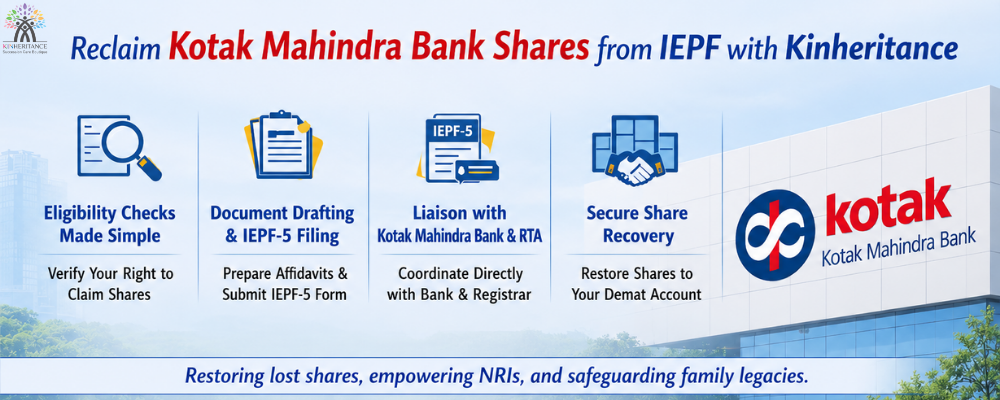
Reclaiming Kotak Mahindra Bank Shares from IEPF with Kinheritance
Kotak Mahindra Bank Limited has established itself as one of India's leading private-sector financial institutions. Over the years, the bank has attracted a large investor base comprising retail investors, high-net-worth individuals, and long-term shareholders who have benefited from capital appreciation, dividend income, and continued growth in shareholder value. However, many investors are often surprised to learn that their Kotak Mahindra Bank shares no longer appear in their investment records. In many cases, this happens because the shares and associated dividends have been transferred to the Investor Education and Protection Fund (IEPF) following prolonged inactivity.
For investors researching the process of IEPF share recovery, understanding why such transfers occur is an essential first step. Under the Companies Act, companies are required to transfer unpaid dividends and corresponding shares to the IEPF Authority when dividends remain unclaimed for seven consecutive years. While this transfer may initially cause concern, shareholders should know that ownership rights are not permanently lost. The original shareholder or their legal heirs retain the right to reclaim the shares and accumulated dividends through the prescribed recovery process. As awareness regarding unclaimed investments continues to grow, increasing numbers of investors and families are discovering dormant Kotak Mahindra Bank shareholdings and beginning the process of recovering them from IEPF. Understanding every stage of this journey can help simplify what may otherwise appear to be a complex legal and administrative procedure.
Understanding the Investor Education and Protection Fund
The Investor Education and Protection Fund was established to safeguard investor interests and hold unclaimed financial assets in a secure environment. Rather than allowing companies to indefinitely retain unclaimed dividends and shares, Indian corporate law requires such assets to be transferred to the custody of the IEPF Authority after a specified period. The IEPF Authority acts as a custodian rather than an owner. This distinction is important because shareholders continue to retain legal rights over their investments even after transfer. The purpose of the fund is to preserve investor assets until the rightful owner or legal heir comes forward and successfully establishes ownership.
For Kotak Mahindra Bank investors, this means that transferred shares remain recoverable through the official IEPF claim process.
Why Kotak Mahindra Bank Shares Are Transferred to IEPF
One of the most common reasons behind IEPF transfers is unclaimed dividend payments. Many investors relocate, change bank accounts, update contact information, or switch communication addresses without updating company records. As a result, dividend payments may remain unpaid or unclaimed for extended periods. Another frequent reason involves physical share certificates. Many investors purchased shares before electronic holding became widespread. Over time, certificates may be misplaced, damaged, forgotten, or lost during relocation. Without access to ownership records, shareholders often fail to claim dividends, eventually triggering the transfer of shares to IEPF. Inheritance-related situations also account for a large number of claims. Family members frequently discover investments years after the death of the original shareholder. By the time these investments are identified, dividends may have remained unclaimed long enough for the shares to be transferred to IEPF. Administrative discrepancies can also contribute to transfer. Differences in names, outdated KYC records, signature variations, PAN mismatches, and banking inconsistencies may prevent successful dividend distribution, ultimately leading to prolonged inactivity.
The Importance of Recovering Kotak Mahindra Bank Shares
Recovering dormant shares is about more than completing a regulatory procedure. Many shares transferred years ago may have appreciated substantially in value over time. Investors are often surprised by the growth in wealth represented by forgotten investments. In addition to recovering the shares themselves, successful claimants may also recover accumulated unpaid dividends that were transferred alongside the shares. For legal heirs, the recovery process helps preserve inherited wealth and ensures that valuable family assets are not left dormant indefinitely. Once ownership is restored, shareholders regain eligibility for future dividend payments, shareholder communications, and other corporate benefits associated with the investment.
Preparing Before Starting the Recovery Process
Preparation plays a significant role in the success of an IEPF recovery application. Claimants should first ensure that they have an active Demat account because recovered shares are credited only in electronic form. A valid bank account is equally important because recovered dividend amounts are generally transferred electronically. The bank account should be fully operational and compliant with KYC requirements. Investors should then gather all available investment records. Historical documents can be extremely valuable during verification. Old share certificates, dividend warrants, transaction records, annual reports, bank statements, tax filings, Demat statements, and correspondence relating to the investment may all support ownership claims.
Legal heirs should begin collecting succession-related documents as early as possible because obtaining such documentation can take considerable time.
Verifying Whether Shares Have Been Transferred to IEPF
Before filing any recovery application, shareholders should confirm that the shares have actually been transferred to the IEPF Authority. Verification generally involves reviewing available shareholder records and identifying relevant information such as shareholder names, folio numbers, certificate numbers, and Demat account details. Historical investment records often provide useful information for tracing transferred shares. Many investors discover the existence of dormant holdings through old financial documents stored at home, inherited family records, or archived banking information. Confirming ownership details at this stage helps ensure accuracy throughout the recovery process.
Documents Required for Kotak Mahindra Bank Share Recovery
Documentation serves as the foundation of every IEPF claim. Authorities must be satisfied that the claimant is genuinely entitled to the shares being claimed. Identity verification documents usually include PAN cards, Aadhaar cards, passports, or similar government-issued identification. Address proof may consist of Aadhaar cards, utility bills, passports, or driving licences. Banking records are required to facilitate dividend payments. These documents often include cancelled cheques, passbook copies, or bank statements showing account details. Claimants must also provide Demat account information, generally through a Client Master List issued by the Depository Participant. Ownership evidence may include original share certificates, dividend warrants, Demat statements, investment records, transaction confirmations, shareholder communications, and other supporting documents. Additional documents commonly required include Form IEPF-5 acknowledgements, indemnity bonds, advance receipts, declarations, affidavits, and verification forms.
Recovery Process for Legal Heirs
Inheritance-related claims often require additional documentation and verification. Legal heirs must first establish their entitlement to the shares before recovery can proceed. The process generally begins with the submission of a death certificate relating to the original shareholder. Depending on the circumstances, additional documents may include probate of a will, succession certificates, legal heir certificates, letters of administration, or family settlement agreements.
Where multiple heirs are involved, authorities may require consent declarations or no-objection certificates from other family members. These requirements help ensure that the recovered assets are transferred to the rightful beneficiaries.
While inheritance claims often involve greater scrutiny, successful recovery remains entirely possible with proper documentation.
Filing Form IEPF-5
The formal recovery journey begins with the online filing of Form IEPF-5. This form requires detailed information about the claimant, the shares being claimed, ownership details, dividend particulars, and associated supporting information. Accuracy is essential because the information provided must correspond with historical company records. Names, PAN numbers, Demat account details, banking information, and ownership references should be entered carefully to avoid discrepancies during verification. Once submitted successfully, the system generates a Service Request Number, commonly referred to as an SRN. This reference number serves as the primary tracking identifier throughout the recovery process. Claimants should save both the acknowledgement and SRN details for future reference.
Submission of Physical Documents
After completing the online filing process, claimants must prepare and submit a physical document package containing all supporting records. The dossier typically includes identity proof, address proof, bank account documentation, Demat details, ownership records, succession documents where applicable, the signed acknowledgement generated after filing Form IEPF-5, and any required declarations. Particular attention should be given to ensuring consistency across all documents. Variations in names, addresses, signatures, or account details frequently result in additional queries during verification. Submitting a well-organised and complete document package can significantly improve processing efficiency.
Company Verification Stage
Following receipt of the claim documents, the verification process begins. During this stage, company records are examined and compared with the claimant's application. Ownership details, dividend histories, signatures, shareholder records, identity information, and banking particulars are reviewed carefully. Where questions arise, additional clarification may be requested. Common issues include spelling differences, signature mismatches, missing supporting documents, outdated records, and inconsistencies in ownership details. Prompt responses to such requests can help prevent unnecessary delays in processing. Once the verification exercise is completed successfully, a verification report is prepared and forwarded to the IEPF Authority for final consideration.
Approval by the IEPF Authority
The IEPF Authority conducts a final review of the claim after receiving the verification report. The Authority examines the documentation submitted by the claimant alongside the verification findings provided during the company review stage. If satisfied that ownership has been established correctly, approval is granted. Following approval, the shares are credited directly into the claimant's Demat account, while accumulated dividend amounts are transferred to the designated bank account. This final step effectively restores ownership rights to the investor or legal heir.
Common Challenges During Share Recovery
Although the process is clearly defined, several practical challenges frequently arise. Missing ownership records can complicate verification, particularly when investments were made decades ago. Lost share certificates and incomplete documentation often require additional investigation. Name mismatches represent another common issue. Shareholder records may contain initials, older surnames, or spellings that differ from current identity documents. Signature discrepancies can also create delays. Investors who purchased shares many years ago may find that their present signatures differ significantly from historical records. Inheritance cases often require extensive verification because entitlement must be established through legal documentation. Missing succession records or disputes among heirs may lengthen processing times. Despite these challenges, most issues can be resolved through careful preparation and accurate documentation.
Frequently Asked Questions About Kotak Mahindra Bank Share Recovery
Many investors wonder how long the recovery process takes. Processing times vary based on documentation quality, claim complexity, and whether additional verification becomes necessary. Applications supported by complete and consistent records typically progress more efficiently.
Another common concern relates to lost share certificates. While original certificates are valuable ownership evidence, their absence does not necessarily prevent recovery. Alternative records may be used to establish entitlement in many cases.
Legal heirs frequently ask whether they can recover shares transferred after the shareholder's death. The answer is yes. Provided that lawful entitlement can be established through appropriate succession documentation, legal heirs retain the right to recover both shares and related dividends.
Investors are also often interested in knowing whether dividends can be recovered alongside the shares. In most successful claims, shareholders receive both the transferred shares and the corresponding unpaid dividends.
Real-Life Recovery Scenarios
Many successful recoveries begin unexpectedly. One family discovered old Kotak Mahindra Bank investment documents while sorting through records belonging to a deceased parent. What initially appeared to be a small holding had grown considerably over the years. Following the completion of succession formalities and verification procedures, the family successfully recovered the shares and associated dividends. In another instance, a long-term investor found forgotten investment records while consolidating financial documents before retirement. The shares had already been transferred to IEPF after years of unclaimed dividends. After gathering supporting documents and completing the prescribed process, ownership was successfully restored. There are also numerous situations in which grandchildren discover ancestral investments decades after the original purchase. These cases often involve extensive documentation and succession procedures, but successful recovery can preserve valuable family wealth that might otherwise remain dormant indefinitely.
Conclusion
Recovering Kotak Mahindra Bank shares from the Investor Education and Protection Fund is a well-established legal process designed to protect investor interests. Shares transferred to IEPF due to unclaimed dividends, forgotten investments, lost share certificates, inheritance-related delays, or documentation discrepancies remain recoverable by their rightful owners. Successful recovery depends on careful preparation, accurate documentation, proper filing of Form IEPF-5, timely submission of supporting records, and effective response to verification requests. While the process may require patience and attention to detail, it provides investors and legal heirs with an opportunity to reclaim valuable assets and restore ownership rights. For individuals researching unclaimed shares recovery and seeking to recover dormant investments, understanding the complete IEPF claim process is the first step toward reclaiming both historical investments and accumulated dividends while preserving long-term financial wealth for future generations.
India’s Leading Shares Recovery & IEPF Claim
Expert assistance for recovering lost, unclaimed, or IEPF-transferred shares and unpaid dividends.