Recover Adani Ports & SEZ Shares from IEPF by Kinheritance
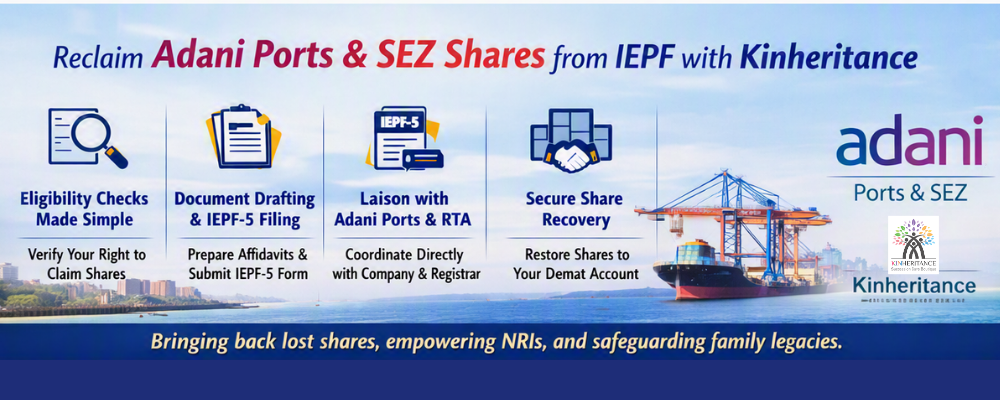
Recover Adani Ports & SEZ Shares from IEPF by Kinheritance
Many investors purchase shares with the intention of creating long-term wealth, passing assets to future generations, or earning regular dividend income. However, over the years, investments can sometimes be forgotten due to changes in address, loss of physical share certificates, migration to another city or country, changes in contact details, or the unfortunate demise of the original shareholder. As a result, dividends remain unclaimed, and communication from the company goes unanswered.
Under the Companies Act, 2013, companies are legally required to transfer dividends that remain unclaimed for seven consecutive years to the Investor Education and Protection Fund (IEPF). Once the dividends associated with a specific shareholding remain unclaimed for this period, the corresponding shares are also transferred to the IEPF Authority. Although many investors worry that such assets are permanently lost, the good news is that shareholders and their legal heirs retain the legal right to recover these investments. Understanding the IEPF share recovery process is therefore essential for reclaiming valuable financial assets that may have been transferred to the government-maintained fund.
For shareholders of Adani Ports and Special Economic Zone Limited, one of India's leading infrastructure and logistics companies, recovering shares from IEPF can seem intimidating at first. However, the process becomes considerably easier when broken down into clear steps. This guide explains every aspect of the recovery journey in simple language so that investors and legal heirs can confidently proceed with their claims.
Understanding Why Adani Ports & SEZ Shares Are Transferred to IEPF
Before initiating a claim, it is important to understand why shares are transferred in the first place. The Investor Education and Protection Fund was established to safeguard unclaimed investor assets. The objective is not to deprive investors of ownership but to ensure that dormant assets are protected and properly regulated. When dividends remain unclaimed for seven consecutive years, companies are obligated to transfer those amounts to the IEPF Authority. The law further requires companies to transfer the corresponding shares linked with those unpaid dividends. This process applies regardless of whether the shares are held in physical form or electronic form. Once transferred, the shares remain under the custody of the IEPF Authority until a legitimate claim is submitted and approved. Several common situations result in such transfers. Investors may forget old investments purchased decades ago. Some shareholders relocate and fail to update their address records. Others lose physical share certificates or dividend warrants. In many cases, family members remain unaware that a deceased relative owned valuable shares in a listed company such as Adani Ports & SEZ. As share prices appreciate over time, these dormant investments can become significantly more valuable than their original purchase price. For many families, recovering such holdings can lead to the restoration of substantial financial wealth.
Understanding Your Rights as a Shareholder
One of the biggest misconceptions surrounding IEPF is that transferred shares become government property permanently. This belief often prevents investors from taking action. In reality, ownership rights remain protected. The transfer to IEPF is only a custodial transfer and does not extinguish shareholder rights. Investors continue to be the beneficial owners of the shares, while legal heirs maintain the right to inherit and recover them after completing the required formalities. This distinction is important because it means investors have a clear legal path to recover their shares and unclaimed dividends, irrespective of how long ago the transfer occurred.
Even if the original shareholder has passed away, the recovery process remains available through succession and transmission procedures established under applicable laws and regulations.
Step 1: Identifying and Verifying the Status of Adani Ports & SEZ Shares
The recovery process begins with confirming whether the shares have actually been transferred to the IEPF. Many investors possess only partial information regarding their holdings. Some may have old share certificates, dividend warrants, annual reports, Demat statements, or tax documents. These records can provide critical information such as folio numbers, shareholder names, DP IDs, or client IDs. Investors should begin by reviewing available documentation to identify their shareholding details. Once these details are available, they can check whether the shares are currently held in their Demat account or whether they have been transferred to IEPF. Legal heirs often face a more complicated situation because they may not possess complete investment records. In such circumstances, reviewing family files, bank records, income tax documents, old correspondence, and investment statements can help establish ownership. The Registrar and Share Transfer Agent associated with Adani Ports & SEZ play a significant role during this stage. By communicating with the registrar and providing available shareholder details, claimants can verify whether the shares are still held in the investor's name or have been transferred to the IEPF Authority. Obtaining accurate information during this preliminary stage reduces confusion later and allows claimants to prepare the appropriate documentation for the recovery process.
Gathering Historical Evidence of Ownership
A successful recovery claim often depends on the quality of the ownership evidence submitted. Historical records can include old share certificates, dividend warrants, company correspondence, corporate action statements, Demat account statements, tax filings, inheritance documents, and bank records reflecting dividend receipts. Even when complete records are unavailable, partial documentation can often establish ownership. The objective is to create a clear audit trail connecting the claimant to the original investment.
Many investors incorrectly assume that recovery is impossible if documents are old or incomplete. In reality, recovery authorities and companies routinely deal with historical investments spanning several decades.
Step 2: Documentation Requirements and Share Transmission Process
Documentation is the foundation of every successful unclaimed shares recovery application. The verification process relies heavily on documentary evidence, making it essential to gather all required records before filing a claim. The claimant generally needs identity proof such as a PAN card and Aadhaar card. Address proof must also be available and should match the information submitted during the claim process. Bank account details are particularly important because recovered dividends are usually credited directly to the claimant's bank account upon approval. Any discrepancy between submitted records can cause delays. A client master list or equivalent demat account statement must also be provided because recovered shares are transferred electronically to the claimant's demat account. The Demat account should contain accurate and updated information. Where available, physical share certificates should be included. If certificates have been lost, alternative supporting documentation may be used together with declarations and indemnities as required by the company.
Consistency across all records is crucial. Differences in names, initials, signatures, birth dates, or addresses frequently trigger verification queries.
Transmission of Shares in the Case of Deceased Shareholders
A large percentage of Adani Ports IEPF claims involve shareholders who are no longer alive. In such situations, shares cannot be directly released to heirs without first establishing legal entitlement through a process known as transmission. Transmission is the legal transfer of ownership rights from a deceased shareholder to eligible beneficiaries. The death certificate serves as the primary document proving the shareholder's demise. Additional documents may be required depending on the specific family and legal circumstances. Where a valid will exists, supporting probate or related legal documents may become necessary. In the absence of a will, succession certificates, legal heir certificates, family settlement records, or court-issued documents may be required to establish entitlement. When multiple heirs are involved, no-objection declarations may also become necessary. The objective is to ensure that ownership rights are transferred to the rightful claimant without future disputes.
This stage often requires careful document collection and coordination among family members. Proper preparation can significantly reduce delays during verification.
Step 3: Filing Form IEPF-5 on the MCA Portal
Once ownership records and supporting documentation are in place, the claimant must submit Form IEPF-5 through the Ministry of Corporate Affairs portal. Form IEPF-5 serves as the official application requesting the release of shares and dividends from the IEPF Authority. Every field must be completed carefully because errors at this stage frequently lead to delays. The claimant must enter personal details exactly as they appear in supporting documents. Information regarding the shareholding, folio numbers, DP IDs, client IDs, company details, and claimant information must be entered with precision. After successful submission, the portal generates a Service Request Number, commonly known as an SRN. This number becomes the primary reference identifier for the entire claim. The SRN should be preserved carefully because it may be required for tracking, correspondence, verification, and future reference.
Common Mistakes While Filing Form IEPF-5
Many applications are delayed because of avoidable errors. The most common issue is name mismatch. For example, a PAN card may show a middle name, while the company's records may not. Such differences can trigger additional scrutiny. Address mismatches represent another common issue. Investors who have changed residence multiple times may have different addresses reflected across documents. Bank details must also be carefully reviewed. Incorrect account numbers, IFSC codes, or account-holder information can result in complications during dividend payment processing. Demat details should be verified multiple times before submission because recovered shares can only be credited electronically to the specified account. Careful review of every field before final submission significantly improves the likelihood of smooth processing.
Step 4: Preparing and Sending Claim Documents
After filing Form IEPF-5 online, claimants must prepare a physical dossier containing supporting documents and submit it to the designated Nodal Officer of Adani Ports & SEZ. The dossier acts as the documentary foundation of the claim. It enables the company to validate ownership, verify identity, and confirm eligibility. The package generally includes the Form IEPF-5 acknowledgement, SRN details, identity documents, address proof, PAN records, bank information, Demat account details, indemnity bond, advance receipt, and self-attested supporting documents. In inheritance-related claims, transmission documents must also be enclosed. These documents should align exactly with the information provided during online filing. Maintaining clarity, completeness, and consistency throughout the dossier helps accelerate verification and minimises the likelihood of deficiency notices.
Claimants should retain photocopies and digital copies of every document submitted during the process.
Step 5: Company Verification and E-Verification Report
Once the physical documents are received, the company initiates its verification process. The company examines ownership records, share transfer history, dividend records, claimant details, succession documents, and supporting evidence. The objective is to ensure that the person making the claim is legally entitled to recover the assets. This stage is extremely important because the company's findings form the basis of the report submitted to the IEPF Authority. The company typically reviews all supporting documentation and may seek clarification if any discrepancies are identified. Prompt responses from claimants help prevent delays.
Upon satisfaction, the company prepares an e-verification report and forwards it to the IEPF Authority for final examination.
IEPF Authority Review and Final Approval
After receiving the company's verification report, the IEPF Authority undertakes an independent review of the claim. The Authority examines both the claimant's application and the company's verification report. It ensures that procedural requirements have been satisfied and that ownership has been properly established. Once approved, the shares are released from the IEPF account and credited to the claimant's Demat account. Similarly, unclaimed dividend amounts are transferred to the claimant's registered banking account. The successful completion of this stage marks the conclusion of the IEPF claim process, restoring full ownership and financial benefits to the rightful shareholder or legal heir.
Real-Life Shareholder Story: Rediscovering a Forgotten Investment
A family in Gujarat discovered old investment papers belonging to their late grandfather while clearing ancestral records. Among various documents were references to Adani Ports shares purchased many years ago. The family initially believed the investment had become worthless because they had received no communication for years. After conducting a detailed search, they discovered that both the dividends and the shares had been transferred to IEPF. The legal heirs collected transmission documents, established succession rights, completed Form IEPF-5, and submitted the necessary paperwork. Following verification and approval, the shares were restored to the claimant's Demat account. What began as a forgotten investment ultimately became a valuable inherited asset.
Real-Life Shareholder Story: Recovery Despite Missing Share Certificates
Another investor lost physical share certificates during multiple relocations across different cities. For years, the investor assumed recovery would be impossible because the certificates could not be located. However, old tax records, dividend references, and historical shareholder documents helped establish ownership. After carefully completing the required procedures and responding to verification requests, the claim was approved. The investor successfully recovered both shares and accumulated dividend entitlements despite the absence of original certificates. This example demonstrates that documentary evidence other than share certificates can often play a significant role in establishing ownership.
Frequently Asked Questions
How long does an IEPF share recovery claim take?
The timeline varies depending on document completeness, company verification requirements, inheritance complexity, and regulatory review. Cases with complete documentation typically progress more smoothly than matters involving succession disputes or missing records.
Can shares be recovered if original certificates are lost?
Yes. Lost certificates do not automatically prevent recovery. Alternative evidence of ownership may be accepted, although additional declarations and verification procedures may be required.
Can legal heirs recover Adani Ports shares transferred to IEPF?
Yes. Legal heirs can claim shares and dividends after completing transmission formalities and establishing legal entitlement through appropriate succession documentation.
Can dividends also be recovered?
Yes. The recovery claim generally covers both transferred shares and unpaid dividends that were moved to the IEPF Authority.
What happens if there is a mismatch in names or addresses?
Such discrepancies should be addressed proactively with supporting documents, correction records, affidavits, and identity proofs wherever necessary. Proper explanation of mismatches helps prevent unnecessary delays.
Conclusion
Recovering Adani Ports & SEZ shares from the Investor Education and Protection Fund is a structured legal process designed to return dormant investments to their rightful owners. Although the procedure involves multiple stages, including verification, documentation, transmission, online filing, and regulatory review, shareholders and legal heirs retain full rights to reclaim their assets. By gathering accurate records, completing Form IEPF-5 carefully, responding promptly to verification requests, and maintaining consistency across all documents, investors can significantly improve the chances of successful recovery. Whether the shares were forgotten decades ago, transferred due to unclaimed dividends, or inherited from a family member, taking timely action can help restore valuable investments and accumulated benefits. Individuals researching Adani Ports share recovery, claim dividends from IEPF, and IEPF share recovery procedures frequently encounter educational resources
India’s Leading Shares Recovery & IEPF Claim
Expert assistance for recovering lost, unclaimed, or IEPF-transferred shares and unpaid dividends.