Accelya Solutions India Ltd
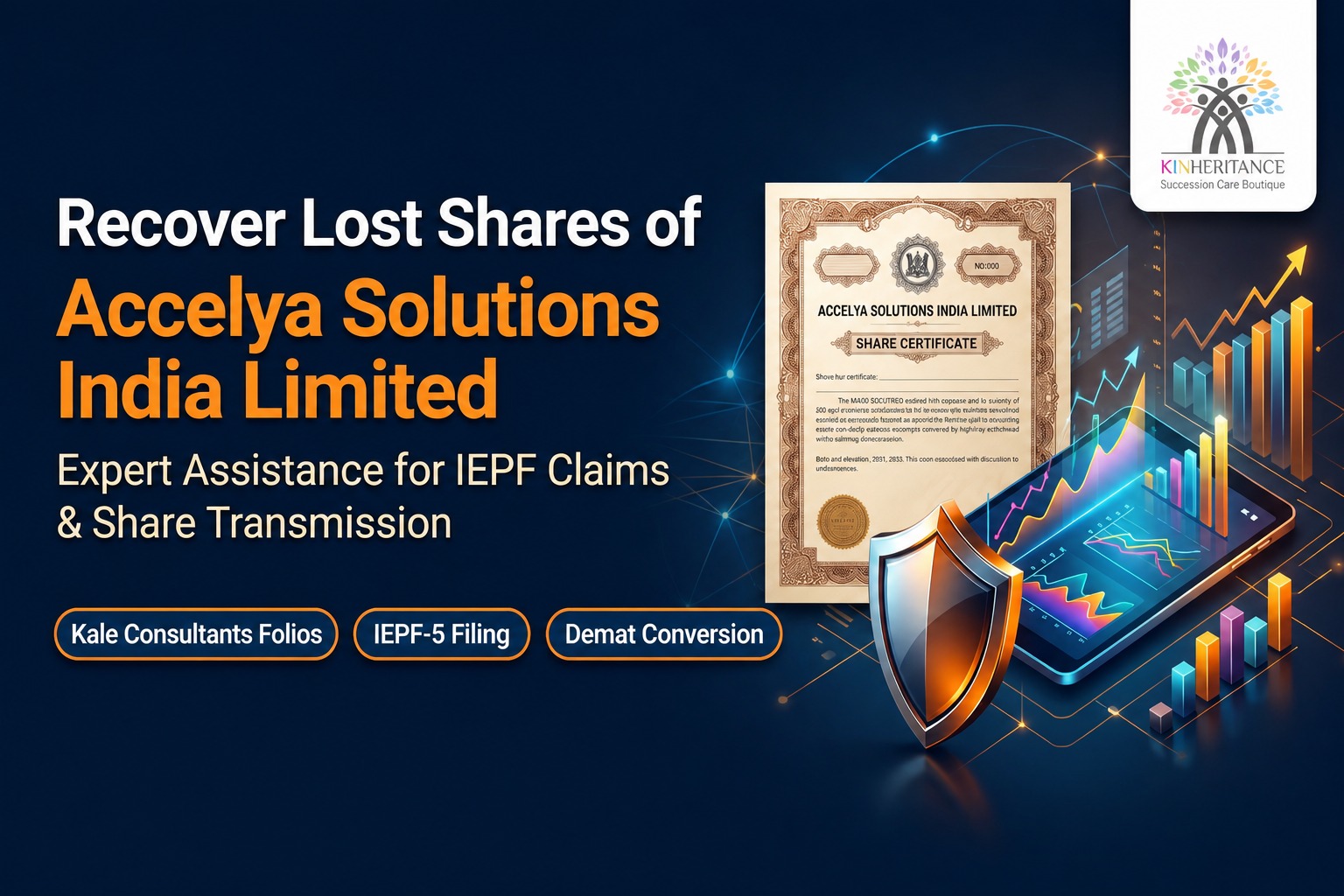
Accelya Solutions India Ltd
Reclaim Your Dormant Equity: How to Recover Lost Shares of Accelya Solutions India Ltd
Discovering that your family holds legacy stock in an established software solutions provider can be a profound financial revelation. For decades, long-term investors accumulated holdings in aviation software pioneer Kale Consultants, which subsequently transformed into Accelya Solutions India Ltd. However, turning these vintage paper certificates or forgotten folios into usable financial wealth presents substantial bureaucratic challenges. Today, numerous retail investors and surviving successors struggle to recover lost shares of Accelya Solutions India Ltd due to outdated records, misplaced documents, and regulatory lockouts.
When dividends go uncollected for seven consecutive financial years, statutory regulations mandate the transfer of those shares to the Investor Education and Protection Fund (IEPF). Navigating the intricate labyrinth of corporate registries, transfer agents, and central government portals demands exacting legal precision. Kinheritance operates as a premier succession care boutique, helping Indian families and global NRIs regularize legacy folios, execute legal transmissions, and retrieve dormant assets. This comprehensive guide outlines the operational steps, documentation requirements, and legal procedures necessary to reclaim your rightful equity.
The Problem Landscape: Why Accelya Solutions Shares Go Unclaimed
Securing ownership of legacy equity in Accelya Solutions India Ltd is rarely hindered by a single administrative roadblock. Instead, retail investors and legal heirs typically confront an interconnected web of corporate and legal hurdles:
Corporate Identity Shifts and Name Changes: The company has undergone major corporate milestones over the years, starting as Kale Consultants Limited before rebranding to Accelya Kale Solutions Limited, and ultimately becoming Accelya Solutions India Ltd. Many elderly shareholders still hold physical certificates printed under the old corporate names, creating confusion regarding the current legitimacy of their folios.
Misplaced, Defaced, or Lost Physical Certificates: Prior to the era of mandatory digital depositories, investments existed exclusively on physical paper. Decades of storage in bank lockers, metal trunks, or ancestral residences frequently result in water damage, insect infestation, or accidental misplacement during home renovations and relocations. Without physical share certificates, proving clear title requires structured legal affidavits and indemnity procedures.
Frozen Folios from Outdated Contact Information: Many folios remain tied to addresses where investors resided twenty or thirty years ago. When an investor changes their residence or closes an old bank account without formally notifying the company, communication breaks down. Critical corporate announcements, rights issue notifications, and dividend warrants simply return undelivered.
Statutory Transfer to the IEPF Authority: Under Section 124(6) of the Companies Act, 2013, companies are legally required to transfer all shares for which dividends have remained unpaid or unclaimed for seven consecutive years to the IEPF Authority. Once this statutory handover occurs, the shares leave the company’s direct register, and recovery is possible only through an official claim submitted to the central government.
Succession Complications and Unregistered Nominees: In numerous instances, the original investor passed away without registering a nominee on the physical folio or leaving a comprehensive testamentary will. Surviving legal heirs face the complex task of establishing legitimate succession rights across multiple regulatory bodies before they can claim the underlying assets.
Underlying Drivers: What Causes Equity to Slip into Inactivity?
Understanding the root causes behind dormant shareholdings helps families identify latent risks in their current investment portfolios:
Frequent Professional Relocations: As professionals in India's booming software and services ecosystem transitioned between technology hubs like Pune, Mumbai, and Bengaluru, or emigrated overseas, updating physical share registers was often neglected. Over time, these communication gaps severed ties between the company and the shareholder.
The Dematerialization Shift: The Securities and Exchange Board of India (SEBI) mandated that physical share certificates can no longer be transferred or traded on stock exchanges. While modern markets moved entirely online, conservative investors often retained paper certificates in lockers, unaware that physical holdings are far more prone to becoming untraceable.
Absence of Structured Estate Planning: Passing away intestate (without a valid will) is a primary contributor to unclaimed corporate wealth across India. When succession is not clearly outlined through professional Will Drafting Services, grieving family members must secure court-issued succession certificates, letters of administration, or probate decrees, a legal ordeal that can take years to resolve.
Lack of Awareness Regarding IEPF Rules: A common misconception among retail investors is that physical certificates guarantee permanent ownership regardless of activity. Many do not realize that leaving dividend warrants uncashed for seven consecutive years triggers the legal transfer of their equity to the central government.
The Recovery Blueprint: Step-by-Step Restoration Strategy
Retrieving your investments requires a structured, compliant, and legally sound procedure. Below is the step-by-step roadmap to successfully restore your shares:
1. Audit Historical Folio Records & Tracing
Begin by gathering every historical document linked to the investment. Search for dividend counterfoils, physical share certificates, Annual General Meeting (AGM) voting slips, income tax deduction certificates (Form 16A), or old bank passbooks showing dividend credits from Kale Consultants or Accelya. Note the registered folio number, shareholder names, certificate numbers, and distinctive numbers. If you only possess partial details, engaging specialists to Recover Lost Shares can help trace your registered folio in corporate registries.
2. Verify Standing with the Company Registrar (RTA)
Accelya Solutions India Ltd manages its registry and share transfer operations through its appointed Registrar and Share Transfer Agent, KFin Technologies Limited. Draft a formal inquiry letter citing your registered folio number, accompanied by self-attested copies of your PAN and Aadhaar cards. Request a comprehensive status statement confirming whether the shares remain in the physical folio, require KYC regularisation, or have been transferred to the IEPF.
3. Regularise SEBI KYC Mandates
Before any corporate action, duplicate issuance, or dematerialization can take place, SEBI mandates that your physical folio must have complete and verified KYC details. Submit the following standardized forms to the RTA:
Form ISR-1: Registering or updating your PAN, postal address, email address, mobile number, and bank account credentials.
Form ISR-2: Formal verification of your signature by your bank manager, accompanied by an original personalized cancelled cheque.
Form SH-13: Registering a legal nominee, ensuring future succession remains seamless.
4. Address Lost Certificates via Duplicate Issuance Process
If the RTA confirms your active shareholding but the original physical certificates cannot be located, you must initiate the duplicate share issuance procedure:
File a First Information Report (FIR) or formal police complaint detailing the loss of the physical certificates, specifying the folio number and distinctive share numbers.
Publish a public loss-of-shares notice in two newspapers (one national English daily and one regional language daily circulating in the district of the company’s registered office).
Execute a notarized indemnity bond and affidavit on non-judicial stamp paper of prescribed value, supported by eligible sureties.
5. Convert Physical Folios to Demat via Letter of Confirmation
Under current SEBI guidelines, RTAs no longer issue replacement paper certificates. Instead, upon verifying your duplicate share application, the RTA issues a formal Letter of Confirmation (Form ISR-4). You must submit this letter along with a Dematerialization Request Form (DRF) to your Depository Participant (DP) within 120 days to credit the shares directly into your active Demat account.
6. File and Process IEPF-5 Claims for Transferred Assets
If your shares and accrued dividends have already been transferred to the central government, you must navigate the formal IEPF recovery process. Complete and submit the online e-form IEPF-5 on the Ministry of Corporate Affairs (MCA) portal. Upon submission, an acknowledgement receipt featuring a Service Request Number (SRN) will be generated. Compile a physical verification dossier—including the signed IEPF-5 form, advance stamped receipt, indemnity bond, verified Client Master List (CML), and original entitlements—and submit it to the Nodal Officer of Accelya Solutions India Ltd for verification.
7. Execute Share Transmission for Deceased Shareholders
If the registered shareholder is deceased, the legal heirs must complete the formal transmission of shares before claiming the equity. Submit a notarized copy of the death certificate, court-issued succession certificate (or probate of will), legal heir affidavits, and No Objection Certificates (NOCs) from all non-claiming family members to the RTA.
8. Clear Corporate Scrutiny and Track Asset Credit
For IEPF claims, the company's Nodal Officer examines your physical documents against company records. Upon successful verification, the company submits an online verification report to the IEPF Authority. Monitor your application status regularly and address any clarification requests or document deficiencies promptly to avoid administrative delays.
Checklist: Essential Documents for Folio Regularisation and Claims
Preparing an accurate, complete document docket is critical to avoiding bureaucratic delays. The primary documents required include:
Primary Identification Proof: Self-attested copies of the claimant’s PAN card and Aadhaar card (or passport for NRI claimants).
Ownership Verification Documents: Original physical share certificates, historical dividend counterfoils, or company allotment letters.
Active Demat Account Verification: A recently generated Client Master List (CML) stamped and signed by your Depository Participant, confirming an active Demat account in the claimant's name.
Banking Proof: A personalized cancelled cheque displaying the claimant's printed name, bank account number, and IFSC code for direct electronic credit of unpaid dividends via NEFT.
SEBI KYC Submission Pack: Duly completed and signed Forms ISR-1, ISR-2 (banker’s signature verification), and Form SH-13.
Duplicate Share Application Docket: Certified copy of the police FIR, original newspaper publication clippings, and executed indemnity bonds with surety documentation.
Succession Records (For Deceased Shareholders): Notarized copy of the death certificate, legal heirship certificate, court-issued succession certificate or probate of will, accompanied by family indemnity bonds.
IEPF Statutory Submissions: Printed copy of the submitted e-form IEPF-5, MCA SRN acknowledgement slip, and an advance stamped receipt signed across a revenue stamp.
Common Friction Points in Corporate Asset Retrieval
Retail investors frequently encounter administrative hurdles that can derail their recovery efforts if not handled correctly:
Signature Divergence: Signatures naturally evolve over decades. If your current signature does not match the specimen card recorded in the RTA's historical archives, your application will be paused until an official banker's verification (Form ISR-2) is approved.
Discrepancies in Name Spelling: Even minor differences—such as an expanded middle name on your PAN card versus initials on the historical share certificate—require sworn name-change affidavits or official gazette notifications to reconcile.
Multiple Legal Heirs and Family Friction: In inheritance scenarios involving multiple siblings or extended family members, securing notarized NOCs and KYC documents from every individual can become a significant bottleneck. Clear communication and legal structuring are essential.
Strict IEPF Audit Standards: The IEPF Authority evaluates claims with absolute precision. A missing revenue stamp, an incorrect date, or an unverified bank mandate on the IEPF-5 form will result in an immediate rejection, requiring the claimant to rectify the issue and restart the verification timeline.
Once these administrative hurdles are cleared and your Accelya Solutions shares are safely credited to your Demat account, they become liquid assets. Beyond selling, you can leverage your restored blue-chip portfolio to secure a Loan Against Shares, providing immediate financial liquidity while preserving your long-term equity ownership.
Frequently Asked Questions (FAQs)
1. How can I recover lost shares of Accelya Solutions India Ltd?
Begin by locating historical records, such as dividend slips or folio numbers under Kale Consultants or Accelya. Contact the company's designated RTA (KFin Technologies Limited) to assess the status of the holding. Update your KYC details using SEBI Forms ISR-1 and ISR-2, apply for duplicate certificates if the originals are missing, and file Form IEPF-5 online if the shares were transferred to the government.
2. Are my old Kale Consultants Limited share certificates still valid?
Yes, certificates issued under the previous corporate names (Kale Consultants Limited or Accelya Kale Solutions Limited) remain valid legal evidence of your investment. However, before you can sell or transfer them, they must be validated by the RTA, regularized through updated KYC, and converted into electronic format in an active Demat account.
3. What should I do if my physical share certificates are completely lost?
Notify the RTA immediately to place a temporary stop mark on the folio to prevent fraudulent transfers. Next, lodge a police FIR detailing the missing certificates, publish a loss notice in two newspapers, and submit an indemnity bond with surety details to receive a Letter of Confirmation for dematerialization.
4. How do I verify if my Accelya Solutions shares have been moved to the IEPF?
You can check the official IEPF portal (iepf.gov.in) using your folio number, PAN, or investor name. Alternatively, you can send a written inquiry along with self-attested KYC documents to the RTA to obtain an official status ledger of your shares and unpaid dividends.
5. Can legal heirs claim shares held by a deceased family member?
Yes. Legal heirs must complete the formal transmission of shares procedure. This involves submitting a notarized death certificate, a court-issued succession certificate (or probate of will), legal heir affidavits, and NOCs from all non-claiming family members to the RTA.
Summary & Key Takeaways
Reclaiming dormant investments in an established technology company like Accelya Solutions India Ltd represents significant family wealth, but navigating corporate registries and regulatory compliance demands precision. From resolving historical corporate name transitions and updating KYC records to completing duplicate share protocols and IEPF filings, each phase requires meticulous attention to statutory guidelines. Taking proactive steps today to organize your family records, update your KYC details, and dematerialize your holdings ensures that your hard-earned investments remain secure for generations to come.
India’s Leading Shares Recovery & IEPF Claim
Expert assistance for recovering lost, unclaimed, or IEPF-transferred shares and unpaid dividends.