Aditya Birla Real Estate Ltd
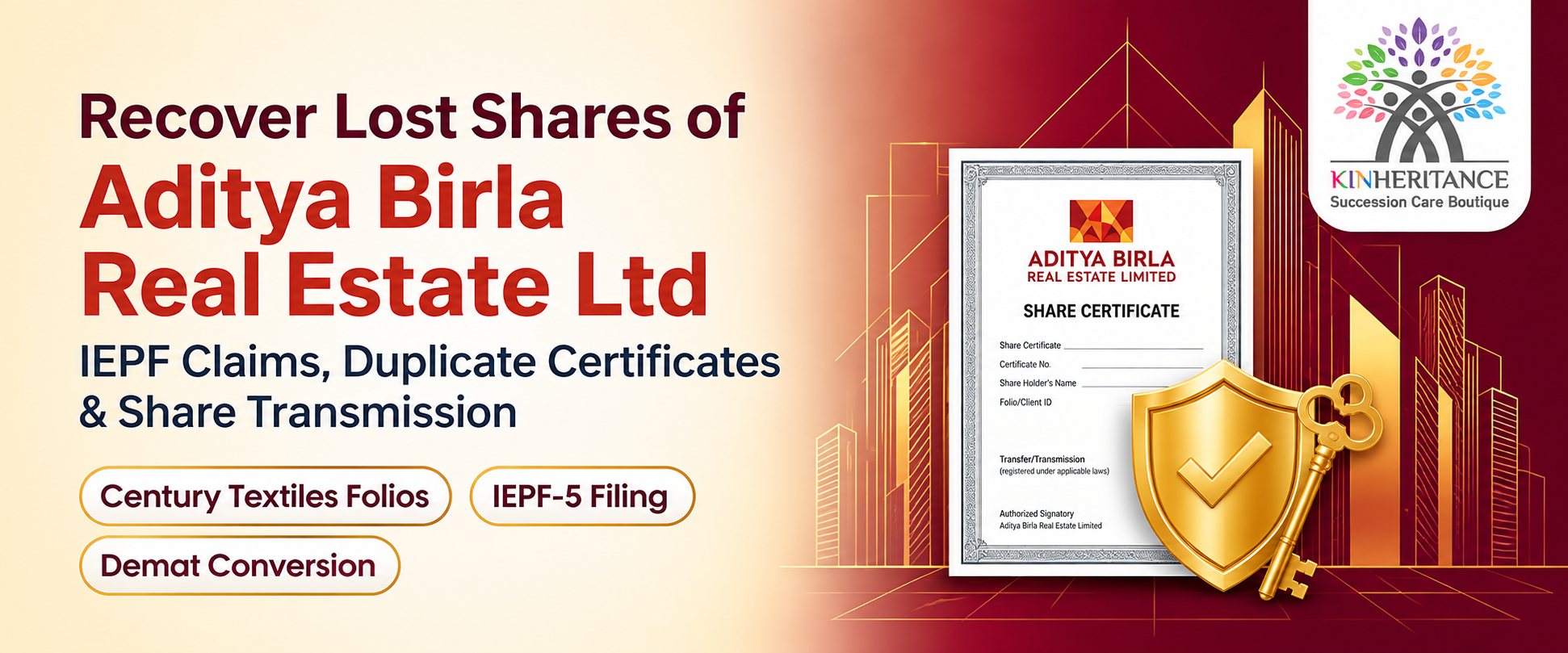
Aditya Birla Real Estate Ltd
Unlocking Century-Old Wealth: A Complete Guide to Recovering Lost Shares of Aditya Birla Real Estate Ltd
Finding old paper share certificates tucked inside an ancestral trunk, a wooden almirah, or a bundle of dusty property documents is a common experience for many Indian households. For thousands of families across the country, these vintage certificates bear the historic name of Century Textiles and Industries Limited—a legacy conglomerate that officially transitioned into Aditya Birla Real Estate Limited in 2024.
While discovering such a certificate feels like stumbling upon hidden family wealth, converting those decades-old paper documents into active, tradable electronic assets in a Demat account is rarely straightforward. Over the last thirty to forty years, India’s capital markets have undergone massive regulatory and technological shifts. Paper shares have been replaced by compulsory dematerialisation, corporate names have evolved, businesses have been demerged, and stricter Know Your Customer (KYC) norms have been enforced by the Securities and Exchange Board of India (SEBI).
Furthermore, under Section 124 of the Companies Act, 2013, if dividends declared on shares remain unclaimed for seven consecutive years, both the unpaid dividend amounts and the underlying shares are statutorily transferred to the Investor Education and Protection Fund (IEPF).
Whether you are an original investor trying to regularise old physical folios or a legal heir attempting to claim an ancestor's forgotten investments, navigating Registrar and Transfer Agent (RTA) verifications, duplicate certificate procedures, and IEPF filings requires precision. This comprehensive guide breaks down every step, document, and regulatory rule involved in tracing and recovering lost shares of Aditya Birla Real Estate Limited.
Understanding the Legacy: Why Are Old Aditya Birla Real Estate Shares Tricky to Recover?
Aditya Birla Real Estate Limited carries more than a century of corporate heritage. Because the company has evolved significantly since its inception in 1897, physical share certificates held by families often reflect outdated corporate structures and shareholder records. Understanding these historical hurdles is the first step toward a smooth recovery.
1. Corporate Name Changes and Structural Demergers
Many investors hold physical certificates issued under the company's earlier names, such as Century Spinning and Manufacturing Company Limited or Century Textiles and Industries Limited. Because the face of the certificate does not match the current listed entity name, heirs often struggle to verify the current market value or share entitlement.
In addition to name changes, corporate actions over the decades—including bonus issues, stock splits, rights issues, and business demergers—have altered original share quantities. Most notably, the demerger of the company’s cement division into UltraTech Cement Limited meant that historical shareholders became entitled to shares in both entities based on the record-date swap ratio. Tracing your exact current holding requires reconciling your original certificate numbers against decades of corporate actions.
2. Damaged, Misplaced, or Faded Physical Certificates
Prior to the introduction of electronic depositories (NSDL and CDSL) in the mid-1990s, physical paper certificates were the sole proof of equity ownership. Stored in humid conditions, moved during house shifts, or left unattended after the passing of senior family members, many certificates suffer from termite damage, torn edges, faded ink, or complete misplacement.
Fortunately, losing the physical paper does not extinguish your legal ownership. As long as your name—or your ancestor's name—appears in the company's Register of Members, you can apply for duplicate share entitlement through the company’s RTA.
3. Outdated KYC, Address, and Signature Records
Decades ago, investors opened folios using handwritten signatures, landline numbers, and old residential addresses without Permanent Account Number (PAN) linkage. Today, SEBI mandates strict PAN, Aadhaar, mobile, email, and bank account seeding for all physical folios. If your current signature differs from a specimen signed forty years ago, or if your address has changed without formal intimation, the RTA will place your request on hold until proper KYC regularisation is completed.
4. Mandatory Transfer of Dormant Shares to IEPF
Under the Investor Education and Protection Fund Authority (Accounting, Audit, Transfer and Refund) Rules, 2016, companies are legally required to transfer shares to the IEPF Authority if dividends remain unpaid or unclaimed for seven straight years. Once shares move to the IEPF demat account, the company and its RTA can no longer release them directly. Claimants must file an online claim with the Ministry of Corporate Affairs (MCA) and undergo a two-tier verification process involving both the company’s Nodal Officer and the IEPF Authority.
5. Complexities in Inheritance and Share Transmission
When a sole shareholder passes away without registering a nominee, family members cannot simply sell or transfer the shares. They must follow the legal transmission of shares process. Disputes among legal heirs, missing death certificates, spelling mismatches across family IDs, or the absence of a registered Will or Succession Certificate can stall claims for months.
Common Reasons Why Valuable Shares Become Dormant
Before diving into the recovery process, it helps to recognize how investments slip through the cracks—so you can safeguard your family’s portfolio going forward:
- Unreported Relocation: Families move homes or cities without updating their new postal address with the RTA. Annual reports, bonus announcements, and physical dividend warrants continue going to the old address and return undelivered.
- Transition to Compulsory Demat: SEBI prohibited the transfer of physical shares (except in cases of transmission or transposition) starting April 2019. Investors who ignored earlier dematerialisation deadlines found their paper certificates frozen from market trading.
- Inactive Bank Accounts: Before National Electronic Clearing Service (NECS) became standard, dividends were sent via paper warrants. Even today, if a linked bank account is closed or dormant, electronic dividend credits fail, triggering the seven-year IEPF countdown.
- Lack of Nomination: Older share application forms did not make nomination mandatory. When an investor passes away intestate (without a Will) and without a nominee, legal heirs face lengthy documentation requirements to prove ownership.
Step-by-Step Process to Recover Lost Shares of Aditya Birla Real Estate Ltd
Recovering old shares requires a systematic approach. Follow these eight steps in sequence to avoid rejection or repeated correspondence with authorities.
Step 1: Gather Historical Proof and Folio Details
Start by conducting a thorough search of old family files, bank lockers, and tax folders. Even if the main share certificate is missing, secondary documents can help trace the folio number. Look for:
- Original or photocopied share certificates (bearing Folio Number, Certificate Number, and Distinctive Numbers).
- Old dividend warrants, counterfoils, or bank passbooks showing historical dividend credits from Century Textiles.
- Annual General Meeting (AGM) notices, postal ballot forms, or bonus allotment letters.
- Old Income Tax return filings or wealth tax statements listing equity holdings.
Record the exact spelling of the shareholder's name, joint holder names (if any), and the registered address printed on the documents.
Step 2: Verify Folio Status with the Registrar and Transfer Agent (RTA)
The RTA maintains the official shareholder register on behalf of the company. For Aditya Birla Real Estate Limited, the appointed RTA is MUFG Intime India Private Limited (formerly known as Link Intime India Private Limited).
Send a formal written inquiry or email to the RTA’s investor service desk attaching self-attested copies of your ID proof and whatever historical folio details you possess. Ask them to confirm:
- Whether the shares are still active in the company’s physical register or have been transferred to the IEPF.
- The exact current number of shares held under the folio (accounting for historical bonus or corporate actions).
- Whether any unpaid dividends are pending.
- What specific KYC, duplicate, or transmission deficiencies exist against the folio.
Step 3: Complete Mandatory KYC Regularisation
If the shares are still held in an active physical folio with the company, your immediate priority is updating KYC details as per SEBI’s latest circular guidelines. You will need to submit:
- Form ISR-1: Request for registering PAN, KYC details (address, email, mobile, bank account), or changes therein.
- Form ISR-2: Confirmation of signature of securities holder by the banker (mandatory if your signature has changed or is unavailable in RTA records).
- Form SH-13: Nomination form to register a nominee for the folio (or Form ISR-3 if you wish to opt out).
- Self-attested copies of your PAN card, Aadhaar card (or valid address proof), and an original cancelled cheque leaf bearing your printed name.
Step 4: Apply for Duplicate Share Entitlement (If Certificates Are Lost)
If the physical certificates are lost, stolen, or destroyed, you must apply for duplicate securities alongside your KYC update. Under current SEBI regulations, RTAs no longer issue new paper share certificates; instead, upon approval, they issue a Letter of Confirmation (LOC).
To apply for a duplicate entitlement, you typically need to submit:
- Form ISR-4: Service request form for issue of duplicate securities and other investor services.
- An Indemnity Bond and Affidavit executed on non-judicial stamp paper of the prescribed value, stating that the certificates were lost and have not been pledged or sold.
- A copy of a Police FIR or non-cognizable complaint acknowledging the loss of the share certificates (mandatory if the market value of the shares exceeds SEBI’s prescribed threshold, currently ₹5 lakh).
- Newspaper advertisement proof (for high-value claims where public notice is required by the RTA).
Step 5: Open a Demat Account and Submit a Demat Request
You cannot sell or hold recovered shares in physical form. Open an active Demat account with a registered Depository Participant (DP) such as Zerodha, CDSL/NSDL-registered banks, or established brokerage houses. Ensure that the name sequence and PAN on the Demat account match the shareholder’s records identically.
Once the RTA verifies your KYC and duplicate application, they will send you the Letter of Confirmation. You must submit this LOC along with a Dematerialisation Request Form (DRF) to your DP within 120 days of the date of issue. Your DP will forward the request electronically, and the shares will be credited directly to your Demat account.
Step 6: Reclaim Shares from IEPF Using Form IEPF-5
If the RTA confirms that your shares have already been transferred to the Investor Education and Protection Fund, follow the MCA recovery route:
- Verify IEPF Records: Search the shareholder's name or folio number on the official IEPF website (iepf.gov.in) to confirm the exact number of shares and unclaimed dividend amount transferred.
- File Form IEPF-5 Online: Log in to the Ministry of Corporate Affairs portal (mca.gov.in), fill out web-based Form IEPF-5 with accurate personal, folio, bank, and Demat (DP ID and Client ID) details, and submit it online.
- Download Acknowledgement: Upon submission, generate the Service Request Number (SRN), Form IEPF-5 PDF, and the auto-generated Indemnity Bond.
- Dispatch Physical Documents: Print and sign the Indemnity Bond (on appropriate stamp paper), attach self-attested copies of PAN, Aadhaar, cancelled cheque, Client Master List (CML), and original share certificates (or duplicate documents if lost), and send the physical packet via speed post to the Nodal Officer (IEPF) at Aditya Birla Real Estate Limited’s registered office.
- Company Verification & Approval: The company verifies your physical documents within 30 days and submits an online Verification Report to the IEPF Authority. Once the IEPF Authority approves the report, shares are credited to your Demat account and unpaid dividends are transferred via electronic clearing.
Step 7: Complete Transmission of Shares (For Deceased Shareholders)
If the original investor has passed away, legal heirs must complete the Transmission process before or alongside dematerialisation/IEPF claim:
- Case A (Nominee Registered): If a nominee is already recorded in the RTA database, the process is straightforward. The nominee submits Form ISR-5, a notarised copy of the death certificate, their own PAN and KYC documents, and the original share certificates (or duplicate paperwork).
- Case B (No Nominee Registered): Legal heirs must submit Form ISR-5, death certificate, KYC of all claimants, an Indemnity Bond, Affidavit, and No Objection Certificates (NOCs) from non-claiming legal heirs. Depending on the market value of the shares (currently above ₹5 lakh per issuer for physical securities without a Will/nomination), the RTA will also require legal proof of succession such as a Succession Certificate, Probated Will, or Letters of Administration issued by a competent court.
Step 8: Track Application Status and Resolve Discrepancies
Both RTA processing and IEPF approvals require diligent follow-up. Keep copies of all courier receipts, SRNs, and service request numbers. If the RTA or Nodal Officer raises a discrepancy memo—such as a minor spelling error or missing witness signature—respond promptly within the stipulated timeline so your application is not rejected.
Essential Documents Checklist
Keeping your paperwork organized prevents unnecessary delays. Below is a summary of key documents required across standard recovery scenarios:
| Document Name | Purpose in Recovery Process |
| PAN Card | Mandatory tax identification for claimant/shareholder. |
| Aadhaar Card / Passport | Verifies current residential address and identity. |
| Original Share Certificates | Establishes historical ownership and distinctive numbers. |
| Cancelled Cheque Leaf | Verifies active bank account (must have account holder's name printed). |
| Demat Client Master List (CML) | Stamped copy from your DP confirming Demat ID and PAN linkage. |
| SEBI ISR Forms (ISR-1, ISR-2, ISR-4, ISR-5) | Standardized forms for KYC update, signature attestation, duplicate issue, and transmission. |
| Death Certificate | Mandatory notarised copy if the original shareholder is deceased. |
| Succession / Legal Heir Documents | Succession Certificate, Probated Will, or Legal Heir Certificate (as applicable). |
| Indemnity Bond & Affidavit | Protects the company/IEPF against future competing claims. |
| Form IEPF-5 & SRN Receipt | Required exclusively when shares have moved to IEPF. |
Common Roadblocks and How to Overcome Them
Even legitimate claims frequently encounter administrative pushback. Watch out for these common pitfalls:
- Name Mismatches Across Decades: An old share certificate might read "R. K. Sharma", while the PAN card says "Rajesh Kumar Sharma". To bridge this gap, execute a One and the Same Person Affidavit notarised before a magistrate or notary public, supported by Gazette notification or marriage certificate (in case of surname changes after marriage).
- Signature Mismatch: Old signatures rarely match how a person signs 30 years later. Always submit Form ISR-2 attested by your bank manager along with an original cancelled cheque to validate your current signature.
- Joint Holder Deceased: If shares were held jointly and one holder has passed away, you must first apply for Deletion of Name of Deceased Joint Holder using Form ISR-4 and a notarised death certificate before requesting dematerialisation.
- Incomplete IEPF Physical Packets: Many IEPF-5 claims get rejected simply because claimants forget to sign the Indemnity Bond with two witnesses or fail to attach a DP-stamped Client Master List. Double-check every enclosure against the MCA instruction kit before mailing.
Frequently Asked Questions (FAQs)
1. Are old Century Textiles and Industries Ltd share certificates still valid?
Yes. Because Century Textiles and Industries Limited was renamed Aditya Birla Real Estate Limited in 2024, old physical share certificates remain valid proof of historical ownership. However, they cannot be traded on the stock exchange until they are verified by the RTA and converted into electronic form in a Demat account.
2. Who is the Registrar and Transfer Agent (RTA) for Aditya Birla Real Estate Ltd?
MUFG Intime India Private Limited (formerly Link Intime India Private Limited) serves as the official RTA for Aditya Birla Real Estate Limited and handles all folio inquiries, KYC updates, duplicate requests, and transmissions.
3. How can I check if my family’s shares have been transferred to IEPF?
You can visit the official IEPF portal (iepf.gov.in), navigate to the "Search Unclaimed/Unpaid Amount" section, and enter the shareholder’s name or folio number. Alternatively, you can email the company's RTA with the shareholder's details to check the exact folio status.
4. How long does it take to recover shares from IEPF?
While RTA KYC updates and dematerialisation typically take 30 to 60 days, recovering shares from the IEPF Authority generally takes anywhere from 4 to 9 months, depending on document accuracy, company verification turnaround, and MCA processing queues.
5. Can I recover shares if I don't even know the folio number?
Yes, though it requires extra effort. You can write to the RTA providing the full name of the shareholder, father's/husband's name, and old residential addresses. RTAs can often trace historical records using name and address combinations from their legacy database.
Conclusion
Recovering decades-old shares of Aditya Birla Real Estate Limited (formerly Century Textiles) is an exercise in patience and paperwork, yet the financial reward makes every step worthwhile. Whether your family’s shares are sitting in an inactive physical folio or have been transferred to the IEPF, Indian securities laws provide clear, structured mechanisms to reclaim your rightful inheritance. By systematically gathering historical clues, regularising KYC records with the RTA, addressing succession formalities upfront, and converting physical entitlements into a Demat account, you can successfully unlock dormant family wealth and secure it for future generations.
India’s Leading Shares Recovery & IEPF Claim
Expert assistance for recovering lost, unclaimed, or IEPF-transferred shares and unpaid dividends.