ASI Industries Limited
ASI Industries Limited
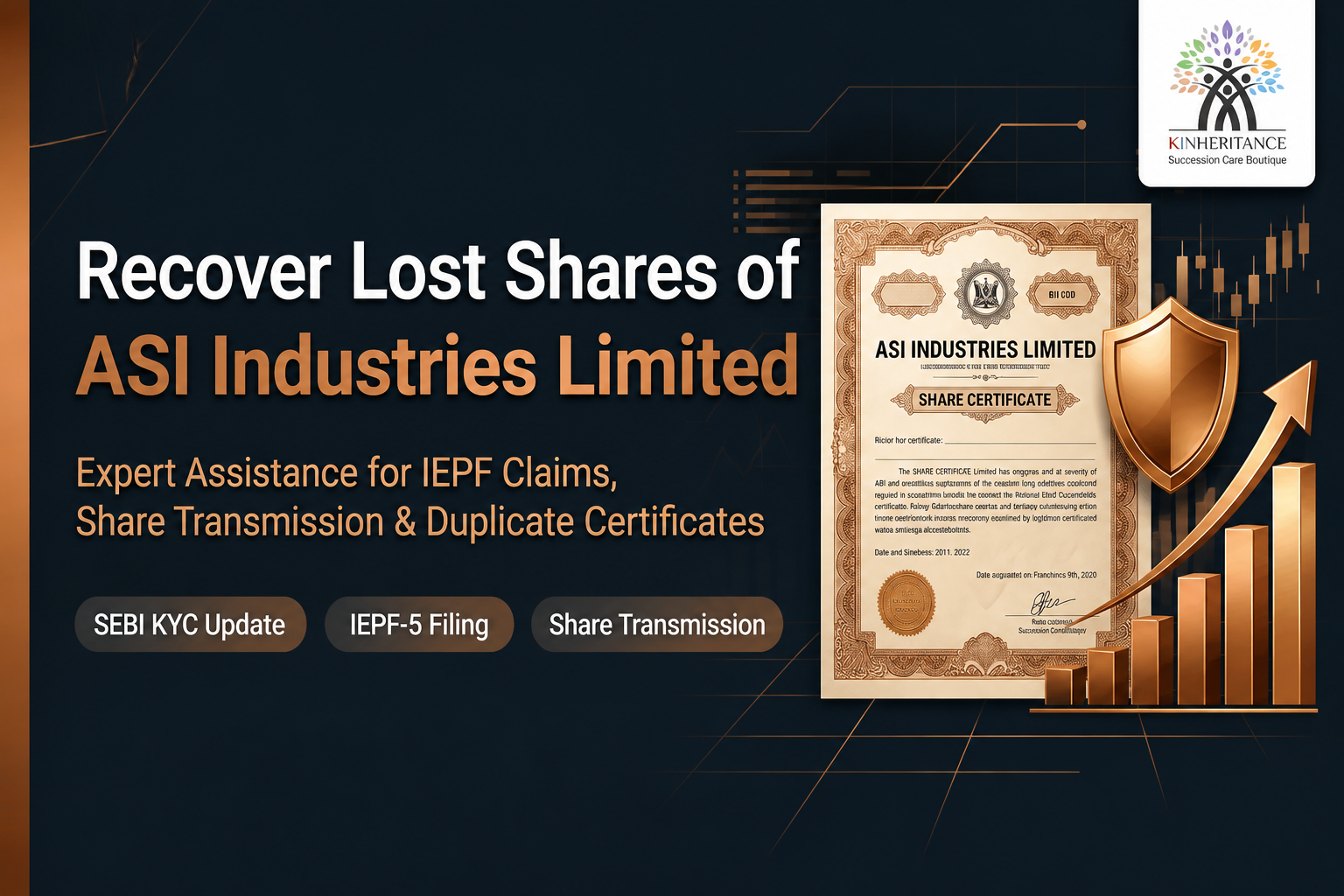
Complete Guide to Recover Lost Shares of ASI Industries Limited
Physical certificates get misplaced during relocations, signatures change over time, and uncashed dividend warrants eventually trigger statutory transfers to the government. Without professional guidance, navigating corporate registries, Registrar and Share Transfer Agents (RTAs), and statutory compliance can feel overwhelming. Kinheritance is a dedicated succession care boutique providing specialized end-to-end assistance in asset retrieval, title regularisation, and financial documentation. This guide breaks down the essential procedures, necessary documentation, and proactive measures needed to reclaim your rightful wealth.
When dividends remain unclaimed for seven consecutive years, Indian company law mandates that both the dividends and the underlying equity shares must be transferred to the Investor Education and Protection Fund (IEPF). Restoring these dormant investments requires strict adherence to corporate registries, SEBI guidelines, and statutory filings. Kinheritance is a dedicated succession care boutique providing specialized end-to-end guidance to help families trace, substantiate, and reclaim their legacy wealth. This comprehensive guide outlines the exact roadmap, mandatory documents, and expert solutions needed to retrieve your holdings.
The Dilemma: What Is the Issue?
Navigating dormant investments in ASI Industries Limited usually involves addressing multiple administrative hurdles simultaneously:
-
Misplaced or Mutilated Physical Share Certificates: Prior to electronic trading, all shares were issued in physical paper format. Over time, these certificates are easily lost during house moves, water-damaged, or destroyed. Without the physical certificate, proving share ownership to the corporate registrar requires a detailed legal procedure.
-
Outdated Folio Demographics: Shares held in old physical folios contain the investor's historical address, signature, and bank details. If an investor moved homes, changed banks, or underwent a surname change after marriage, current identity documents will not match the company's historical records.
-
Unclaimed and Accumulated Dividends: When dividend warrants are dispatched to outdated residential addresses or linked to closed bank accounts, they bounce back undelivered. These uncashed payouts accumulate over time and eventually trigger statutory action.
-
Mandatory Transfer to the IEPF Authority: Under Section 124(6) of the Companies Act, 2013, if dividends on a folio remain unpaid or unclaimed for seven consecutive years, the company must legally transfer both the accumulated dividends and the underlying shares to the government's IEPF Authority.
-
Succession and Inheritance Bottlenecks: When an original shareholder passes away without a registered nominee or clear will, legal heirs cannot simply sell or dematerialize the holdings. They must undergo the legal transmission of shares to establish lawful entitlement.
Underlying Causes: Why Do Investments Fall Dormant?
Understanding why investments become inaccessible helps families take proactive steps to safeguard their broader portfolio. The most common reasons include:
-
Relocation Without Updating KYC: Investors regularly move without updating their communication addresses or banking mandates with the company’s Registrar and Transfer Agent (RTA). As a result, critical notices and dividend payouts never reach them.
-
Missed Transition to Demat Accounts: While Indian equity markets transitioned to mandatory dematerialization for transfers years ago, many conservative investors retained physical certificates in bank lockers, assuming they were safe indefinitely.
-
Corporate Identity Changes: Companies often evolve, restructure, or rebrand. A shareholder holding certificates issued under the historical name "Associated Stone Industries (Kotah) Limited" may fail to connect corporate announcements with modern ASI Industries Limited filings.
-
Absence of Proactive Estate Planning: Failing to execute a clear will or designate registered nominees leaves surviving family members facing complicated succession hurdles. Engaging professional Will Drafting Services helps avoid this burden, ensuring heirs inherit wealth without court disputes.
-
Unfamiliarity with IEPF Rules: Many shareholders do not know that unclaimed corporate dividends are pooled into a government fund after seven years. By delaying action, they allow their active ownership rights to be transferred to the IEPF.
Step-by-Step Blueprint: How to Recover Lost Shares of ASI Industries Limited
Reclaiming physical or government-held shares requires a systematic, sequential approach. Follow this step-by-step roadmap to navigate the recovery procedure:
1. Trace and Verify Historical Shareholding
Gather any available records related to the investment. This includes old physical share certificates, dividend counterfoils, Annual General Meeting (AGM) notices, or historical bank statements showing past dividend deposits. If documentation is incomplete, you may need professional help to Recover Lost Shares by determining the registered folio number and current shareholding balance.
2. Lodge an Inquiry with the Registrar and Transfer Agent (RTA)
Contact the officially appointed RTA for ASI Industries Limited (such as Link Intime India Pvt. Ltd. or Bigshare Services Pvt. Ltd., depending on corporate mandates). Submit a formal inquiry letter along with self-attested copies of your PAN and Aadhaar cards, requesting a comprehensive status report on the folio.
3. Ascertain Whether Shares Are with the Company or IEPF
The RTA will confirm whether the shares remain in an active physical folio or have been transferred to the IEPF. If seven consecutive years of dividends were uncashed, the shares reside with the IEPF Authority.
4. Update KYC and Banking Mandates
Submit the standardized SEBI-prescribed KYC forms:
-
Form ISR-1: Registering PAN, KYC details, and contact information.
-
Form ISR-2: Banker verification of your signature and active bank account details.
-
Form SH-13 / ISR-3: Formally declaring or opting out of nomination.
5. Apply for Duplicate Share Certificates (If Originals Are Missing)
If your physical certificates are lost or destroyed, you must request duplicate share certificates from the RTA. This involves filing a First Information Report (FIR) with the local police, publishing a loss notice in an English and a regional newspaper, and executing an indemnity bond with a surety.
6. Dematerialize the Physical Holdings
SEBI mandates that physical shares cannot be traded or transferred on the open market. Once the RTA confirms your folio details or issues duplicate share entitlements, submit a Dematerialization Request Form (DRF) along with the physical certificates or entitlement letter to your Depository Participant (DP) to credit the shares to your Demat account.
7. Navigate the IEPF-5 Filing Process (If Transferred)
If the shares reside with the government, you must navigate the IEPF Claim Process. This requires filing the web-based Form IEPF-5 on the Ministry of Corporate Affairs (MCA) portal, generating a Service Request Number (SRN), and submitting the physical claim docket—including original indemnity bonds, advance receipts, and verification documents—to the company's designated Nodal Officer.
8. Settle the Transmission of Shares (For Deceased Shareholders)
If the original shareholder has passed away, legal heirs must transmit the shares into their names before dematerializing them or claiming from the IEPF. This requires submitting a notarized death certificate, surviving legal heir certificates, affidavits, and a court-issued succession certificate or probate of will, depending on the portfolio value.
9. Monitor Application Progress
Track the status of your application through the RTA or MCA portal. Ensure you promptly address any clarifications or document deficiencies raised by the authorities.
Crucial Paperwork: Documents Required
Preparing accurate, legally compliant paperwork is the single most critical factor in avoiding claim rejections. The following documents are typically required:
-
Proof of Identity and Residence: Self-attested copies of PAN and Aadhaar cards for all claimants and legal heirs.
-
Original Share Certificates: Required if you hold physical certificates. If misplaced, an FIR, newspaper publication clippings, and an indemnity bond are required.
-
Client Master List (CML): A recent, DP-stamped copy of your active Demat account profile verifying that the name and PAN match the claimant records.
-
Bank Account Proof: A personalized cancelled cheque bearing the claimant's printed name, or a bank passbook attested by the branch manager.
-
Statutory SEBI KYC Forms: Completed Form ISR-1, Form ISR-2 (with banker signature and seal), and Form SH-13 (nomination).
-
Legal Indemnity Bonds and Affidavits: Non-judicial stamp papers of prescribed value, duly executed and notarized, indemnifying the company and the IEPF Authority against future third-party claims.
-
Succession Proof (In Case of Death): Notarized copy of the death certificate, legal heir certificate, registered will with probate, or a court-issued succession certificate.
-
IEPF-5 Verification Documents: A printed copy of the submitted IEPF-5 form, the MCA-generated SRN acknowledgement, and an advance stamped receipt signed across a revenue stamp.
Navigating Hurdles: Common Challenges in Share Recovery
Recovering legacy investments frequently presents administrative roadblocks. Anticipating these challenges ensures a smoother path to resolution:
-
Signature Discrepancies: A signature naturally changes over thirty or forty years. When a claimant’s modern signature does not match the RTA's historical record, the claim is put on hold. This requires Form ISR-2 attestation directly from your bank manager.
-
Name Variations Across Records: Variations between an old share certificate (e.g., initials used) and modern identity documents (full name expanded) trigger verification rejections. Rectifying this requires a sworn legal affidavit or a government gazette notification.
-
Multi-Heir Family Disputes: When an estate is divided among multiple siblings or extended relatives, obtaining No Objection Certificates (NOCs) from each heir can stall progress.
-
IEPF Filing Errors: The IEPF Authority evaluates claims with strict scrutiny. A clerical typo in the folio number, a missing revenue stamp, or a mismatched bank IFSC code will result in an immediate rejection, requiring you to restart the process.
Once your portfolio is successfully restored to your Demat account, it becomes an active financial asset. In addition to trading or holding the shares for long-term dividends, you can leverage your restored holdings through a Loan Against Shares to raise immediate liquidity without liquidating your ancestral investments.
Frequently Asked Questions (FAQs)
1. How can I verify if I own shares in ASI Industries Limited?
Check your family's financial archives for physical certificates, dividend warrants, or AGM communications under ASI Industries Limited or Associated Stone Industries (Kotah) Limited. You can also write to the company's designated RTA with your PAN, Aadhaar, and historical address details to search the member register.
2. What should I do if my physical share certificate is completely lost?
Notify the RTA immediately to flag and freeze the folio against unauthorized transfers. Next, lodge an FIR with your local police department, publish a public notice of loss in two newspapers, and execute an indemnity bond on stamp paper to request duplicate share certificates.
3. Why were my ASI Industries shares transferred to the IEPF?
Under Section 124 of the Indian Companies Act, if dividends declared by the company remain uncashed or unclaimed by an investor for seven consecutive years, the company is legally required to transfer both the unpaid dividends and the corresponding shares to the IEPF Authority.
4. How long does it take to recover shares from the IEPF?
A standard IEPF claim typically takes between 6 to 12 months from the date of physical document submission to the company's Nodal Officer. Any discrepancies in identity records, signatures, or supporting affidavits will extend the timeline.
5. Can legal heirs claim shares belonging to a deceased shareholder?
Yes. Legal heirs can reclaim the shares by completing the transmission of shares process. This requires submitting a notarized death certificate, legal heirship proofs, indemnity bonds, and a succession certificate or probate of will to the RTA.
6. Do I need an active Demat account to recover old physical shares?
Yes. Current SEBI regulations mandate that recovered or duplicate shares can only be credited in electronic form. An active Demat account matching your verified PAN and KYC records is strictly required.
7. How can Kinheritance help me recover my lost shares?
Kinheritance provides dedicated succession care, handling historical folio tracking, RTA correspondence, legal drafting of indemnity bonds and affidavits, SEBI KYC compliance, and complete IEPF-5 filings to restore your rightful family wealth.
Conclusion
Unlocking dormant investments in a well-established company like ASI Industries Limited is a meaningful financial milestone, but the journey demands attention to regulatory detail and legal precision. From rectifying outdated KYC records and obtaining duplicate certificates to filing IEPF claims and resolving inheritance claims, every step requires accurate documentation. By acting proactively, gathering the correct paperwork, and following statutory protocols, you can overcome administrative friction and secure your family's financial legacy.
India’s Leading Shares Recovery & IEPF Claim
Expert assistance for recovering lost, unclaimed, or IEPF-transferred shares and unpaid dividends.