Demystifying Dematerialisation: Your Ultimate Guide to Converting Physical Shares to Electronic Form
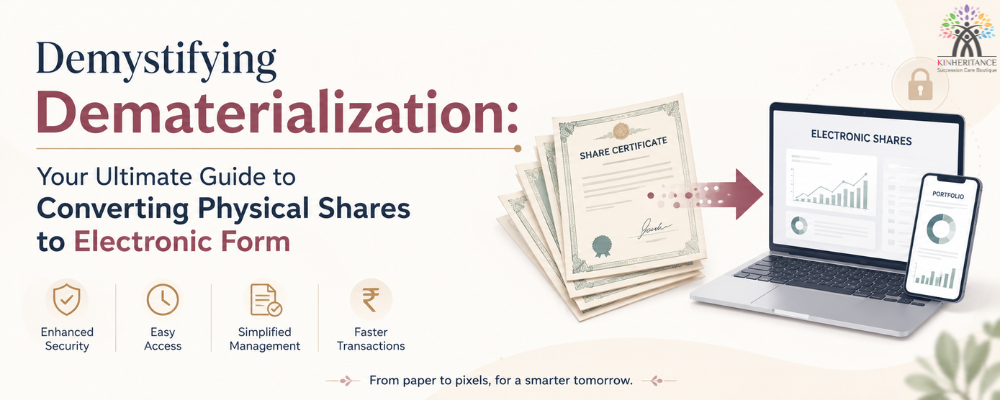
Demystifying Dematerialisation: Your Ultimate Guide to Converting Physical Shares to Electronic Form
Have you ever discovered old share certificates tucked away in a family locker, filing cabinet, or safe deposit vault? Perhaps they belong to your parents, grandparents, or even yourself. What may appear to be old pieces of paper could actually represent valuable investments built over decades. In many cases, these shares have appreciated significantly over time and may continue to offer financial benefits through dividends, bonus shares, and capital appreciation. However, the way investors hold and manage shares has changed dramatically over the years. The Indian securities market has moved from paper-based ownership to a fully electronic system, making investing safer, faster, and far more convenient. Today, physical share certificates are considered outdated, and most transactions require shares to be held in a Demat account. Dematerialization is the process that bridges the gap between old physical share certificates and modern electronic ownership. It helps investors convert paper certificates into digital holdings while reducing risk and improving accessibility. Many investors who still possess physical certificates often face additional challenges such as lost documents, inherited shares, ownership discrepancies, outdated records, or unclaimed investments. Understanding the dematerialization process can help address these issues and unlock the true value of long-forgotten assets. This guide explains what dematerialization is, why it is important, how the process works, common challenges investors face, and the steps required to successfully convert physical shares into electronic form.
What Is Dematerialization?
Dematerialization refers to the conversion of physical share certificates into electronic securities held in a Demat account.
Traditionally, ownership of shares was represented through paper certificates issued by companies. These certificates served as proof of ownership and were required whenever an investor wanted to transfer or sell shares. Managing these physical documents involved considerable paperwork and administrative effort. With dematerialization, paper certificates are replaced by electronic records maintained by authorized depositories. The investor continues to own the shares, but ownership is reflected digitally instead of through physical documentation.
In India, the electronic holding of securities is managed through two regulated depositories:
- National Securities Depository Limited (NSDL)
- Central Depository Services (India) Limited (CDSL)
These institutions maintain secure electronic records of securities and facilitate transactions between investors, brokers, registrars, and companies.
Just as banking has evolved from passbooks and physical cash to online transactions and mobile banking, the securities market has evolved from physical certificates to digital ownership.
Why Was Dematerialization Introduced?
Before the introduction of the Demat system, investors experienced numerous difficulties in managing and transferring physical securities. Physical certificates were vulnerable to loss, theft, damage, and destruction. Investors often spent years safeguarding important certificates in cupboards, lockers, or bank vaults. If a certificate was misplaced or damaged, replacing it could become a lengthy and complicated process. Transfers of ownership were equally cumbersome. Whenever shares changed hands, forms had to be completed, signatures verified, and documents physically submitted for processing. Even minor discrepancies could result in rejections or delays. Another common issue involved signature mismatches. Since investors often purchased shares decades earlier, signatures maintained in company records sometimes differed from current signatures, leading to verification difficulties. Fraud and forgery also presented significant risks. Physical certificates could potentially be duplicated, altered, or misused, creating security concerns for both investors and companies. To eliminate these problems and improve market efficiency, regulators introduced an electronic framework that offered safer and more reliable management of securities.
Understanding a Demat Account
A Demat account functions much like a bank account, except it stores securities instead of money. When shares are dematerialized, they are credited to the investor's Demat account and can be viewed electronically through an online platform. Investors can monitor holdings, track transactions, review portfolio values, and receive corporate benefits without dealing with physical paperwork.
A Demat account can hold various financial instruments, including equity shares, mutual funds, bonds, debentures, exchange-traded funds (ETFs), government securities, and other eligible investments. Having a Demat account simplifies portfolio management by providing a centralized location for monitoring investments.
Benefits of Dematerialization
The shift from physical certificates to electronic holdings offers several significant advantages.
Enhanced Security
One of the biggest benefits of dematerialization is the elimination of risks associated with physical documents. Electronic securities cannot be stolen, misplaced, torn, damaged, or destroyed by accidents such as floods or fires. Investors gain greater peace of mind knowing their assets are securely recorded within a regulated depository system.
Easier Portfolio Management
Managing investments becomes considerably simpler when all holdings are available electronically. Investors can access account statements, monitor portfolio performance, and review transaction history through a single platform.
Faster Transactions
Electronic transfers are significantly faster than paper-based procedures. Buying, selling, or transferring shares can be completed with far fewer administrative steps, reducing delays and improving efficiency.
Automatic Corporate Benefits
When shares are held electronically, dividends, bonus shares, stock splits, and rights entitlements are automatically credited to the investor's account. This reduces the likelihood of missing important benefits due to outdated addresses or communication issues.
Improved Liquidity
Dematerialized shares can generally be sold and transferred much more easily than physical certificates. Investors gain quicker access to market opportunities and can react more efficiently to changing financial circumstances.
Reduced Administrative Burden
Investors no longer need to maintain extensive files of share certificates or worry about preserving important documents. Electronic record-keeping simplifies compliance and reduces paperwork.
Who Should Consider Dematerialization?
Dematerialization is important for virtually anyone holding physical share certificates. Many senior citizens purchased shares decades ago when paper certificates were standard practice. Some families inherit investments from parents or grandparents without fully understanding how to access or manage those holdings. In other cases, investors may find old certificates while reviewing family records and discover that the underlying securities remain valid and valuable. Legal heirs inheriting shares often need to complete ownership transfers before the securities can be converted into electronic form. Non-resident Indians who maintain legacy investments in India also benefit from digitizing their holdings for easier management. Regardless of the investor's profile, dematerialization provides greater accessibility, transparency, and security.
Can Physical Shares Still Be Sold?
Regulatory changes have significantly limited transactions involving physical share certificates.
In most situations, investors must first convert physical holdings into electronic form before they can sell or transfer them. As a result, dematerialization is no longer merely a convenience but an essential requirement for many investors seeking to manage or liquidate their holdings. For individuals who continue to hold paper certificates, converting them into electronic form is often the first step toward accessing the value of those investments.
Documents Required for Dematerialization
The specific requirements may vary depending on the Depository Participant (DP), but investors generally need:
- Original share certificates
- PAN card
- Aadhaar card or other identity proof
- Address proof
- Bank account details
- Demat account information
In cases involving joint holdings, documents from all holders may be required.
For inherited shares, additional documentation such as death certificates, succession certificates, probate orders, legal heir certificates, or indemnity documents may also be necessary depending on the circumstances.
Preparing complete and accurate documentation before starting the process can significantly reduce delays.
Step-by-Step Process of Dematerialization
The dematerialization process is straightforward when all records and documents are in order. The first step involves opening a Demat account with a registered Depository Participant. Banks, stockbrokers, and financial institutions commonly offer Demat account services. Once the account is operational, the investor must complete a Dematerialization Request Form (DRF). This form captures details relating to the company, certificate numbers, folio numbers, and quantity of shares being submitted for conversion. The original share certificates must then be submitted along with the completed request form. Most Depository Participants require investors to write "Surrendered for Dematerialization" across each certificate before submission. After receiving the documents, the DP verifies the information and forwards the request to the relevant Registrar and Transfer Agent (RTA). The RTA reviews ownership records, validates certificate authenticity, and confirms the details against company records.
Once verification is successfully completed, the physical certificates are cancelled and equivalent shares are electronically credited to the investor's Demat account.
The investor can then access and manage the shares digitally.
Common Challenges During Dematerialisation
Although the process is generally straightforward, many investors encounter complications due to old records, missing documents, or discrepancies in ownership details.One common issue involves name mismatches. An investor's name on old share certificates may differ from current identity documents due to changes in spelling, use of initials, marriage-related name changes, or clerical errors.Signature mismatches also pose challenges. Since some shares may have been purchased decades ago, signatures available in company records may no longer resemble current signatures.Another issue arises when inherited shares have not undergone proper transmission. Before dematerialisation can occur, ownership must first be legally transferred to the rightful heir.Missing documentation, incomplete forms, and damaged certificates can also delay processing.
Resolving Name Mismatch Issues
Name mismatches are among the most frequent reasons for rejection or delay.For example, a share certificate may contain a name such as "R. Kumar," while current PAN records show "Rajesh Kumar." Although both names belong to the same individual, discrepancies often require formal clarification.Investors may need to submit supporting documents such as affidavits, identity proofs, marriage certificates, gazette notifications, or other records that establish continuity of identity.Addressing these discrepancies before initiating dematerialisation can significantly improve processing timelines.
Special Situations Requiring Additional Attention
Some dematerialisation requests involve circumstances that require additional verification and legal documentation.When shares belong to a deceased shareholder, legal heirs must first establish ownership rights through transmission procedures. Depending on the value of the investment and family circumstances, this may involve succession certificates, probate of wills, indemnity documents, or legal heir certificates.Lost share certificates present another challenge. Before dematerialisation can proceed, investors may need to obtain duplicate certificates through the issuing company. This process often includes identity verification, indemnity bonds, public notices, and additional documentation.Unclaimed shares transferred to the Investor Education and Protection Fund (IEPF) may also require recovery before electronic conversion can take place.These situations often benefit from professional guidance due to their legal and procedural complexities.
Importance of Updated KYC Records
Maintaining updated Know Your Customer (KYC) records is critical for successful dematerialisation.Investors should verify that their PAN details, bank account information, mobile number, email address, and residential address are current before initiating the process.Accurate KYC information helps reduce the risk of rejection, improves ownership verification, and enables faster processing. It also ensures that future communications and corporate benefits are delivered correctly.
How Long Does Dematerialisation Take?
The timeline for dematerialisation depends on several factors, including document accuracy, verification requirements, company records, and the complexity of the case.Straightforward cases involving properly documented shares often progress relatively quickly. However, cases involving inheritance, ownership disputes, transmission requests, missing certificates, or name corrections may require additional verification and therefore take longer.Investors should ensure that all supporting documentation is complete to avoid unnecessary delays.
Costs Associated with Dematerialisation
The cost of dematerialisation varies among Depository Participants.Potential expenses may include account opening charges, annual maintenance fees, processing charges, and documentation-related costs. Investors should compare different service providers and understand applicable fees before opening a Demat account.While there may be certain administrative costs involved, the long-term benefits of electronic ownership often outweigh these expenses.
Tips for a Smooth Dematerialisation Process
A few simple precautions can improve the likelihood of successful and timely processing:
- Organize all documents before starting the application.
- Verify certificate details carefully.
- Ensure KYC records are updated.
- Respond promptly to any requests for clarification.
- Keep copies of all submitted documents.
- Seek professional guidance for inheritance or recovery-related cases.
Proactive preparation helps avoid delays and simplifies the overall experience.
The Future of Share Ownership
Financial markets continue moving toward increased digitalisation. Today's investors expect instant access to information, real-time portfolio monitoring, faster settlements, and enhanced security.Dematerialisation aligns perfectly with these expectations by providing a modern framework for ownership and investment management.Paperless transactions have become the norm across banking, payments, and financial services. Securities ownership is no exception. Electronic holdings offer greater efficiency, transparency, and convenience than traditional paper certificates ever could.As technology continues to evolve, digital ownership will remain the foundation of modern investing.
Conclusion
Dematerialisation is a crucial step for anyone holding physical share certificates. By converting paper-based holdings into electronic form, investors gain greater security, accessibility, liquidity, and control over their investments.Whether you are an investor managing long-forgotten certificates, a senior citizen holding legacy investments, or a legal heir seeking to recover family assets, share transmission dematerialisation can help unlock the value of those holdings while ensuring compliance with today's securities framework.Rather than allowing valuable investments to remain dormant in physical form, taking action now can simplify portfolio management, reduce administrative challenges, and safeguard wealth for future generations.In an increasingly digital financial world, dematerialisation is more than a procedural requirement. It is a practical step toward preserving, accessing, and maximizing the value of investments that may have been built over a lifetime
India’s Leading Shares Recovery & IEPF Claim
Expert assistance for recovering lost, unclaimed, or IEPF-transferred shares and unpaid dividends.