Reclaim Your Wealth: How to Recover Lost Shares of 3M India Ltd
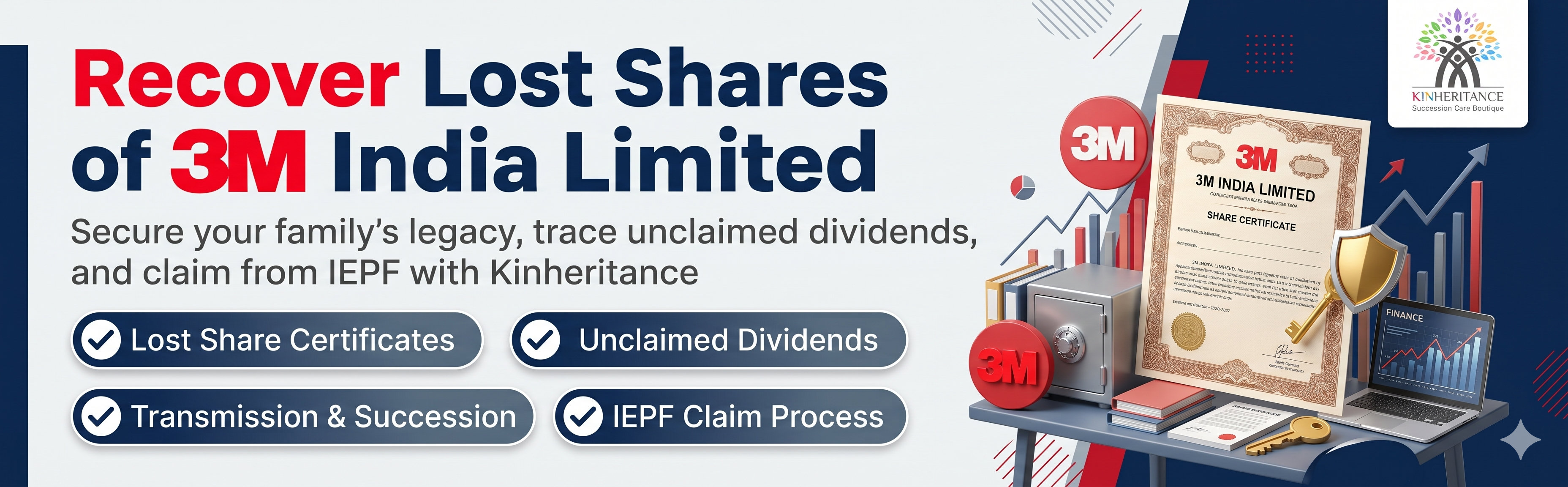
Reclaim Your Wealth: How to Recover Lost Shares of 3M India Ltd
Discovering an old, forgotten investment can be a life-changing financial event, especially when it involves a blue-chip multinational company with a massive footprint. For many Indian families, stumbling upon old physical stock certificates or realizing that dividends have suddenly stopped arriving is a common scenario. However, navigating the bureaucratic maze to recover lost shares of 3M India Ltd. can quickly turn excitement into frustration.
When share certificates are misplaced, holding details remain outdated, or dividends go uncashed for years, these assets are often frozen or transferred to government funds. Unlocking them requires precise legal documentation and strict regulatory compliance. Kinheritance is a premier succession care boutique dedicated to helping retail investors and legal heirs untangle these complex financial histories. In this comprehensive guide, we will explore the exact procedures, necessary documents, and expert strategies required to successfully reclaim your rightful investments and secure your family's financial legacy.
The Dilemma: Why 3M India Shares Become Unreachable
Before diving into the recovery process, it is essential to understand the specific hurdles shareholders face. Investors and legal heirs dealing with legacy investments in 3M India Ltd. typically encounter a combination of the following issues:
-
Lost or Damaged Physical Certificates: Paper certificates issued decades ago are highly susceptible to damage from pests, moisture, or simply being misplaced during household relocations. Without the original document, proving ownership requires a rigorous legal protocol.
-
Outdated Shareholder Details: Shares held in old physical folios often contain outdated personal details. If a shareholder's name has changed (post-marriage), or their signature has evolved over the years, the company’s current records will reject modern identity documents during verification.
-
Unclaimed Dividend Accumulation: When dividend warrants are mailed to old addresses or linked to dormant bank accounts, they return undelivered. These uncashed dividends pile up and eventually trigger regulatory actions.
-
Transfer to the IEPF Authority: Under the Companies Act, if dividends remain unclaimed for seven consecutive years, the company is legally mandated to transfer both the unpaid dividend amounts and the corresponding shares to the Investor Education and Protection Fund (IEPF). Once this happens, the investor loses direct access to their holdings.
-
Inheritance and Succession Ambiguities: When a shareholder passes away without a registered nominee, surviving family members face immense difficulties claiming the assets. Establishing legal heirship requires complex court documents and lengthy verification processes.
Root Causes: How Do Investments Turn Dormant?
Understanding the root causes of dormant shares helps investors take corrective action and prevents future generations from facing similar roadblocks. Most share recovery cases stem from a few common life events and regulatory shifts:
-
Relocation Without Updation: When investors move to a new city or change their primary bank account, they often forget to update their Know Your Customer (KYC) details with the company. Consequently, vital communications and dividend payouts are lost.
-
Lack of Dematerialization: For decades, shares were held exclusively in paper format. Many senior investors missed the transition to mandatory electronic (demat) holdings, leaving their physical shares vulnerable to becoming dormant.
-
Inadequate Succession Planning: The most complex recovery cases arise when individuals pass away without organizing their estate. Failing to utilize professional Will Drafting Services or establish clear nominees leaves families burdened with proving succession through probate or succession certificates, which can take years.
-
Regulatory Blind Spots: Many retail investors are completely unaware of the seven-year IEPF transfer rule. They assume their physical shares are safe in a locker indefinitely, only to realize later that their assets have been moved to a government pool.
The Blueprint: Step-by-Step Recovery of 3M India Shares
Reclaiming your financial assets requires a systematic approach. Here is the step-by-step procedure to guide you through retrieving your shares and unpaid dividends.
1. Trace and Verify the Shareholding The first step is to establish a clear picture of your holdings. Gather any available evidence, such as old dividend counterfoils, AGM notices, or physical certificates. If you only have partial information, you may need to engage professional help to Recover Lost Shares by tracing the exact folio numbers and current status of the investment.
2. Communicate with the Registrar and Transfer Agent (RTA) 3M India Ltd. manages its shareholder records through an officially appointed RTA. You must draft a formal inquiry letter, attach your self-attested PAN and Aadhaar, and request a status report on your folio. The RTA will confirm whether the shares are active, require KYC updation, or have been moved to the IEPF.
3. Address Lost or Missing Share Certificates If the RTA confirms your holdings but you cannot locate the physical certificates, you must apply for duplicate shares. This involves filing a First Information Report (FIR) with the local police, publishing a loss-of-shares notice in an English and a vernacular newspaper, and submitting an executed indemnity bond to the RTA.
4. Execute the Dematerialization Process SEBI regulations mandate that physical shares must be converted into electronic format for any trading or transfer to occur. Once your physical or duplicate certificates are validated, you must submit a Dematerialization Request Form (DRF) along with the certificates to your Depository Participant (DP).
5. Process the IEPF Claim (If Applicable) If your shares and dividends have been transferred to the government due to the seven-year dormancy rule, you must navigate the IEPF claim process. This involves filing the IEPF-5 web form on the MCA portal, generating an SRN, and sending the complete physical docket (including indemnity bonds and original certificates) to the Nodal Officer of 3M India Ltd. for thorough verification.
6. Complete the Transmission of Shares In cases where the original shareholder is deceased, legal heirs must first transmit the shares into their names. This requires submitting a notarized death certificate, surviving family member affidavits, and appropriate succession documents to the RTA before initiating dematerialization or an IEPF claim.
Vital Paperwork: Documents Required for Verification
A successful recovery application relies entirely on accurate, error-free documentation. While exact requirements vary based on the specifics of the case, the following documents are universally required:
-
Primary Identity and Address Proof: Self-attested copies of your PAN card and Aadhaar card or Passport.
-
Proof of Share Ownership: Original physical share certificates, old dividend warrants, or official folio allocation letters.
-
Active Demat Account Proof: A recently stamped and signed Client Master List (CML) from your broker, proving you have a demat account ready to receive the electronic shares.
-
Banking Details: A personalized cancelled cheque or attested bank statement to ensure unpaid dividends are credited to the correct account.
-
Mandatory KYC Forms: Forms like ISR-1 (for registering PAN and KYC details), ISR-2 (for signature verification by a bank manager), and SH-13 (for nomination).
-
Legal Affidavits and Bonds: Non-judicial stamp paper documents, including indemnity bonds and surety forms, which protect the company from future disputes.
-
Police Reports: An FIR explicitly stating the loss of the specific share certificates (required for duplicate issuance).
-
Succession Proofs (For Deceased Shareholders): A notarized death certificate alongside a registered Will, Probate, Letters of Administration, or a Court-issued Succession Certificate.
-
IEPF-Specific Documents: The printed IEPF-5 form, SRN acknowledgement receipt, and advance stamped receipts.
Navigating the Roadblocks in Asset Retrieval
Even with a clear guide, investors frequently encounter administrative roadblocks that can stall the process indefinitely. Understanding these challenges can help you prepare a flawless application.
Signature and Name Mismatches Over decades, signatures change naturally, and names may be altered due to marriage or spelling corrections. RTAs are exceptionally strict about these discrepancies. A signature mismatch will require an official attestation from your bank manager, while name discrepancies often require a gazette notification or a sworn affidavit.
Complex Multiple Heir Scenarios When an estate is divided among multiple siblings or relatives, acquiring No Objection Certificates (NOCs) from everyone involved can be emotionally taxing and legally slow. One missing signature can halt the entire transmission process.
Stringent IEPF Rejections The IEPF Authority has zero tolerance for clerical errors. A missing revenue stamp, a slight typo in the IEPF-5 form, or a mismatch in the demat account details will result in an immediate rejection, forcing you to restart the months-long process.
Once these hurdles are cleared and the shares are safely in your demat account, the financial flexibility is immense. Beyond simply selling them, you can utilize the restored portfolio to secure a Loan Against Shares, gaining immediate liquidity while keeping your legacy investments intact.
Frequently Asked Questions (FAQs)
1. How can I verify if I own old shares of 3M India Ltd.? You can verify your ownership by checking old financial records for dividend warrants, physical certificates, or folio numbers. If you have partial details, you can contact the company's designated RTA with your PAN and KYC documents to request a status check on your holdings.
2. What is the procedure if my 3M India Ltd. share certificates are lost? If your original certificates are lost, you must formally notify the RTA to freeze the account. Subsequently, you need to file a police FIR, publish a public notice in two newspapers, and submit indemnity bonds to the RTA to request the issuance of duplicate share certificates.
3. Why would my 3M India shares be transferred to the IEPF? According to Indian corporate laws, if an investor fails to claim their dividends for seven consecutive years, the company must legally transfer both the accumulated dividends and the corresponding equity shares to the Investor Education and Protection Fund (IEPF).
4. How long does the IEPF claim process typically take? If the documentation is flawless, the IEPF claim process usually takes between 6 to 12 months. However, if there are discrepancies in signatures, KYC details, or missing documents, the timeline can easily extend beyond a year due to required rectifications.
5. Can I claim shares if the original shareholder has passed away? Yes, legal heirs can claim the shares. However, they must first complete the "transmission of shares" procedure. This involves submitting the deceased's death certificate along with a succession certificate, probate, or registered will to the RTA to transfer ownership to the surviving heirs.
6. Do I need a Demat account to recover physical shares? Yes, holding a valid Demat account is absolutely mandatory. Whether you are dematerializing physical certificates or claiming shares back from the IEPF Authority, the recovered shares will only be credited in electronic format to an active Demat account.
7. Where can I find more resources on recovering dormant assets? For detailed insights, regulatory updates, and expert strategies on wealth recovery and succession planning, you can explore our extensive library of IEPF claim process guides and share recovery articles.
Conclusion
Unearthing old investments in a robust company like 3M India Ltd. is a tremendous financial advantage, but the journey to reclaim those assets is paved with strict compliance, legal drafting, and endless follow-ups. From identifying lost folios to navigating the stringent demands of RTAs and the IEPF Authority, every step requires precision. By organizing your documentation, updating your KYC, and understanding the regulatory landscape, you can effectively protect and restore your family's hard-earned wealth.
India’s Leading Shares Recovery & IEPF Claim
Expert assistance for recovering lost, unclaimed, or IEPF-transferred shares and unpaid dividends.