Recover JSW Steel Ltd Shares from IEPF by Kinheritance
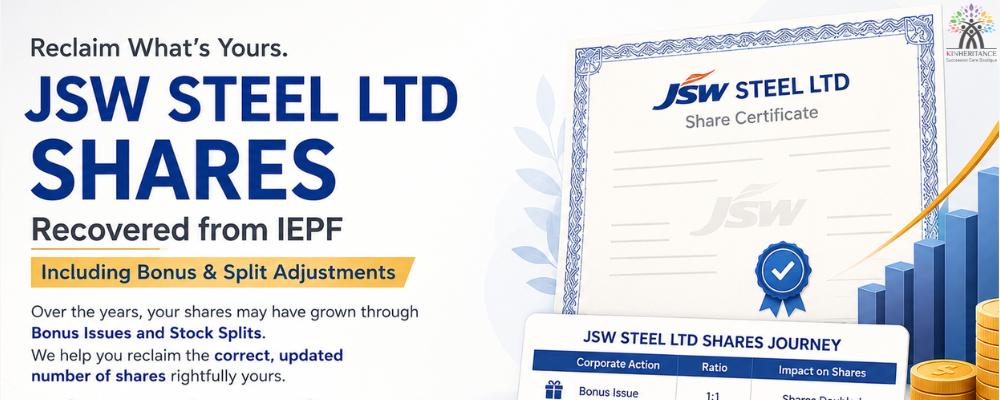
Recover JSW Steel Ltd Shares from IEPF by Kinheritance
Many Indian families invested in strong companies during the 1990s and early 2000s with the intention of creating long-term wealth. Among these trusted investments was JSW Steel Ltd, one of India's leading steel manufacturers. Over time, however, numerous investors lost track of their shareholdings because of relocation, outdated contact information, loss of physical share certificates, inactive demat accounts, or the unfortunate demise of the original shareholder.
As a result, many JSW Steel shares and their associated dividends were eventually transferred to the Investor Education and Protection Fund (IEPF) after remaining unclaimed for several years. Fortunately, transfer to the IEPF does not mean the investment is lost forever. The rightful shareholder, nominee, or legal heir continues to retain ownership rights and can claim the shares by following the prescribed procedure. Investors can refer to the official IEPF Rules and Notifications published by the Government of India and the latest SEBI transmission guidelines for understanding the legal framework governing the recovery and transmission of shares.
This guide explains everything investors need to know about recovering JSW Steel Ltd shares from IEPF, including the company's corporate history, reasons for transfer to IEPF, eligibility for recovery, legal heir claims, transmission of shares, recovery process, documentation requirements, and common challenges faced during the claim process.
About JSW Steel Limited
JSW Steel Ltd is the flagship steel company of the JSW Group and one of India's largest private-sector steel producers. The company plays a crucial role in infrastructure development, construction, engineering, automotive manufacturing, and industrial growth. Through continuous expansion, modernisation, and capacity enhancement, JSW Steel has established itself as one of the most recognised names in India's steel industry.
Over the years, JSW Steel has attracted long-term investors due to its strong market presence and growth potential. Many families accumulated these shares as part of retirement planning, wealth creation strategies, or inheritance assets intended for future generations. Unfortunately, due to changing circumstances, some of these investments became dormant and eventually found their way into the IEPF.
Historical Background of JSW Steel Shares
One of the most important aspects of old share recovery is understanding the corporate history of the company. Investors often possess share certificates bearing names different from the current company name, creating confusion regarding ownership and valuation.
Many investors originally held shares of Jindal Vijaynagar Steel Limited, which later became part of JSW Steel. Following corporate restructuring and merger activities, shareholders received JSW Steel shares in accordance with approved exchange ratios.
For example, shareholders holding 100 shares of Jindal Vijaynagar Steel received 4 shares of JSW Steel after the merger in 2005 based on the merger ratio of 25:1. Subsequently, JSW Steel implemented a 10:1 stock split in 2017, resulting in those 4 shares becoming 40 shares.
This demonstrates why historical investments should never be ignored. What may appear to be a small investment from decades ago could potentially represent significant value today after mergers, stock splits, and corporate actions.
Many families discover old certificates while sorting through family records, estate documents, lockers, or inherited financial files. Understanding the effect of these corporate actions is often the first step in establishing the current value of a dormant investment.
Why JSW Steel Shares Are Transferred to IEPF
The transfer of shares to the Investor Education and Protection Fund is governed by provisions of the Companies Act, 2013. If dividends declared on shares remain unclaimed for seven consecutive years, the associated shares become liable for transfer to the IEPF Authority.
This situation arises more frequently than many investors realise. A common example involves investors who moved to another city and failed to update their address with the company. Dividend warrants sent to the old address remained undelivered for several years. Since the dividends were never claimed, the shares eventually qualified for transfer to the IEPF. In other situations, shareholders held physical share certificates and simply forgot about the investment. Since there was no active monitoring of dividend payments, the shares remained inactive for years. The death of a shareholder is another frequent reason. Family members often remain unaware of investments held by parents or grandparents. By the time the investments are discovered, the shares may already have been transferred to the IEPF. Other common factors include outdated bank details, inactive demat accounts, unregistered nominations, PAN mismatches, incomplete KYC records, and failure to respond to company communications.
Are Shares Permanently Lost After Transfer to IEPF?
The answer is no.
Transfer to the Investor Education and Protection Fund does not extinguish ownership rights. The government acts as a custodian of these shares until the rightful owner comes forward and successfully establishes entitlement. The following individuals may be eligible to recover shares transferred to the IEPF:
-
Original shareholders
-
Registered nominees
-
Legal heirs
-
Beneficiaries under a valid will
-
Successors holding a succession certificate
-
Claimants authorised through probate or letters of administration
As long as the claimant can establish lawful ownership and complete the required documentation, recovery remains legally possible.
How to Check Whether Your JSW Steel Shares Are in IEPF
Before starting any recovery action, investors should first determine whether their shares have actually been transferred to the IEPF. The search typically begins with collecting all available records related to the investment. These may include physical share certificates, dividend warrants, old demat account statements, tax records, annual reports, bank statements showing dividend credits, or correspondence received from the company. Even where complete records are unavailable, partial information can often help trace a shareholding. Important information may include the shareholder's name, folio number, certificate number, distinctive numbers, PAN details, DP ID, client ID, or historical dividend information. Legal heirs should carefully review documents left behind by deceased family members. Old files, income tax records, insurance papers, investment diaries, and bank locker contents frequently contain valuable clues about forgotten investments. Many investors are surprised to discover that shares they believed were lost years ago can still be located through proper record tracing and verification.
Importance of KYC Compliance
One of the most overlooked aspects of share ownership is maintaining updated KYC information.
Many IEPF recovery cases encounter delays because the claimant's present records do not match historical company records. This may happen due to changes in signature, residential address, marital status, bank account details, or identity information.
Before filing a claim, investors should ensure that their PAN, Aadhaar, address proof, bank account information, specimen signature, and other KYC records are consistent and up to date.
Accurate KYC documentation helps prevent objections and significantly improves the efficiency of the verification process.
Step-by-Step Process for Recovering JSW Steel Shares from IEPF
- The recovery process involves multiple stages, each requiring careful attention to detail.
- The first step is confirming that the shares have been transferred to the Investor Education and Protection Fund. Once the transfer is confirmed, the claimant should gather all supporting documentation related to the investment.
- The next stage involves completing KYC formalities and ensuring that an active demat account is available to receive the recovered shares. Since recovered shares are generally credited electronically, maintaining an active demat account is essential.
- After assembling the necessary records, the claimant proceeds with the prescribed IEPF recovery process and submits the required documentation. Accuracy is critical because mistakes, omissions, or inconsistencies may lead to additional queries or delays.
- Once submitted, the company and its registrar and transfer agent review the claim and compare the information against historical shareholding records. They verify ownership, identity, KYC compliance, and supporting evidence.
- Following company verification, the matter is forwarded to the IEPF Authority for further scrutiny. The authority reviews the claim, validates eligibility, and examines the supporting documentation.
- Upon successful completion of all verification stages, the recovered shares are credited to the claimant's demat account. Any eligible unpaid dividends may also be released in accordance with applicable regulations.
Recovery by Legal Heirs
A significant percentage of IEPF recovery claims involve deceased shareholders. When a valid nominee has been registered, the recovery process is generally more straightforward because the nominee's rights are already recorded. However, when no nomination exists, legal heirs must establish entitlement through legally recognised documentation. Depending on the circumstances, heirs may need documents such as a death certificate, legal heir certificate, succession certificate, registered will, probate of will, letters of administration, family settlement agreement, relationship proof, or no-objection declarations from other family members. The complexity of the claim often depends on the number of heirs involved, the value of the securities, the existence of a will, and the completeness of historical records. Families should approach transmission matters carefully because transmission generally forms the foundation for successful IEPF recovery.
Common Problems Faced During Recovery
- Although the law permits recovery of shares from the IEPF, investors frequently encounter practical challenges. Lost physical share certificates remain one of the most common issues.
- Many certificates were misplaced during relocation, property transfers, or decades of document storage.
- Signature mismatches create another recurring challenge. Investors who originally signed documents many years ago may find that their current signatures differ significantly from historical records.
- Women investors may face name variations because of marriage-related changes. Similarly, spelling inconsistencies between PAN, Aadhaar, bank records, and shareholder records can result in additional scrutiny.
- Address changes, missing dividend history, incomplete KYC records, dormant demat accounts, and unavailable investment documents also contribute to delays.
- Legal heir cases present an additional layer of complexity where multiple family members must establish entitlement before recovery can proceed.
- Fortunately, most of these issues can be resolved through proper documentation and regulatory compliance.
Why Investors Should Review Old Investments
Many families underestimate the value of forgotten investments. Corporate actions such as stock splits, mergers, demergers, bonus issues, and dividend accumulations may substantially increase the value of old shareholdings over time. What appears today as an insignificant certificate stored in a family file may represent a meaningful financial asset. Regular review of historical investments can help families identify dormant shareholdings before important records become difficult to trace. This is particularly important during succession planning, estate administration, inheritance discussions, and retirement planning. Old share certificates should never be discarded without conducting proper verification.
Can NRIs Recover JSW Steel Shares?
Yes. Non-resident Indians are also entitled to recover shares transferred to the Investor Education and Protection Fund. NRI claimants may need additional documentation, depending on their country of residence and the requirements applicable to their individual situation. Passport copies, overseas address proof, foreign attestation procedures, and OCI documentation may be required in certain cases. Despite the additional formalities, NRIs retain the same ownership rights and can pursue recovery of eligible shares and dividends.
Conclusion
Thousands of investors across India may be holding forgotten JSW Steel investments without realising their present value. In many cases, these shares have already been transferred to the Investor Education and Protection Fund because dividends remained unclaimed for seven consecutive years. Fortunately, ownership rights do not disappear after transfer to IEPF. The original shareholder, nominee, or legal heir continues to retain the legal right to reclaim eligible shares and dividends by following the prescribed recovery process.
Whether the investment involves old physical share certificates, inherited securities, inactive demat holdings, or long-forgotten dividend records, identifying and verifying the shareholding is the first step toward recovery. Investors should gather available records, update KYC information, understand transmission requirements, and review the applicable regulations governing IEPF claims. For official guidance on recovery procedures and transmission requirements, investors may refer to the IEPF Rules and Notifications and the latest SEBI framework for transmission of securities. Taking timely action can help investors safeguard family wealth, recover rightful assets, and preserve their financial legacy for future generations.
Client Story: Neeraj Kumar, Uttar Pradesh
Mr Neeraj Kumar inherited 200 physical shares of JSW Steel Ltd from his family. For years, the shares remained inactive, and the associated dividends went unclaimed. Eventually, both the shares and dividends were transferred to the Investor Education and Protection Fund. While reviewing family financial records, he discovered the old share certificates and began investigating their status. After collecting historical documents, updating his records, completing the required formalities, and establishing his entitlement, the recovery process moved forward successfully. Following verification and regulatory approval, the shares were restored to his demat account, and the eligible dividends were credited to him. His experience serves as a reminder that long-forgotten investments often retain substantial value and that proactive review of family financial records can help prevent valuable assets from remaining unclaimed for years.
India’s Leading Shares Recovery & IEPF Claim
Expert assistance for recovering lost, unclaimed, or IEPF-transferred shares and unpaid dividends.