Issue of Duplicate Share Certificates | A Complete Guide for Investors
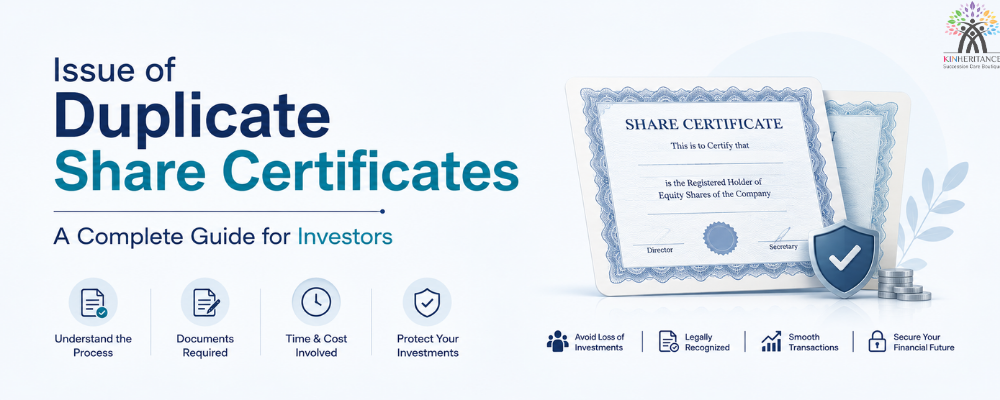
Issue of Duplicate Share Certificates | A Complete Guide for Investors
Why Duplicate Certificates Are Needed
Share certificates are legal proof of ownership in a company. For decades, investors relied on these paper documents to demonstrate their stake in businesses. However, physical certificates are vulnerable. They can be misplaced, stolen, damaged by fire or water, or even destroyed over time. When this happens, investors face difficulties in proving ownership and claiming dividends or transferring shares. To address these challenges, companies allow shareholders to apply for duplicate share certificates. This process ensures that rightful owners can continue to exercise their rights without disruption. Understanding how duplicate certificates are issued is crucial for investor awareness and financial security.
A duplicate share certificate is a replacement issued by a company when the original certificate is lost, stolen, or damaged. It carries the same legal validity as the original and confirms the shareholder’s ownership. The process of obtaining a duplicate certificate involves verification, documentation, and approval by the company’s registrar and transfer agent. This safeguard ensures that investors are not deprived of their rights due to accidents or negligence. It also prevents fraudulent claims by requiring strict compliance with procedures.
Difference Between Original and Duplicate Share Certificates
Many investors assume that a duplicate share certificate is somehow less valuable or carries fewer rights than the original certificate. However, this is not the case. Once issued by the company following due verification, a duplicate share certificate enjoys the same legal status as the original document. The duplicate certificate serves as official evidence of share ownership and can be used for all shareholder-related activities, including transfer of shares, transmission to legal heirs, dematerialization, and claiming dividends. The primary difference is that the original certificate becomes invalid once a duplicate is issued. Companies follow strict verification procedures before issuing a duplicate certificate to prevent fraudulent claims. This ensures that only the rightful owner receives the replacement document. Investors should therefore view duplicate certificates as a secure mechanism for restoring ownership rights rather than as a secondary document. For families dealing with inheritance-related matters, obtaining a duplicate certificate often becomes the first step toward completing the broader share recovery process and securing ownership of valuable investments.
The Role of Registrars and Transfer Agents (RTAs)
Registrars and transfer agents play a crucial role in the administration of shareholder records and issuance of duplicate share certificates. They act as intermediaries between companies and investors, maintaining records related to ownership, transfers, corporate actions, and investor communications. When an investor applies for a duplicate certificate, the RTA verifies ownership details, examines supporting documents, checks whether the shares remain active, and confirms there are no conflicting claims. This verification process protects both the company and investors from fraudulent activities. Some of India's prominent RTAs manage records for thousands of listed companies and process requests involving duplicate certificates, transmission of shares, name corrections, and dematerialization. Maintaining accurate records with the RTA is essential. Investors should promptly update changes in address, contact details, bank information, and signatures to avoid delays during future transactions.
The RTA's involvement ensures that the issuance of duplicate certificates remains transparent, secure, and compliant with regulatory requirements.
Why Dematerialization Should Follow Duplicate Certificate Issuance
Obtaining a duplicate share certificate solves an immediate ownership issue, but it should not be considered the final step. Investors are strongly encouraged to convert the shares into electronic form through dematerialization after receiving duplicate certificates. Holding shares in a Demat account offers multiple advantages. Electronic ownership eliminates the risk of future loss, theft, physical damage, or deterioration of certificates. It also simplifies portfolio management and ensures that dividends, bonus shares, and other corporate benefits are credited directly to the investor's account. In many cases, investors discover old certificates that have remained untouched for decades. Once duplicate certificates are obtained, converting them into electronic form makes future administration significantly easier. Additionally, modern securities regulations increasingly favor electronic holdings for transactions and transfers. Dematerialization helps investors align with current practices while reducing paperwork and improving accessibility. For investors recovering legacy assets, duplicate certificates and https://kinheritance.com/blogs/dematerialisation-of-physical-sharesdematerialisation of physical shares often go hand in hand, forming an important part of wealth preservation and asset recovery.
Investors may need duplicate certificates for several reasons. Loss is the most common, often due to misplacement during relocation or poor record‑keeping. Theft is another possibility, especially when certificates are stored in unsecured locations. Damage from fire, floods, or aging paper also necessitates replacement. In some cases, certificates may be mutilated or torn, making them unreadable. Even minor damage can create problems during verification, prompting the need for duplicates. Regardless of the reason, the process ensures that ownership remains intact and legally recognized.
The Legal Framework
The issuance of duplicate share certificates is governed by company law and regulations laid down by the Securities and Exchange Board of India (SEBI). Companies must follow strict procedures to prevent misuse. Shareholders are required to submit affidavits, indemnity bonds, and supporting documents to establish authenticity. Registrars and transfer agents play a key role in verifying claims. They ensure that duplicates are issued only to rightful owners. This legal framework balances investor protection with fraud prevention, maintaining trust in the financial system.
Step‑by‑Step Process to Obtain Duplicate Certificates
The journey begins with the shareholder filing a request to the company or its registrar. The application must clearly state the reason for seeking a duplicate. Along with the request, the shareholder submits an affidavit declaring the loss or damage and an indemnity bond promising to indemnify the company against future claims. If the certificate was lost due to theft, a copy of the police complaint or FIR is required. In cases of damage, the mutilated certificate must be surrendered. The registrar verifies the documents, checks ownership records, and ensures there are no disputes. Once satisfied, the company issues a duplicate certificate, duly signed and sealed. This process may take several weeks, depending on the complexity of verification. Patience and accuracy in documentation are essential for smooth completion.
Challenges Investors Face
While the process is straightforward, investors often encounter hurdles. Delays in verification are common, especially when signatures do not match records. Missing documents or incomplete affidavits can also stall applications. In some cases, disputes among heirs complicate matters, requiring legal intervention. Another challenge is lack of awareness. Many investors are unaware of the requirement to file police complaints or indemnity bonds. This leads to repeated rejections and frustration. Staying informed and proactive is the best way to avoid delays.
Importance of Duplicate Certificates in Legacy Planning
Duplicate certificates are not just about replacing lost documents; they are about protecting family wealth. Inheritance disputes often arise when certificates are missing. By obtaining duplicates, families ensure that ownership is clear and legally recognized.
This clarity simplifies succession planning, reduces conflicts, and ensures that investments continue to serve their intended purpose. For NRIs and heirs living abroad, duplicate certificates provide a secure way to claim ownership without physical paperwork.
Investor Awareness and Best Practices
Investors should adopt best practices to avoid complications. Certificates must be stored securely, preferably in bank lockers. Digital records should be maintained alongside physical documents. In case of loss, immediate action is crucial. Filing a police complaint and notifying the company registrar prevents misuse.
Regular monitoring of dividends and account statements also helps identify issues early. Awareness of procedures ensures that investors remain in control of their wealth.
Case Study: Recovering Lost Certificates
Consider an investor who inherited shares from a parent but discovered that the certificates were missing. Without proof of ownership, claiming dividends became impossible. By filing a police complaint, submitting an affidavit, and providing supporting documents, the investor obtained duplicate certificates.
This allowed them to dematerialize the shares into electronic form, reclaim dividends, and transfer ownership to heirs. The case highlights how duplicate certificates safeguard financial rights and simplify legacy planning.
Frequently Asked Questions (FAQs)
1. How long does it take to get a duplicate certificate?
The process usually takes four to six weeks, depending on verification speed and document accuracy.
2. Is a police complaint mandatory?
Yes, if the certificate is lost or stolen. For damaged certificates, surrendering the mutilated document is sufficient.
3. Can heirs apply for duplicates?
Yes, heirs can apply by providing succession certificates or legal heirship documents.
4. Are duplicate certificates valid for dematerialization?
Absolutely. Once issued, duplicates carry the same legal validity as originals and can be converted into electronic form.
5. What costs are involved?
Companies may charge nominal fees for processing duplicate requests. The cost is minimal compared to the value of protecting ownership.
Tips for Investors
Managing share certificates and ensuring smooth financial security requires a proactive approach. Investors who take small but consistent steps can avoid the stress of lost documents or delayed claims. Here are some practical measures every shareholder should follow: One of the most important habits is to keep digital copies of all share certificates and related documents. Scanned versions stored securely in cloud storage or password‑protected folders act as a backup in case physical papers are misplaced or damaged. These digital records also make it easier to share information with registrars or family members when needed. Another essential practice is to update KYC details regularly. Outdated addresses, phone numbers, or signatures are among the most common reasons for delays in issuing duplicate certificates or processing dematerialization requests. By ensuring that Aadhaar, PAN, and bank details are current, investors reduce the risk of account freezes and verification hurdles. It is equally important to monitor dividends and account statements. Unclaimed dividends are often the first sign that something is wrong with share records. If dividends remain unclaimed for several years, shares may be transferred to the Investor Education and Protection Fund. Regular monitoring helps investors identify issues early and take corrective action before ownership is jeopardized. Investors should also store physical certificates securely, preferably in bank lockers or fireproof safes. While duplicates can be issued, prevention is always better than cure. Safe storage reduces the risk of theft or damage and ensures that heirs can access documents easily.
Finally, maintaining clear communication with registrars and transfer agents is vital. Promptly reporting losses, submitting accurate documents, and following up on applications ensures smoother processing. Awareness of procedures and timelines empowers investors to stay in control of their wealth. By adopting these simple practices, investors not only protect their current holdings but also strengthen their legacy planning. These tips ensure that wealth remains secure, accessible, and ready to serve future generations without unnecessary complications.
Conclusion
Duplicate share certificates play a vital role in protecting investor rights and ensuring financial security. They provide a legal safeguard against loss, theft, or damage and simplify inheritance and succession planning. By understanding the process and staying proactive, investors can secure their wealth for future generations. Investor awareness is the foundation of financial security. By staying informed and proactive, you can ensure your investments continue to serve your goals. For detailed guidance, visit our Share Recovery Service Page to learn more about practical steps you can take today.
India’s Leading Shares Recovery & IEPF Claim
Expert assistance for recovering lost, unclaimed, or IEPF-transferred shares and unpaid dividends.