Reclaim Old Hyundai Shares from IEPF by Kinheritance
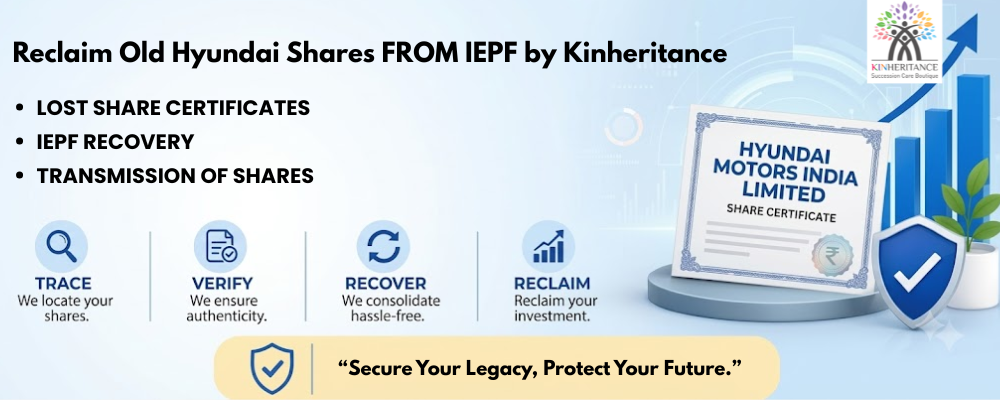
Reclaim Old Hyundai Shares from IEPF by Kinheritance
Across India countless families discover old share certificates while sorting through cupboards, lockers, family documents, or inherited records. What may initially appear to be a forgotten piece of paper can sometimes represent a valuable financial asset. In several cases, these investments were made decades ago by parents or grandparents and were later forgotten due to relocation, change of address, death of the shareholder, loss of records, or the transition from physical shareholding to electronic ownership.
If you have found an old Hyundai share certificate, it is important not to assume that the investment has lost its value. Even if the shareholder is no longer alive, dividends were never received, or the shares were transferred to IEPF (Investor Education and Protection Fund), there may still be a valid process available to reclaim ownership.
This guide explains how old Hyundai shares can be traced, verified, transmitted to legal heirs, recovered from IEPF, and eventually credited into a demat account.
Why Old Hyundai Share Certificates Are Important
For many years, shares in India were issued in physical certificate form. Investors received printed certificates showing their ownership in a company. These certificates contained important information such as the shareholder's name, folio number, certificate number, number of shares, and distinctive numbers. Today, many families continue to possess such certificates without fully understanding their current significance. Some certificates are preserved in old files, while others may be found among inheritance documents after the death of a family member. An old Hyundai share certificate should never be discarded simply because it appears outdated. Even if the certificate is several years old, it may still help establish historical ownership and support a recovery claim. The document can provide the starting point for tracing the investment and determining its current status.
How Hyundai Shares Become Forgotten
There are several reasons why investors lose track of their shareholdings.
- One of the most common reasons is a change of address. When shareholders move to another city and fail to update their registered address, future communications from the company may continue to be sent to an old residence. Over time, dividends, annual reports, and investor notices stop reaching the shareholder, eventually leading to a loss of visibility over the investment.
- Another common issue is a change of name. Marriage, legal name changes, corrections in spelling, or modifications in identity documents can create differences between the details appearing on old share certificates and those appearing on current records.
- The death of the original shareholder is another major reason investments become forgotten. Many families are unaware that a parent or grandparent invested in shares years ago. The certificates may remain unnoticed until family documents are reviewed long after the investor's death.
- The transition from physical shareholding to electronic demat accounts has also contributed to forgotten investments. Shareholders who never converted their physical shares into electronic form may have misplaced certificates or believed they no longer held any valuable securities.
- Unclaimed dividends create additional complications. When dividend payments remain unclaimed for several years, regulatory provisions may result in both dividends and corresponding shares being transferred to the Investor Education and Protection Fund.
What Happens to Old Physical Hyundai Shares?
Finding an old physical share certificate does not automatically mean you can sell the shares immediately. The first step is establishing whether the shares continue to exist in company records and determining their current ownership status. In many cases, investors may also possess dividend warrants, folio details, shareholder correspondence, bank statements showing dividend credits, transfer deeds, transmission records, wills, or succession documents. These historical records can be extremely valuable because they help create a connection between the original investor and the present claimant. While a physical certificate represents evidence of historical ownership, current entitlement must generally be verified through company records and the Registrar and Transfer Agent (RTA). Therefore, every available document should be carefully preserved.
Can Hyundai Shares Be Transferred to IEPF?
Yes. This is one of the most important issues investors must understand. Under Indian law, dividends that remain unpaid or unclaimed for seven consecutive years are liable to be transferred to the Investor Education and Protection Fund. Once this occurs, the corresponding shares may also be transferred to the IEPF Authority.
As a result, old Hyundai shares may fall into one of two categories.
In the first situation, the shares continue to remain on the records of the company or its registrar and transfer agent. Recovery in such cases typically involves transmission formalities, KYC compliance, correction of records, and dematerialisation procedures.
In the second situation, the shares have already been transferred to the Investor Education and Protection Fund due to long-term inactivity. In such cases, recovery requires a formal IEPF claim process and documentary proof of entitlement.
Understanding which category applies is essential because the recovery process differs significantly.
What Is IEPF?
The Investor Education and Protection Fund, commonly known as IEPF, is a statutory mechanism established under the Companies Act, 2013. Its purpose includes receiving specified unclaimed dividends, deposits, securities, and other amounts after the expiry of prescribed periods. Many investors mistakenly believe that once shares are transferred to IEPF, ownership is permanently lost. This is not true. Transfer to IEPF does not eliminate the rights of the rightful owner. Instead, the shares remain recoverable subject to successful completion of the prescribed claim procedure and verification of ownership. Therefore, if your family's Hyundai shares have been transferred to IEPF, recovery may still be possible provided sufficient evidence and supporting documents are available.
Who Can Claim Old Hyundai Shares?
- The person entitled to claim old Hyundai shares depends entirely on the facts of each case.
- The original shareholder may initiate the claim if they are alive. Joint holders may also possess rights depending on the mode of shareholding.
- Where a nominee exists, the nominee may become entitled to claim according to applicable regulations.
- If the shareholder has passed away, legal heirs, beneficiaries, executors, administrators, or other legally entitled persons may seek recovery after establishing succession rights.
- Documentation requirements vary depending on whether a nomination exists, whether a will was executed, whether multiple heirs are involved, and whether any succession proceedings were completed.
Recovering Hyundai Shares After the Death of a Shareholder
One of the most common situations occurs when a family discovers old share certificates belonging to a deceased parent or grandparent. The discovery often takes place years after the death of the original investor. Family members may initially believe that the investment is no longer recoverable. However, that assumption is often incorrect. The recovery process generally starts with identifying the shareholder and verifying available ownership information. The shareholder's name, folio number, certificate number, distinctive numbers, and old communications can help establish the existence of the investment. After verification, the next step is determining whether the shares remain with the company or have been transferred to IEPF. The claimant must then establish legal succession through appropriate documents. These documents may include the death certificate, legal heir records, nominee details, succession certificates, probate orders, wills, affidavits, indemnities, or declarations, depending on the circumstances.
Once the ownership chain is established and necessary formalities are completed, the shares may eventually be transferred or credited to the rightful claimant.
Documents That Should Never Be Discarded
Many investors unintentionally damage their recovery prospects by throwing away old paperwork. Every document related to an investment should be preserved. The original share certificate is often the most important record because it contains crucial ownership details. The folio number helps identify the shareholder's account in company records. Certificate numbers and distinctive numbers assist in verification procedures. Dividend warrants can help establish that the investor previously received benefits from the investment. Old bank records showing dividend credits can strengthen ownership claims. Where the shareholder is deceased, the death certificate becomes a critical document. Wills, probate orders, succession certificates, legal heir certificates, and inheritance-related records may also become necessary depending on the facts of the case. Modern documentation including PAN details, bank account information, identity proof, address proof, and KYC records may be required for shareholder service requests, transmission processes, dematerialisation, and IEPF recovery claims.
What If You Have Lost the Original Certificate?
Many families worry that losing the original certificate automatically ends any possibility of recovery.Fortunately, this is not always the case.The first step is determining whether records of the shareholding still exist. Historical information such as the shareholder's name, folio number, bank details, old address, dividend information, and historical correspondence can help trace the investment.Once the shareholding is verified, the company or Registrar and Transfer Agent may prescribe procedures relating to duplicate certificates or alternative evidence requirements.Although the absence of a certificate can make recovery more complex, it does not necessarily make recovery impossible.
What If the Shareholder's Name Has Changed?
Name mismatches are common in old investments.For example, a share certificate may display a maiden name while current records reflect a married surname. In other situations, spelling differences or legal name changes may create inconsistencies.Such cases generally require documentary evidence establishing that both names belong to the same person.Marriage certificates, gazette notifications, affidavits, or other supporting records may be necessary depending on the circumstances.Investors should remember that a name mismatch is usually a documentation issue rather than an ownership issue. With sufficient evidence, the discrepancy can often be resolved through the appropriate shareholder service process.
What If the Registered Address Is Decades Old?
Address mismatches occur frequently with legacy investments.An investor may have purchased shares while living in one city and later relocated to another part of the country without updating their shareholder records.As a result, dividend communications, annual reports, and other correspondence continued to be sent to an outdated address.This often explains why families lose track of investments.Fortunately, outdated addresses can generally be corrected once ownership has been established and KYC requirements have been completed.
Corporate Actions Can Change Shareholding Value
One of the biggest mistakes investors make is focusing solely on the number of shares printed on an old certificate.Companies evolve over time. They may undertake share splits, share subdivisions, bonus issues, rights issues, mergers, demergers, restructuring exercises, or other corporate actions.As a result, the current entitlement associated with an old certificate may differ significantly from the original number of shares mentioned in historical documents.For this reason, determining the value of old Hyundai share certificates requires careful examination of the company's corporate history and shareholder records.The true value of an investment can only be understood after reconstructing its complete history.
Common Mistakes Investors Should Avoid
Many recovery efforts are delayed because investors rely on incorrect assumptions.One major mistake is assuming that an old share certificate is worthless simply because it is several years old. In reality, age alone does not eliminate ownership rights.Another mistake is ignoring dividend records. Unclaimed dividends may represent additional recoverable assets alongside the shares themselves.Some investors fail to investigate whether shares have been transferred to IEPF. If a transfer has occurred, the normal recovery route may no longer apply and a formal IEPF claim may be required.Others focus immediately on selling shares before confirming ownership. Recovery, transmission, validation, and dematerialisation must typically be completed first.Perhaps the most damaging mistake is losing or discarding original records. Even when alternative evidence is accepted, original documents often simplify verification and strengthen the case for recovery.
What Happens After Recovery Is Completed?
Once all required procedures have been completed successfully, recovered shares may be credited to the claimant's demat account.Dematerialisation is important because listed securities are generally held electronically.After the shares are credited, the investor gains control over the holding and can decide whether to continue holding the investment or make future investment decisions based on personal circumstances.However, reclaiming ownership and deciding what to do with the shares are two entirely separate stages.The first priority should always be confirming ownership and recovering the securities.
Forgotten Investments Can Become Valuable Family Assets
The story of old Hyundai shares reflects a broader reality across India. Thousands of families possess forgotten investments purchased years or even decades ago.Many investors acquired shares as long-term holdings and never imagined that future generations would need to trace them. Over time, addresses changed, records were misplaced, shareholders passed away, and physical certificates were forgotten.Meanwhile, the company may have undergone significant changes, creating a gap between the original investment and its current form.This is why investors should never judge the value of a certificate merely by looking at the paper itself.Every old share certificate tells a financial story that may still have value today.
Conclusion
If you have discovered old Hyundai share certificates, do not assume they are outdated or worthless. Whether the shares are still recorded with the company, held in physical form, belong to a deceased shareholder, involve unclaimed dividends, or have already been transferred to the Investor Education and Protection Fund (IEPF), recovery may still be possible.The key is to gather all available records, verify historical ownership, establish legal entitlement, understand any corporate actions affecting the investment, complete the required documentation, and follow the appropriate recovery process.Many forgotten investments remain hidden in family records across India. With patience, proper documentation, and a systematic approach, old Hyundai shares can often be traced, verified, recovered, and restored to their rightful owners, helping preserve family wealth for future generations.Investors should carefully review old share certificates, dividend records, folio details, and succession documents whenever such records are discovered. Taking timely action can help avoid further complications and ensure that valuable financial assets are not left unclaimed. Understanding the status of the shares, whether they remain with the company or have been transferred to the IEPF, is often the first step toward successfully reclaiming a forgotten investment.
For the most accurate and updated information regarding shareholder services, transmission procedures, dematerialisation requirements, unclaimed dividends, and IEPF claims, investors should refer to the official investor relations resources of Hyundai Motor India and the relevant regulatory authorities before initiating any recovery process.
India’s Leading Shares Recovery & IEPF Claim
Expert assistance for recovering lost, unclaimed, or IEPF-transferred shares and unpaid dividends.