Reclaim Old Reliance Industries Shares with Kinheritance from IEPF
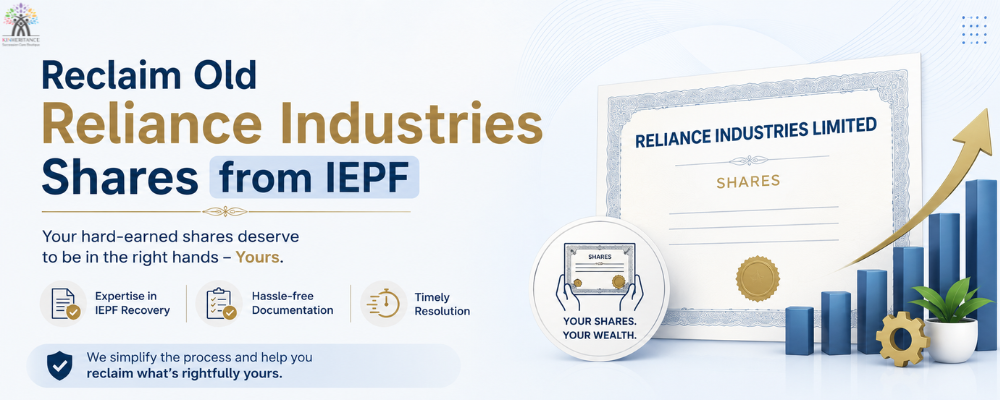
Reclaim Old Reliance Industries Shares with Kinheritance from IEPF
Recovering old Reliance shares from the IEPF is possible, but the process requires careful documentation and coordination. It involves the Ministry of Corporate Affairs, the IEPF Authority, Reliance Industries, and its Registrar and Share Transfer Agent. The process can become more complicated when physical certificates are lost, the shareholder has died, or the name and address in the old records do not match current identity documents.
This guide explains the process in simple language and outlines the important documents, common problems, and steps involved in reclaiming old Reliance Industries shares.
What Is the IEPF?
The Investor Education and Protection Fund is a statutory fund established under the Companies Act, 2013. It is administered by the Ministry of Corporate Affairs, Government of India. The IEPF was created to protect investors and promote awareness about financial investments. It also provides a system for managing unpaid dividends and other unclaimed financial assets. Under Section 124 of the Companies Act, 2013, if a dividend remains unpaid or unclaimed for seven consecutive years, the amount is transferred to the IEPF. In certain cases, the shares connected with those unpaid dividends are also transferred to the IEPF. This does not mean that the original owner permanently loses the shares. The legal owner or eligible legal heir can apply to recover the shares and unpaid dividends by following the prescribed procedure. The shares are generally returned electronically to the claimant’s Demat account. The IEPF does not normally return shares in the form of old paper certificates.
Why Are Reliance Shares Transferred to the IEPF?
Reliance Industries has had a large shareholder base for many decades. Many investors purchased shares when certificates were issued in physical form. Over the years, changes in family circumstances, relocation, death, and the shift to electronic investments caused many holdings to become inactive.
Some common reasons include:
Change of address: Shareholders often move from one city or state to another without updating their address with the company’s registrar and share transfer agent. Dividend checks, notices, and other communications are then sent to the old address and returned undelivered.
Lost share certificates Paper certificates may be misplaced during house moves, damaged by water or fire, or accidentally discarded. Families may also be unaware that a relative held shares.
Outdated bank details Older investors may have closed their bank accounts or changed branches. If dividend payments are sent to an inactive or incorrect account, the payment may remain unpaid.
Failure to dematerialize shares: Physical shares must generally be converted into electronic form before they can be sold or transferred through the modern securities system. Shareholders who did not dematerialize their holdings may later face additional verification requirements.
Death of the shareholder When the registered shareholder dies, the family may not know about the investment. Even if the family is aware of the shares, transferring them requires documents that prove legal heirship or authority under a will.
Name differences: A shareholder’s name may appear differently on the old share certificate, PAN card, Aadhaar card, passport, or bank account. For example, one document may include a middle name while another may not. Even minor differences can lead to additional documentation requirements.
Can Old Reliance Shares Still Be Recovered?
In many cases, yes. A shareholder or legal heir can submit a claim to recover shares and unpaid dividends transferred to the IEPF. However, recovery is not automatic. The claimant must prove ownership or legal entitlement. The claim must also be supported by accurate documents and submitted through the correct process. The final decision depends on verification by the concerned company, its registrar and share transfer agent, and the IEPF Authority. A claim may take time because historical records must be checked carefully. The process is usually easier when the claimant has the original share certificate, folio number, dividend records, and complete identity documents. It can take longer when the certificate is missing or the original shareholder is no longer alive.
Important Information to Collect Before Applying Before starting the claim, the family should collect as much historical information as possible. Useful records may include:
- Old Reliance share certificates
- Folio numbers
- Certificate numbers
- Distinctive numbers
- Old dividend warrants
- Dividend letters or company correspondence
- Bank statements showing earlier dividend payments
- Demat statements, if the shares were partly converted
- PAN and Aadhaar records
- Death certificate, if the shareholder has passed away
- Will, succession certificate, or legal heir documents
- Details of the claimant’s active Demat account
Even if the original certificate is not available, the folio number or old dividend document may help the company trace the investment. Families should avoid sending original documents until the submission requirements are confirmed. Copies should be retained for personal records, and valuable documents should be sent only through a trackable delivery method where required.
Understanding the Role of the Different Authorities
One reason the process can feel complicated is that several organizations are involved. The Ministry of Corporate Affairs provides the electronic filing system and receives Form IEPF-5. The IEPF Authority reviews claims and approves the transfer of eligible shares and dividends. Reliance Industries is the company whose shares are being claimed. Its Registrar and Share Transfer Agent checks the claimant’s documents against historical company records. The Registrar and Share Transfer Agent may verify the folio, certificate details, dividend history, signatures, ownership records, and other information. It then submits a verification report to the IEPF Authority. The claimant’s bank and Depository Participant also play an important role. The bank may verify the claimant’s signature, while the Depository Participant issues the Client Master List confirming the Demat account details.
Step-by-Step Process to Reclaim Reliance Shares
- Find the share and dividend details The first step is to identify whether the shares were transferred to the IEPF. The claimant should check old company notices, IEPF records, dividend statements, and the company’s investor information.
The key details are the shareholder’s name, folio number, number of shares, year of unpaid dividends, and certificate information.
If the shareholder has passed away, the family should confirm whether the shares were registered solely in that person’s name or jointly with another holder.
- Update KYC and bank information Current KYC details must generally be provided to the company or RTA. These may include PAN, address, mobile number, email address, and bank details.
The claimant may need to submit Form ISR-1 for updating KYC information. Bank details should be supported by a cancelled check or other acceptable proof.
The name on the bank account, PAN, Demat account, and claim documents should match as closely as possible. If there is a difference, an affidavit or additional proof may be required.
- Arrange signature verification Older company records may contain a signature that is different from the claimant’s current signature. Form ISR-2 may be required to verify the shareholder’s signature through the bank.
The bank official generally confirms the account details and signature. The form must contain the required stamp, signature, and identification details. Incomplete or unclear bank verification can delay the process.
- Open or verify a Demat account The IEPF generally transfers recovered shares electronically. Therefore, the claimant must have an active Demat account.
The Demat account should be held in the correct name. The claimant will usually need a Client Master List issued by the Depository Participant. This document contains the Depository Participant ID, Client ID, account holder’s name, and other details.
The CML should be recent and properly authenticated by the Depository Participant.
- File Form IEPF-5 The formal claim is submitted through Form IEPF-5 on the Ministry of Corporate Affairs portal.
The form generally requires:
Claimant’s personal information Details of the original shareholder Company information, folio number, and share details Number of shares being claimed Unpaid dividend information Demat account details Bank account details Supporting documents: The information in the form should be checked carefully before submission. An incorrect folio number, wrong share quantity, or mismatch in the claimant’s details may result in a resubmission request.
After submission, the applicant receives a Service Request Number, commonly called an SRN. This number is used to track the application.
- Send documents to the company’s Nodal Officer After filing Form IEPF-5, the claimant must send the required physical documents to the company’s designated Nodal Officer or Registrar and Share Transfer Agent.
The document package may include the signed IEPF-5 form, acknowledgement, identity proofs, bank verification, CML, share certificates, affidavits, indemnity bonds, and other supporting records.
The exact documents can vary depending on whether the certificate is available, whether the shareholder is alive, and whether there are name or address differences. Applicants should follow the latest instructions issued by the company, RTA, MCA, and IEPF Authority.
- Verification by the Registrar and Share Transfer Agent The RTA checks the documents against company records. This may include the original folio, signature records, dividend registers, certificate numbers, distinctive numbers, and past correspondence.
If the documents are complete, the RTA prepares a verification report and sends it to the IEPF Authority.
If something is missing or inconsistent, the applicant may receive a query or request for additional documents. It is important to respond within the permitted period.
- Approval and electronic transfer After receiving the verification report, the IEPF Authority examines the claim. If the claim is approved, the shares are credited to the claimant’s Demat account.
Eligible unpaid dividends are generally paid to the claimant’s verified bank account. The timing can vary depending on the completeness of the application, the verification workload, and the complexity of the case.
What If the Original Share Certificate Is Lost?
A lost certificate does not always prevent recovery, but it usually creates additional steps. The claimant may need to submit an affidavit explaining how the certificate was lost. An indemnity bond may also be required. Depending on the company’s requirements, the claimant could be asked to publish a notice in a newspaper or provide a police complaint or other evidence. The purpose of these documents is to protect the company and other investors from duplicate claims. The company must be satisfied that the person making the claim is the genuine owner or lawful heir. The requirements for lost certificates can change, so claimants should confirm the current procedure before preparing affidavits or paying for newspaper notices.
What If the Original Shareholder Has Died?
When the shareholder has passed away, the claim becomes a legal heir or transmission claim. The claimant must prove both the original ownership and their right to inherit the assets. Common documents may include the death certificate, legal heir certificate, will, probate, succession certificate, letters of administration, family settlement, affidavits, and no-objection certificates from other heirs. The documents required depend on the value of the shares, whether there is a valid will, the number of legal heirs, and the company’s current rules. If there is a will, the executor may need to obtain probate or another court document, depending on the circumstances. If there is no will, a succession certificate or letters of administration may be required in higher-value or disputed cases. All legal heirs should be identified before submitting the claim. If one heir is claiming the shares for the family, other heirs may need to provide written consent or release their claims through appropriate legal documents.
Handling Name Mismatches
Name mismatches are common in old share claims. A certificate may show “Ramesh Kumar,” while the PAN card says “Ramesh K. Sharma.” A married woman may have a different surname in the old folio and current identity documents. Small differences do not always mean that the claim will fail, but they must be explained. The claimant may need a name-mismatch affidavit, gazette notification, marriage certificate, newspaper publication, or other supporting proof. It is important not to alter or overwrite an original share certificate. Historical documents should remain unchanged and should be submitted only as instructed.
Common Reasons for Delay or Rejection
Many applications are delayed because the documents are incomplete rather than because the claimant lacks a genuine right to the shares. Typical problems include incorrect details in Form IEPF-5, an outdated CML, missing bank attestation, unsigned forms, unclear copies, incorrect folio numbers, incomplete legal heir documents, and differences in names that have not been explained. Another common issue is sending documents to the wrong address or failing to submit them within the required time after filing the online form. Applicants should also keep copies of every form, receipt, postal tracking record, and communication. These records are useful if the application needs clarification or follow-up.
How Long Does Recovery Take?
There is no single fixed timeline for every claim. A straightforward case may move faster when the shareholder is alive, the original certificate is available, and all records match. Claims involving lost certificates, deceased shareholders, multiple heirs, court documents, or name discrepancies usually take longer. Verification may require several rounds of communication between the claimant, the RTA, and the IEPF Authority. Applicants should be cautious of anyone who promises guaranteed approval or an unusually short timeline. The final decision rests with the relevant authorities, and genuine verification cannot always be completed immediately. No private organization can guarantee that the IEPF will approve a claim. Approval depends on ownership evidence, legal entitlement, accurate documentation, and verification by the concerned authorities.
Final Thoughts
Old Reliance Industries shares may represent significant family wealth, especially when bonus shares, stock splits, and long-term growth are taken into account. A forgotten certificate or unpaid dividend should not automatically be treated as worthless. With proper records, a valid legal claim, and careful compliance, eligible shareholders and heirs may recover shares transferred to the IEPF. The process requires patience and attention to detail, but understanding the steps makes it easier to avoid unnecessary errors. Before beginning, verify the latest instructions from the relevant authorities and the company’s Registrar and Share Transfer Agent.
India’s Leading Shares Recovery & IEPF Claim
Expert assistance for recovering lost, unclaimed, or IEPF-transferred shares and unpaid dividends.