Retrieve old BSE Limited Shares from IEPF with Kinheritance
Retrieve old BSE Limited Shares from IEPF with Kinheritance
If you or someone in your family invested in BSE Limited—Asia’s oldest stock exchange, situated right at the heart of Dalal Street in Mumbai—there is a good chance a portion of that investment has quietly slipped into a government account. It isn't lost forever, but it has been parked in a designated government fund because dividend payments remained unclaimed for seven consecutive years.
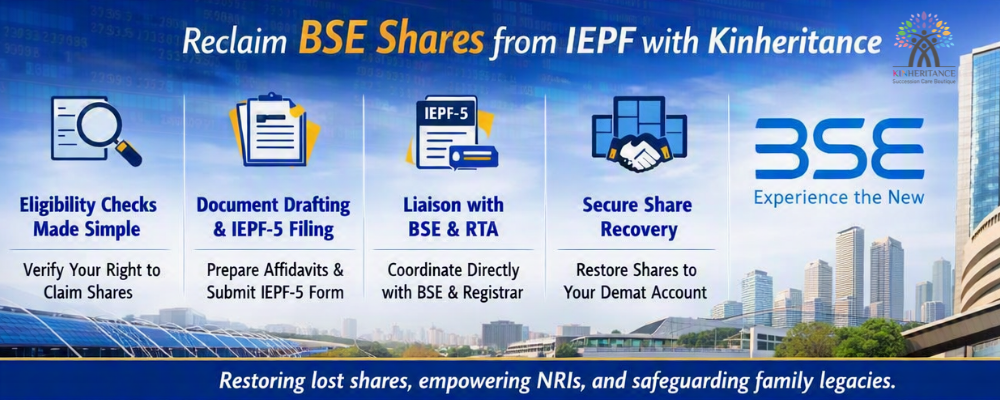
When dealing with the IEPF claim process, partnering with a trusted share recovery service can simplify document preparation, IEPF-5 filing, and verification while minimizing delays or procedural rejections.
This situation occurs frequently. A shareholder changes their residence without updating their address with the registrar, a parent passes away without sharing their full portfolio details, or physical paper certificates sit forgotten in an old trunk. Under Indian corporate law, failing to claim dividends for seven straight years requires the company to transfer both the unclaimed dividends and the underlying shares to the Investor Education and Protection Fund (IEPF).
If your family holds forgotten BSE Limited shares, this guide details how they ended up with the IEPF, how to check their status, and how to recover them legally and smoothly.
What Is the IEPF?The Investor Education and Protection Fund (IEPF) was established by the Ministry of Corporate Affairs (MCA) under Section 124 of the Companies Act, 2013. Its primary function is to hold unclaimed dividends, matured deposits, and forgotten shares on behalf of investors until the rightful owner or legal heir files a claim.
- The 7-Year Rule: Transfer to the IEPF is triggered when dividends remain unencashed or unclaimed for seven consecutive years.
- Entire Holding Transfer: The law transfers the entire shareholding associated with that specific folio or demat account—not just the unpaid dividend amount.
- No Forfeiture: The transfer does not mean you have lost your property. There is no expiry date on claiming these shares back, provided you complete the required legal verification.
Understanding Corporate Actions: Bonus Shares and Stock Splits
When shares remain with the IEPF for several years, their nominal quantity and underlying value often change dramatically due to corporate actions. Over the decades, BSE Limited has declared corporate events such as stock splits and bonus share issues. When your base shares are transferred to the IEPF Authority, any subsequent corporate benefits including bonus shares and split ratios are automatically credited directly to the IEPF under your folio reference. This means that if your original paper certificate showed 100 shares, the actual claim balance sitting with the IEPF today could easily be 500 or 1,000 shares. Identifying these corporate corporate adjustments prior to filing ensures that your IEPF-5 form reflects the true, updated share count, preventing claim rejections or partial recoveries.
Addressing Name Mismatches and Signature Discrepancies
One of the most common reasons the IEPF Authority returns or rejects a claim is a discrepancy between historical share records and current official identification. It is very common for an investor’s name spelling on an old physical certificate to differ slightly from their modern PAN or Aadhaar card, or for a signature to evolve over 20 to 30 years. To resolve these issues smoothly, you must submit supporting legal documentation along with your IEPF-5 package. This typically includes a notarized Affidavit for Name Difference, a Joint Identity Affidavit, or an official Gazette Notification in cases of major name changes (such as post-marriage name updates). Address discrepancies can similarly be resolved by providing historic address proofs paired with a banker’s verification of signature.
Tax Implications of Recovered Shares and Dividends
Reclaiming your BSE shares from the IEPF brings up important tax considerations that every investor should prepare for. The recovery of the shares themselves into your demat account is not treated as a taxable transfer or income event under the Income Tax Act. However, any accumulated dividends that are released alongside the shares are considered taxable income in the financial year you receive them, subject to Applicable Tax Deducted at Source (TDS) by the company. Furthermore, if you decide to sell the recovered BSE shares later, your capital gains tax will be calculated using the original purchase date and acquisition cost (or the indexed fair market value as of April 1, 2001, for shares acquired before that date). Keeping thorough records of the recovery documentation is essential for accurate future tax filing.
The Role of Professional Share Recovery Services
While investors have the right to file Form IEPF-5 independently, navigating the procedural intersections between the Depository Participant, the Registrar and Transfer Agent (RTA), the company's Nodal Officer, and the MCA portal can become overwhelming. Professional share recovery firms like Kinheritance specialize in untangling complex recovery scenarios, such as tracing lost folio details, coordinating cross-border NRI documentation, and resolving multi-generational transmission hurdles. By managing document preparation, legal affidavits, and continuous follow-ups with corporate officers on your behalf, professional assistance significantly minimizes paperwork errors, eliminates procedural delays, and ensures a seamless credit straight to your demat account.
Why BSE Limited Shares Often End Up in the IEPF
BSE Limited has a long history and a massive base of retail investors across India. Several factors lead to BSE shares being moved to the IEPF:
Outdated Contact & Bank Details: Change of address or closed bank accounts mean dividend warrants bounce or electronic credits fail.
Unconverted Physical Certificates: Paper share certificates from decades ago were never converted to electronic (demat) form.
Deceased Shareholders: Original investors passed away without their heirs knowing about the investment or how to initiate transmission.
Corporate Actions: Stock splits, bonus shares, or restructuring over the years often multiply the value of the holding without the owner's active tracking.
How to Check If Your BSE Shares Are with the IEPF
Before filing any legal claim, verify whether the shares sit with the IEPF Authority:
IEPF Portal: Search the official portal at iepf.gov.in under the "Search Unclaimed/Unpaid Amount" section using your name, folio number, or company name (BSE Limited).
Company Disclosures: Review the Investor Relations section on BSE Limited's official website, where lists of unclaimed dividend accounts are regularly published.
Registrar & Transfer Agent (RTA) Records: Match your folio details with records maintained by BSE's designated RTA.
Recovering shares requires coordination between the investor, BSE Limited's Nodal Officer, and the IEPF Authority.
Essential Documents for the Physical Claim Package:
Self-attested copies of PAN Card and Aadhaar Card.
Cancelled cheque leaf of the linked bank account.
Client Master List (CML) of your active Demat Account, stamped by your Depository Participant (DP).
Original physical share certificates or dividend warrants (if available).
Executed Indemnity Bond and Advance Stamped Receipt.
Recoveries Involving Deceased Shareholders & Legal Heirs
If the original shareholder has passed away, the shares cannot be claimed directly. The process requires a Transmission of Shares step before or during the IEPF claim:
Establishing Legal Succession: Legal heirs must provide a Succession Certificate, Legal Heir Certificate, or Probated Will depending on the total market value and corporate requirements.
No-Objection Certificates (NOCs): If there are multiple legal heirs, non-claiming heirs must sign NOCs in favor of the primary claimant.
Filing as Heir: Once legal entitlement is established, the heir files Form IEPF-5 as the rightful claimant.
Real-World Recovery Stories
The Forgotten Legacy in Mumbai
A family in Mumbai discovered physical certificates for BSE-listed shares worth ₹12 Lakhs that had belonged to their late grandfather. Unclaimed dividends had caused the holding to transfer to the IEPF years ago. Facing confusion over legal heir documentation and RTA requirements, they engaged Kinheritance to streamline the process. The team compiled the succession paperwork, filed Form IEPF-5, and coordinated with the Nodal Officer. Within 80 days, the shares and accumulated dividends were safely credited to the family’s demat and bank accounts.
The Overseas Investor
An NRI investor living in Dubai had purchased BSE shares before moving abroad. After a bank account closure caused dividend credits to bounce, the shares were moved to the IEPF. Navigating embassy attestations, notarizations, and Client Master List requirements from overseas proved difficult. Kinheritance managed the document verification, coordinated the filings, and oversaw the process until the shares were restored to his demat account without requiring a single visit to India.
Frequently Asked Questions
1. Is there a deadline to claim BSE shares back from the IEPF? No. While seven years of unclaimed dividends trigger the transfer to IEPF, there is no deadline for claiming your shares back once they arrive there.
2. Do I need an active demat account to receive recovered shares? Yes. The IEPF Authority does not issue physical share certificates; recovered shares are credited electronically directly to an active demat account in the claimant's name.
3. What happens if an IEPF claim gets rejected due to a name mismatch? Minor spelling variations or name mismatches between PAN, Aadhaar, and old share certificates require supplementary affidavits, name-change gazette notifications, or joint-identity declarations before refiling.
4. How long does the entire recovery process take? Once the complete physical package reaches the company's Nodal Officer, verification and final transfer by the IEPF Authority typically take between 60 to 120 days, depending on document completeness.
India’s Leading Shares Recovery & IEPF Claim
Expert assistance for recovering lost, unclaimed, or IEPF-transferred shares and unpaid dividends.