Unclaimed Dividends & Shares in India: Reclaiming Forgotten Family Wealth
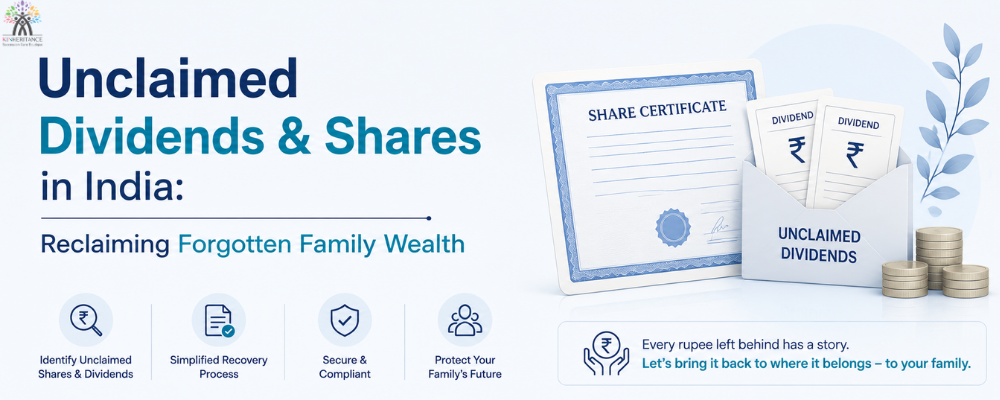
Unclaimed Dividends & Shares in India: Reclaiming Forgotten Family Wealth
Across India, countless investors and families remain unaware that valuable investments purchased years or even decades ago may still exist in their names. Forgotten share certificates, unclaimed dividends, outdated addresses, and incomplete succession planning often result in investments becoming disconnected from their rightful owners. In many cases, these dormant assets continue to hold significant value, creating an opportunity for individuals and legal heirs to reclaim long-lost wealth. For those exploring IEPF share recovery, understanding how unclaimed investments are transferred and later recovered is the first step toward reclaiming forgotten family assets. Under Indian corporate regulations, when dividends remain unclaimed for seven consecutive years, the corresponding shares are transferred to the Investor Education and Protection Fund (IEPF). While these shares move into the custody of the IEPF Authority, the legal ownership rights of shareholders and their heirs remain protected, allowing them to recover both shares and accumulated dividends through a prescribed process.
Understanding Why Shares Are Transferred to the IEPF
The Investor Education and Protection Fund was established to safeguard investor interests and manage dormant financial assets. Whenever dividends declared by a company remain unclaimed for seven continuous years, the company is legally required to transfer both the unpaid dividends and the corresponding shares to the IEPF Authority. This transfer does not mean that investors lose ownership of their investments. Rather, it is an administrative mechanism designed to account for inactive holdings while preserving the right of genuine shareholders and legal heirs to recover their assets in the future. Many investors become separated from their investments because they relocate without updating records, lose physical share certificates, change bank accounts, or simply forget about old investments. In other situations, investments remain undiscovered after the death of a family member, leaving future generations unaware of valuable holdings that may still exist.
How Forgotten Investments Are Discovered
The discovery of unclaimed shares often happens unexpectedly. Families sorting through old documents may find share certificates, dividend warrants, annual reports, or correspondence related to investments made many years ago. Sometimes, references to shares emerge through bank records, income tax documents, or estate planning papers. In other cases, investors deliberately search for dormant investments after suspecting that a parent, grandparent, or relative held shares in publicly listed companies. Since many investments date back decades, their value may have appreciated significantly through stock price growth, bonus issues, stock splits, and accumulated corporate benefits. Before starting the recovery process, it is important to verify whether the dividends remain unpaid and whether the shares have already been transferred to the IEPF Authority.
Step 1: Identifying and Verifying the Status of Shares
The recovery process begins by establishing the status of the investment. Investors or legal heirs should gather whatever information is available regarding the original shareholder. This may include the shareholder's name, folio number, DP ID, client ID, old share certificates, dividend records, bank statements, or any correspondence received from the company. The IEPF records allow claimants to determine whether shares and dividends have been transferred to the authority. Company investor records may also provide useful information regarding unclaimed dividends and pending transfers. Where information is incomplete, claimants may contact the relevant Registrar and Share Transfer Agent. Registrars maintain historical shareholder records and can help verify folio details, ownership information, dividend history, and the current status of shares. Careful verification at this stage is essential because ownership details entered during the recovery process must match company records. Any inconsistencies involving names, addresses, PAN information, or folio details may result in delays later in the claim process.
Step 2: Documentation and Share Transmission Requirements
Successful recovery depends heavily on proper documentation. Both the company and the IEPF Authority require sufficient evidence to establish that the claimant is the rightful owner or legal successor of the investment. For living shareholders, the documentation generally focuses on identity verification and ownership confirmation. Commonly required records include PAN, Aadhaar, bank account details, cancelled cheque copies, client master list records, and Demat account information. Historical share certificates, where available, also serve as valuable supporting evidence. Bank records play an important role because recovered dividend amounts are usually credited directly into the claimant's registered account. Likewise, Demat account information must be accurate because recovered shares are generally transferred electronically. The consistency of information across all documents significantly influences the speed and success of the verification process.
Share Transmission for Deceased Shareholders
Many unclaimed shares recovery cases involve investments owned by deceased family members. In such situations, legal heirs must complete the transmission process before or alongside the IEPF claim. The death certificate serves as the primary document confirming the passing of the shareholder. Additional documentation helps establish the entitlement of the claimant to inherit the shares. The exact requirements vary depending on the family structure, the existence of a will, and the value of the securities involved. Legal heir certificates, succession certificates, probate documents, surviving member certificates, family settlement deeds, or registered wills may all play a role in establishing succession rights. Where multiple heirs exist, declarations or no-objection documents may also be required. These documents help demonstrate consensus among family members and reduce the likelihood of ownership disputes. Although transmission documentation can seem complicated, its primary purpose is simply to create a clear legal link between the original shareholder and the person seeking recovery.
Step 3: Filing Form IEPF-5 Through the MCA Portal
Once ownership documents have been organized, claimants can proceed with filing Form IEPF-5 through the Ministry of Corporate Affairs portal. The form requires detailed information relating to the claimant, shareholder details, company information, shareholding records, dividend claims, and supporting evidence. Accuracy throughout the form is extremely important because all information will later be cross-checked against company records and regulatory databases. After completing and submitting the form, the system generates a Service Request Number, commonly known as an SRN. This reference number is used for future communication and tracking of the claim. One of the most common reasons for delays is inconsistency between records. Differences in spelling, outdated addresses, incorrect PAN details, and mismatches between Demat records and application details can trigger verification queries. Reviewing all entries carefully before submission can significantly reduce processing complications and improve the likelihood of smooth approval.
Step 4: Compiling and Sending the Physical Documents
The online application is only one part of the overall recovery framework. Following submission of Form IEPF-5, claimants must prepare and send a physical set of supporting documents to the designated company representative responsible for investor claims. The physical dossier typically contains signed claim documents, indemnity bond requirements, advance receipt forms, self-attested identity proofs, address proof, bank verification documents, and Demat account records. Claims involving deceased shareholders may also include death certificates, legal heir documentation, succession records, will-related documents, affidavits, declarations, and supporting family records. Every document should be reviewed for consistency before dispatch. Signatures, names, account numbers, and supporting details should align with the information submitted in Form IEPF-5.
A complete and well-organized dossier helps facilitate faster corporate verification and reduces the likelihood of requests for additional information.
Step 5: Company Verification and IEPF Approval
After receiving the application and supporting documents, the company performs a detailed verification process. Historical shareholder records are examined to confirm ownership, dividend history, transmission status, and claim authenticity. During the corporate review phase, the company may seek clarification if discrepancies are identified. Missing records, inconsistent information, or incomplete documentation can result in requests for additional evidence. Once verification is completed, the company submits its report electronically to the IEPF Authority. This verification report forms a critical part of the approval process. The IEPF Authority then independently reviews the claim and supporting documentation. If the claim satisfies all requirements, approval is granted and the recovery process is completed. Recovered shares are typically credited to the claimant's Demat account, while approved dividend amounts are transferred to the registered bank account. This final step concludes the IEPF claim process and restores ownership of the assets to the rightful claimant.
Real Shareholder Story: An Investment Hidden for Decades
A family clearing an ancestral home discovered a collection of old financial records belonging to a grandfather who had invested in various listed companies many years earlier. Initially, the documents appeared outdated and irrelevant. However, closer examination revealed evidence of significant shareholdings that had remained untouched for decades.
The family conducted ownership verification, gathered succession documents, and initiated the recovery process. Although the claims required careful documentation and transmission formalities, they ultimately succeeded in recovering assets that none of the family members knew still existed.The recovered investments became a powerful reminder that forgotten shares often remain valuable regardless of how much time has passed.
Real Shareholder Story: Recovering Assets Despite Missing Certificates
Another claimant faced a common obstacle when attempting unclaimed shares recovery. The original share certificates had been lost years earlier during multiple residential relocations.Rather than abandoning the claim, the claimant worked to reconstruct the ownership trail using available records, old correspondence, historical folio information, and supporting identity documents. Additional declarations helped compensate for missing evidence.Although the process required persistence, the ownership history was successfully established and the shares were eventually recovered. This experience demonstrates that missing physical certificates do not automatically prevent recovery when alternative documentation supports the claim.
Frequently Asked Questions
How long does the recovery process take?
The timeline varies depending on the complexity of the case. Claims involving complete documentation and straightforward ownership records generally progress more smoothly than those involving multiple legal heirs, missing records, or transmission requirements. Delays often occur when additional verification becomes necessary.
Can shares be recovered if original certificates are unavailable?
Yes. While original share certificates strengthen a claim, alternative evidence may also be used to establish ownership. Historical records, folio references, company correspondence, dividend documents, and registrar records can assist in proving entitlement.
Can legal heirs recover investments from deceased family members?
Yes. Legal heirs may recover shares and dividends by establishing succession rights through the appropriate legal documents and satisfying verification requirements.
Is a Demat account necessary for recovery?
In most cases, recovered shares are credited electronically. Therefore, maintaining an active Demat account with accurate personal information is generally an important requirement for successful recovery.
Can both shares and dividends be claimed together?
Yes. Eligible claimants can seek recovery of transferred shares along with associated unpaid dividend amounts, subject to proper verification.
What happens if multiple heirs are involved?
Where several legal heirs exist, additional succession documentation and declarations may be required. Clear legal records help establish entitlement and reduce processing delays.
Conclusion
Unclaimed shares and dividends represent a significant source of forgotten family wealth across India. Investments acquired years ago can continue to exist long after shareholders lose track of them, and many such assets eventually find their way into the Investor Education and Protection Fund due to prolonged inactivity.Recovering these assets requires careful verification, proper documentation, completion of transmission of shares formalities where applicable, filing Form IEPF-5, submitting supporting records, and successfully navigating the review process. While the procedure can appear detailed, it remains entirely achievable for genuine shareholders and legal heirs who understand the requirements and maintain accurate documentation.
India’s Leading Shares Recovery & IEPF Claim
Expert assistance for recovering lost, unclaimed, or IEPF-transferred shares and unpaid dividends.