Succession planning is not merely about transferring material wealth; it is about ensuring long-term financial stability, legal clarity, and family harmony. A Will serves as the absolute cornerstone of estate planning, providing a legally recognized roadmap for how your assets, investments, properties, and personal responsibilities should be passed on to the next generation. Without a structured Will in place, families are often forced to navigate complex inheritance laws, administrative delays, and emotional disputes during already difficult times.
When an individual drafts a clear and legally sound Will, their family avoids the stress of navigating statutory succession codes or prolonged court battles. Instead, legal heirs follow explicit, written instructions, ensuring that every piece of wealth—whether a family residence, corporate shares, mutual fund folios, insurance proceeds, or digital assets—is accounted for and transferred to the intended beneficiaries.
Understanding search intent is essential when evaluating estate management solutions. Informational intent helps individuals understand the legal mechanics of wills, trusts, and probate processes. Commercial intent allows families to compare traditional paper wills against modern digital vaults and private trust structures. Transactional intent drives immediate action, encouraging individuals to document holdings, update nominations, and execute legally binding succession papers.
To begin structuring your portfolio documentation and organizing your financial holdings for future generations, explore the Kinheritance platform to build a comprehensive, lasting foundation for your family's financial security.
What Is a Will?
A Will is a legally valid instrument in which an individual explicitly declares how their properties, financial investments, bank accounts, shares, mutual funds, jewelry, digital assets, and personal belongings must be distributed after their demise. It reflects the direct intentions of the creator—known legally as the Testator—regarding the management and distribution of their accumulated estate.
A properly drafted Will provides complete legal clarity and ensures that your hard-earned assets reach your chosen beneficiaries without bureaucratic delays. Simply put, a Will gives your family legal certainty when life becomes uncertain.
The Core Pillars of Modern Estate Planning
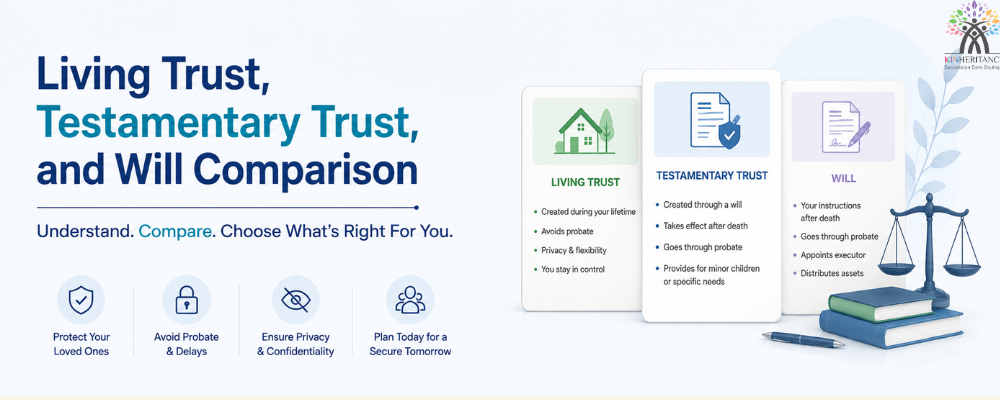
Estate planning is a critical discipline for any individual holding bank accounts, real estate, equity portfolios, or business interests. A comprehensive estate strategy rests on three primary legal pillars: valid wills, family trusts, and power of attorney designations.
1. Will Creation and Legal Fundamentals
A legally binding Will is the primary instrument used to declare your final wishes regarding asset distribution. If an individual passes away without leaving a valid Will, they die intestate. Under intestacy rules, rigid government succession codes dictate how assets are divided among surviving relatives, regardless of the deceased's personal relationships or unwritten promises.
To ensure a Will stands up to legal scrutiny and avoids being contested in court, it must fulfill specific legal criteria:
Testamentary Capacity: The testator must be of legal age and sound mind, demonstrating a clear understanding of the assets they own and the beneficiaries they are designating.
Explicit Asset and Beneficiary Mapping: Assets must be accurately identified—including account numbers, property boundaries, demat IDs, and corporate holdings—alongside the precise legal identities of the assigned beneficiaries.
Designation of an Executor: A trusted individual or professional entity must be named as executor. The executor holds the legal duty to gather estate assets, settle outstanding liabilities, pay applicable taxes, and distribute the remaining wealth according to the Will's explicit terms.
Valid Attestation: The document must be signed by the testator in the physical presence of at least two independent attesting witnesses. Crucially, these witnesses should not be named beneficiaries in the Will to avoid allegations of undue influence or conflict of interest.
2. Family Trusts for Advanced Asset Protection
While a Will directs asset distribution after death, a private family trust provides continuous control, privacy, and tax efficiency both during your lifetime and after. When establishing a trust, you transfer legal ownership of selected assets to a trustee (which can be a corporate entity or a trusted proxy) to manage on behalf of named beneficiaries.
Unlike wills, which frequently undergo public court probate before assets are distributed, assets held within a private trust bypass probate entirely. This allows beneficiaries to access funds immediately without waiting months or years for court clearance. Furthermore, because trust deeds remain private legal contracts, they keep family financial details out of public court records while offering strong protection against potential business liabilities or creditor claims.
3. Power of Attorney Guidelines
A complete estate plan must also protect you during your lifetime. Unexpected illness, severe accidents, or cognitive decline can render an individual unable to manage financial affairs or make medical decisions. Executing a Power of Attorney (POA) grants legal authority to a trusted agent to act on your behalf during incapacitation.
A Financial Power of Attorney enables your designated agent to pay bills, manage investment accounts, oversee property transactions, and handle tax filings. A Medical Power of Attorney empowers them to make critical healthcare decisions in consultation with medical professionals. Executing these documents in advance ensures that your financial and personal well-being remains in trusted hands without requiring emergency court intervention.
A Tale of Two Futures: Ramesh vs. Suresh
To understand the real-world impact of estate planning, consider the contrasting experiences of two lifelong friends, Ramesh and Suresh.
Ramesh and Suresh were childhood friends who built successful careers side by side. Both worked hard, purchased homes, built substantial portfolios in shares and mutual funds, and raised loving families. However, their approaches to long-term estate planning diverged significantly.
When Ramesh passed away unexpectedly, his family discovered he had left behind a meticulously drafted and legally executed Will. His wife and children knew exactly what steps to take. The designated executor guided them through the process, and within months, his bank accounts, property deeds, and investment portfolios were smoothly transferred. Despite their grief, his family found immense comfort and stability in the clarity Ramesh had provided.
Suresh, however, had repeatedly delayed writing his Will, assuming there would always be time later. When he passed away without a plan, his family was left confused regarding his active bank accounts, real estate deeds, and untracked investments. Legal notices arrived, distant relatives raised conflicting claims, and court procedures dragged on for years. What should have been a period of peaceful remembrance turned into a stressful cycle of paperwork and family disputes.
The difference between the two families was not the magnitude of their wealth; it was foresight. Ramesh’s Will gave his family certainty when life became uncertain, while Suresh’s absence of planning left his loved ones struggling through legal hurdles.
Why Every Family Should Have a Will: Key Benefits
Life is inherently unpredictable. While most people dedicate decades to career growth, investment strategy, and retirement planning, many overlook the crucial final step of estate planning. A Will is not merely a legal document; it is a fundamental safeguard for your family’s future.
Without a Will, the distribution of your accumulated wealth is governed strictly by default succession laws, which rarely align perfectly with personal intentions. This absence often leads to administrative friction, costly legal battles, and unclaimed financial assets.
Major Advantages of Executing a Will:
Absolute Decision-Making Authority: You retain full control over who inherits your wealth. Instead of statutory default formulas, you explicitly define who receives your real estate, bank deposits, stock portfolios, mutual fund units, jewelry, business equity, digital assets, and insurance proceeds.
Protection from Unnecessary Family Stress: A well-drafted Will eliminates guesswork, allowing your loved ones to navigate asset transfers smoothly during a time of emotional grief.
Prevention of Intrafamily Disputes: Many inheritance conflicts arise due to ambiguity. By defining exact beneficiaries, specific asset allocations, and executor duties, you eliminate misunderstandings and preserve family harmony.
Significant Time and Cost Savings: Dying intestate often forces heirs to obtain succession certificates, letters of administration, or court probate decrees—processes that are lengthy and expensive. A valid Will simplifies administrative requirements significantly.
Comprehensive Asset Accounting: Individuals often lose track of investments made years prior, such as paper stock certificates, inactive demat accounts, old mutual fund folios, insurance policies, or digital wallets. A structured Will catalogs every holding, preventing assets from becoming dormant or lost.
Guardianship Appointment for Minor Children: For parents of young children, a Will provides the legal mechanism to appoint trusted guardians, ensuring their personal upbringing and financial care align with your values.
Unmatched Peace of Mind: Knowing that your family’s future is legally protected brings profound relief. Estate planning is ultimately an act of foresight, responsibility, and care.
What Happens If You Don't Have a Will?
If you pass away without leaving a valid Will, you die intestate, leaving the distribution of your estate entirely to statutory succession laws. These laws apply rigid rules based on legal relationships, completely disregarding personal preferences, family dynamics, or special financial needs.
Common Consequences of Intestacy:
Prolonged Court Procedures: Heirs must apply for legal succession certificates or letters of administration to claim bank balances, mutual funds, or real estate titles. These procedures can take months or years, locking away needed funds.
Increased Risk of Disputes: In the absence of clear instructions from the deceased, family members often disagree on how properties or business shares should be divided, leading to bitter legal fights.
Assets Left Dormant or Unclaimed: Without a master inventory attached to a Will, heirs may remain completely unaware of fixed deposits, dividend balances, or mutual fund folios, allowing those assets to sit dormant indefinitely.
Unintended Distribution of Wealth: Statutory laws divide wealth strictly by percentage among legal heirs, which may result in family members receiving assets you never intended for them to hold.
Who Should Make a Will?
A common misconception is that estate planning is only necessary for wealthy individuals or retirees. In reality, every adult who owns any financial or physical asset should execute a Will.
You should consider drafting a Will immediately if you own any of the following:
Residential real estate, commercial land, or apartment units
Savings bank accounts, current accounts, or fixed deposits
Mutual fund folios, equity demat holdings, or corporate bonds
Sovereign gold bonds, physical gold, or family jewelry
Ownership shares in private companies, partnerships, or sole proprietorships
Life insurance policies, pension accounts, or provident fund balances
Digital assets, cryptocurrency holdings, domain names, or online monetization accounts
Whether your estate is modest or extensive, executing a Will ensures complete legal clarity for your loved ones.
Managing Digital Assets and Preventing Unclaimed Wealth
The rapid digital transformation of personal finance has fundamentally changed how we store and manage wealth. Today, a significant portion of an individual's net worth exists electronically across app-based stock brokerages, mutual fund portals, digital wallets, bank accounts, and cryptocurrency exchanges. However, this shift has introduced a major vulnerability: hidden or lost digital wealth.
The Unclaimed Asset Challenge
Traditional assets, such as land deeds, paper stock certificates, or bank passbooks, leave a physical paper trail. Relatives sorting through physical files can usually discover these holdings. Digital assets, by contrast, leave no physical footprint. Bank statements are delivered via password-protected emails, stock trades occur inside mobile applications, and digital tokens reside in encrypted software wallets.
If an asset owner passes away without sharing account credentials or maintaining a central asset map, family members may never learn that these accounts exist. Over time, financial institutions classify unmonitored accounts as dormant, eventually transferring millions in forgotten capital into government-managed unclaimed asset funds.
Building a Centralized Asset Inventory
To prevent your hard-earned capital from being lost, build a comprehensive, secure inventory of your financial footprint across four primary categories:
Banking & Fixed Income: Active savings accounts, fixed deposits, recurring deposits, and safe deposit box locations.
Investment Portfolios: Demat accounts, direct stock holdings, mutual fund folios, corporate bonds, and government security registries.
Insurance Coverage: Term life policies, health coverage, pension plans, personal accident insurance, and employer-provided benefits.
Digital Holdings: Cryptocurrency exchange accounts, hardware wallet recovery keys, domain assets, intellectual property, and digital payment app balances.
Encrypted Digital Vaults
Storing account details, master passwords, and financial maps on plain paper sheets or unencrypted text files creates severe security risks, exposing your accounts to identity theft, fraud, or physical destruction.
Modern estate management platforms resolve this security challenge by utilizing zero-knowledge encrypted digital vaults. These cloud-based repositories allow you to store critical documents, account numbers, title deeds, and access instructions safely. The underlying security architecture ensures that your data remains encrypted and completely private during your lifetime. Upon verified life events or formal legal requests, access instructions are securely released to your pre-designated beneficiaries, guaranteeing that your family can locate and claim every asset you own.
Beneficiary Setup, Nominations, and What a Good Will Must Include
One of the most frequent points of failure in personal finance is a misunderstanding of how account nominations function relative to property law. Millions of investors assume that naming a spouse or child as a nominee on a bank account or mutual fund folio automatically makes them the sole legal owner of those funds upon death. In reality, legal ownership works quite differently.
Nominee vs. Legal Heir: The Legal Difference
Under most corporate and property legal frameworks, a nominee is an authorized custodian, not necessarily the ultimate legal owner. Financial institutions require account nominations so they can clear their liabilities quickly upon an account holder's death. When you name a nominee, you give the institution legal permission to release funds to that person without waiting for court decrees.
However, the nominee receives those funds in the capacity of a trustee. They are legally obligated to hold those assets on behalf of the ultimate legal heirs, who are designated either through a valid Will or through statutory succession laws. If the nominee named on a bank account differs from the beneficiary named in a valid Will, legal disputes can arise, resulting in frozen accounts and court litigation.
Essential Components of an Effective Will:
To ensure a Will is valid, comprehensive, and resistant to legal challenges, it must include the following core elements:
Personal Identification: Full legal name, age, residential address, and government identification details to establish your identity as the Testator.
Declaration of Sound Mind: A formal clause confirming that you are mentally fit, acting voluntarily, and drafting the document free from coercion or undue influence.
Appointment of an Executor: Naming a trusted individual or institutional executor to manage estate distribution, settle debts, and carry out the Will's terms.
Explicit Beneficiary Designations: Clearly identifying individuals, family members, or charitable organizations intended to receive assets.
Comprehensive Asset Description: Detailed listings of real estate, bank deposits, stock portfolios, mutual fund folios, jewelry, insurance, and digital holdings.
Property Distribution Instructions: Clear, unambiguous directions specifying how each asset or percentage of an asset should be divided among beneficiaries.
Appointment of Guardians: Designating legal guardians for minor children to ensure their personal care and financial management are secured.
Signatures and Witness Attestation: Your physical signature or thumb impression, alongside the signatures of at least two independent witnesses who observe your signing.
Why Professional Drafting Matters
A Will must be drafted with legal precision. Ambiguous language, missing clauses, or procedural mistakes during execution can make a Will vulnerable to challenges in court. Incomplete asset descriptions or using beneficiaries as attesting witnesses can invalidate key sections or render the entire document void. Professional drafting ensures that your intentions are expressed clearly, conform to current statutory standards, and prevent future family friction.
Liquidity Management: Borrowing vs. Liquidating
Financial management is not limited to long-term estate organization; it also requires managing unexpected, immediate cash demands. Sudden medical emergencies, high-value business opportunities, temporary cash flow gaps, or tax obligations often require immediate liquidity. How you raise this capital has a direct impact on your overall wealth.
The Cost of Premature Investment Liquidation
When faced with a sudden cash shortage, many investors react by redeeming mutual fund units, selling equity stocks, or breaking fixed-income investments. While this provides immediate cash, it creates significant long-term financial drawbacks:
Capital Gains Tax Liabilities: Selling mutual funds or equities triggers short-term or long-term capital gains taxes, reducing the net cash received and accelerating tax obligations.
Loss of Compound Growth: Exiting the market permanently disrupts compound growth. Selling equity holdings that generate strong annual returns sacrifices all future capital appreciation that those assets would have earned over coming years.
Market Timing Risk: Emergency liquidations often force investors to sell assets during market downturns, locking in losses and damaging long-term portfolio performance.
Unlocking Capital with Secured Credit Lines
Instead of liquidating long-term investments, smart portfolio owners use collateral-backed borrowing options, such as Loans Against Mutual Funds (LAMF) or Loans Against Securities (LAS).
Under a secured loan structure, an investor pledges their equity or debt mutual fund units to a financial institution as security. The lender marks a digital lien against the chosen units, approving a flexible credit line or overdraft limit based on the portfolio's net asset value (NAV).
This approach provides major strategic benefits:
Tax Efficiency: Borrowed funds are classified as a loan liability rather than taxable income, meaning no capital gains taxes are triggered.
Continuous Market Exposure: The pledged mutual fund units remain active in your portfolio. You continue earning all dividends, interest, and market growth generated by those funds during the loan tenure.
Flexible Overdraft Interest Models: Most secured digital credit lines operate as overdraft facilities. You pay interest strictly on the exact amount drawn down and for the specific number of days you utilize the funds.
Competitive Interest Rates: Because the credit line is backed by market securities, interest rates for collateralized loans (typically 9% to 12% p.a.) sit far below unsecured personal loans or credit card debt.
Step-by-Step Estate Planning Execution Roadmap
Building a complete wealth management and asset transfer framework requires a structured, step-by-step approach. Follow this execution roadmap to secure your financial legacy.
Step 1: Portfolio Consolidation
Gather all financial records into a single master index. Record account numbers, branch details, demat IDs, insurance policy numbers, property titles, and digital asset locations. Calculate your total net worth and review how your assets are distributed across liquid, equity, real estate, and fixed-income categories.
Step 2: Audit and Align Account Nominations
Log into your banking portals, stock brokerage dashboards, and mutual fund management platforms. Confirm that active nominees are named for every single account. Cross-reference these entries to ensure that every nominee matches the intended legal heirs specified in your broader financial plan.
Step 3: Draft and Register Your Legal Will
Work with a qualified legal professional to draft a clear, legally sound Will. Ensure that all assets are accurately described, executor duties are defined, and attestation requirements are fully met. Where local legal frameworks allow, register the executed Will with local property authorities to establish its legal validity and minimize future challenge risks.
Step 4: Establish Power of Attorney
Select a dependable family member or legal proxy and execute formal Power of Attorney documents for financial management and healthcare decisions. Make sure your financial institutions have copies of these filings on record so your proxy can step in smoothly if an emergency arises.
Step 5: Secure Records in an Encrypted Vault
Upload digital copies of your registered Will, property titles, insurance policies, power of attorney filings, and asset maps into a secure, zero-knowledge encrypted vault. Configure beneficiary access protocols so your loved ones can easily locate these records when required.
Step 6: Perform Annual Portfolio Reviews
An estate plan is not a static, one-time document; it must adapt as your life changes. Set aside time once a year to review your estate framework. Update your asset listings to reflect new investments, adjust beneficiary designations after major life events, and update document structures to stay aligned with evolving tax laws and legal guidelines.
How Kinheritance Helps
At Kinheritance, we understand that every family's circumstances, asset profiles, and dynamics are unique. Estate planning should never feel overwhelming or confusing.
Our specialized Kin-Will services are designed to help you:
Draft a Legally Structured Will: Custom-built to reflect your precise instructions while ensuring full statutory compliance.
Document Complete Asset Footprints: Cataloging physical property, banking, equities, mutual funds, insurance, and digital holdings so nothing is overlooked.
Plan Smooth Wealth Transfers: Structuring clear beneficiary distribution models to eliminate ambiguity.
Minimize Future Family Disputes: Establishing transparent executor roles and precise asset allocation language.
Protect Your Financial Legacy: Preserving the wealth you have built across your lifetime for generations to come.
Confidential & Guided Experience: Providing step-by-step assistance through the Will creation process with complete privacy and care.
Real Client Experience: Pranav Goswami’s Journey
Pranav Goswami, a resident of Mumbai, had long viewed estate planning as a complex and intimidating process. While he and his wife frequently discussed the importance of securing their family’s financial future, the mechanics of drafting a Will felt daunting.
After learning about Kinheritance’s Kin-Will services, they scheduled an initial consultation. From their very first interaction, Pranav felt reassured. The Kinheritance team systematically explained the estate planning framework, answered every question, and guided them through cataloging their assets with professional care.
What had felt like a complex legal burden quickly transformed into a smooth, structured experience. The couple realized that creating a Will was not merely about paperwork; it was about securing peace of mind and ensuring their family’s future was protected.
When their Wills were finalized and notarized, Pranav and his wife experienced a profound sense of relief. The entire process was completed efficiently, transparently, and with complete confidentiality. Pranav now actively encourages other families to prioritize estate planning, viewing it as an essential step toward long-term family stability.
Frequently Asked Questions (FAQs)
Is a Will legally valid under Indian law?
Yes. A properly executed Will—signed by the testator in the presence of two independent attesting witnesses—is fully recognized and legally enforceable under Indian succession laws.
Can I include shares, mutual funds, and digital assets in my Will?
Yes. A Will can cover all classes of assets, including real estate, bank deposits, equity shares, mutual fund folios, insurance policies, jewelry, intellectual property, and digital assets like cryptocurrency or online accounts.
Can I update or revise my Will later in life?
Yes. A Will can be modified, updated, or revoked at any time during your lifetime, provided you maintain testamentary capacity. Revisions are typically made through a legal amendment (a Codicil) or by drafting an entirely new Will that revokes all prior versions.
Is the registration of a Will compulsory?
Registration of a Will is generally not legally mandatory. However, registering a Will with the local Sub-Registrar provides strong evidentiary value, making it significantly harder for disgruntled parties to contest the document's authenticity later.
Why should I choose professional drafting over a DIY template?
Generic or self-drafted templates often use ambiguous phrasing, miss statutory requirements, or fail to account for complex asset types like digital holdings and mutual fund liens. Professional drafting ensures precise legal phrasing, statutory compliance, and airtight structure, preventing future disputes among heirs.
Securing Your Legacy
A Will is far more than a routine legal document; it is a lasting expression of care, responsibility, and foresight for those you love. It ensures that your hard-earned assets are distributed according to your intentions, protects your family from administrative delays and legal battles, and preserves long-term family harmony.
The ideal time to create a Will is today, while you have the clarity and opportunity to make informed decisions about your legacy.
When sudden cash needs arise during your lifetime, avoiding the premature liquidation of long-term investments is critical to preserving your wealth engine. Utilizing a flexible loan against securities allows you to meet urgent liquidity demands instantly while keeping your portfolio fully invested for future generations.
Secure your family's tomorrow with thoughtful, structured planning today. Reach out to the Kinheritance Kin-Will team to take the first step toward safeguarding your family’s financial future.
New Delhi
A-1, Hamilton House, Connaught Place, New Delhi -110001
Ahmedabad
4-D, Vardan Tower,, Navarangpura, Ahmedabad – 380009